
Stratasys (Nasdaq: SSYS) reported second-quarter results showing strong demand in aerospace and defense, record consumables sales, and further progress in its shift toward manufacturing. Overall sales were pretty much unchanged from a year ago, as growth in materials and services helped offset weaker 3D printer sales. Stratasys maintained its 2026 revenue and earnings outlook but no longer expects to generate positive operating cash flow for the full year.
Revenue was $137.6 million for the quarter ended June 30, down slightly from $138.1 million a year ago but up 3.7% from $132.7 million in the first quarter of 2026. Stratasys expects sales to continue growing through the rest of the year.
System revenue fell to $26.4 million from $30.6 million a year ago, while consumables reached a quarterly record of $66.3 million, up from $64.2 million. Service revenue also rose to $44.9 million from $43.3 million. Stratasys Direct, the company’s on-demand parts manufacturing business, grew 12.1% year over year. The results also point to Stratasys’ shift from prototyping to manufacturing, with customers buying more materials to produce end-use parts.
“Our second quarter results reflect a record-setting level of consumables sales as we continue to effectively drive recurring revenue from materials that are specifically used for manufacturing end-use parts,” CEO Yoav Zeif told investors during the earnings call on Thursday, August 13. “This growth in consumables is a great indicator of the high utilization of our systems and speaks directly to our strategy to increase the manufacturing portion of our business.”
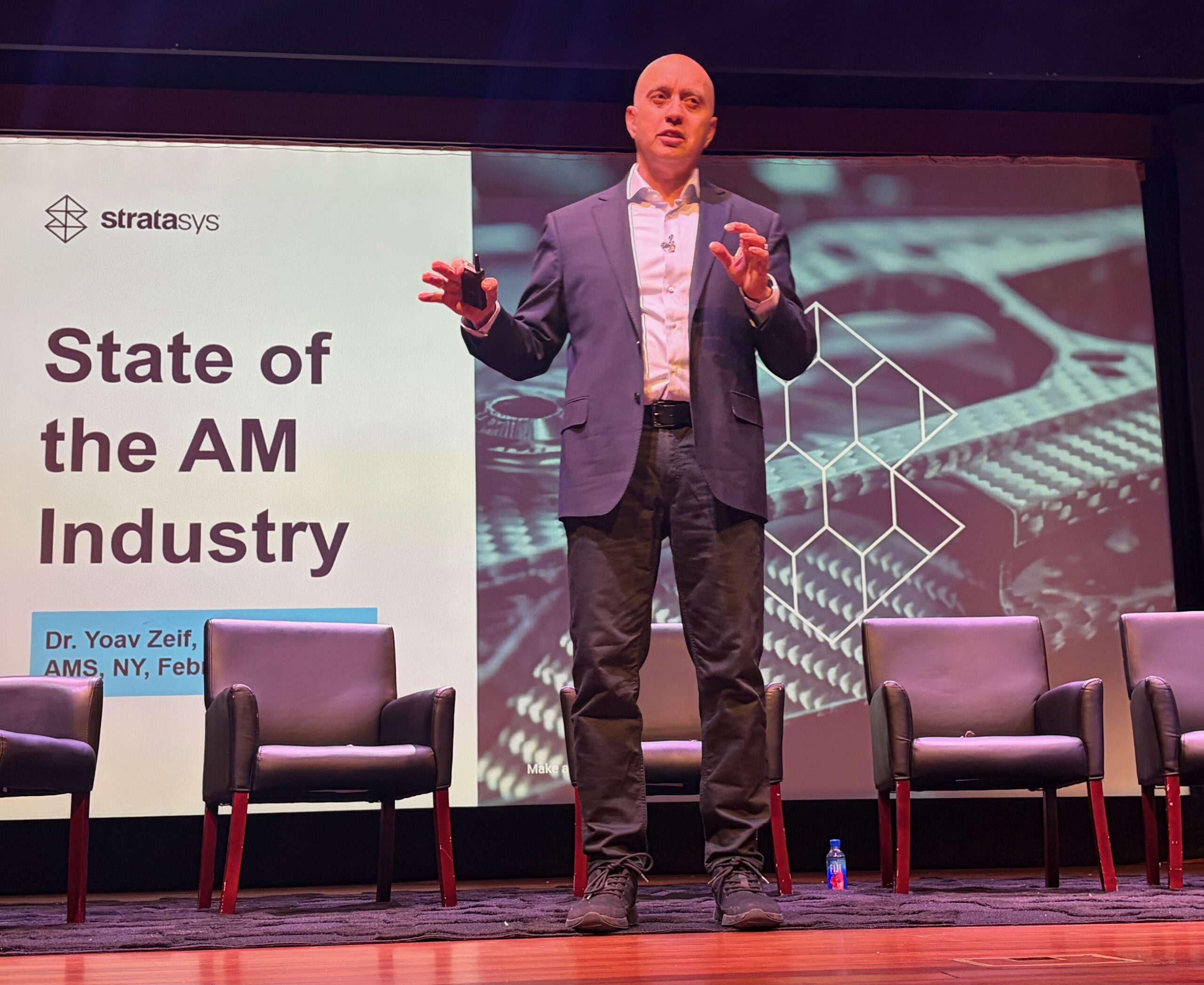
Stratasys CEO Yoav Zeif at AMS 2026.
Aerospace and Defense Leads Growth
The most evident growth area was aerospace and defense, now Stratasys’ largest vertical. Revenue from the sector increased 17% from a year earlier, with the company pointing to growing use of its systems by the U.S. Air Force for sustainment and spare-parts production.
Stratasys’ management told investors that multiple F900 systems are being deployed across the Air Force sustainment network to produce flightworthy parts. Management stressed that these are not isolated machine purchases but part of larger programs that can generate recurring demand once parts and processes have been qualified.
Defense demand is also showing up in Stratasys Direct. The 12.1% growth in that business was driven largely by defense technology companies using the company’s manufacturing capacity for drones, munitions and other next-generation platforms.
At the end of the earnings call, Zeif added another detail: Stratasys Direct produced more than 12,000 aerospace and defense parts during the period, mainly for drones, and is working with what he described as the top 10 drone companies. He also said the business has its highest backlog to date.
“We are going to invest in this capacity, in penetration into aerospace and defense, and we have the financial stress. So we are there. We are moving to manufacturing. It will be a different company, and we are happy to share it with the investors,” Zeif noted. “We are on the right track in the shift from prototyping to manufacturing.”
Stratasys also pointed to several new production deals. For example, Quickparts agreed to buy 12 Neo 800+ stereolithography systems, adding to six it already operates. The multi-year, multimillion-dollar agreement also covers materials, software, and services, with the machines intended for production applications in aerospace, defense, advanced mobility, and energy.
In the automotive sector, China’s FAW Group agreed to purchase 12 F900 systems by year-end. Two were shipped during the second quarter. FAW already operates five F900 printers and eight other Stratasys systems, and the new machines are being used primarily to manufacture end-use interior parts.
Stratasys also recently secured a two-year, $7.8 million America Makes program focused on advancing monitoring capabilities for its F900 and a future F3300 technology refresh for defense manufacturing.
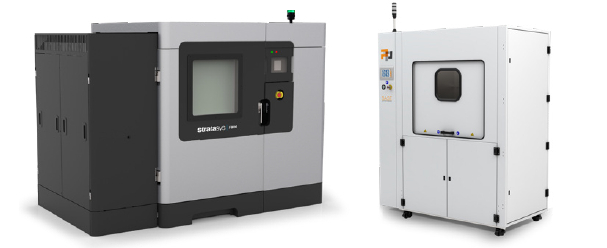
From left, Stratasys F900 industrial printer and PostProcess® BASE Automated FDM Support Removal System. Image courtesy of Stratasys.
Printer Sales Remain the Weak Spot
But printer sales remain a weak spot. System revenue fell year over year, and the decline was noted during the earnings call. William Blair analyst Brian Drab pointed out that system sales were below both last year and the same quarter two years ago. Meanwhile, Zeif attributed some of the volatility to Stratasys’ shift toward larger manufacturing deals, which can take longer to close and make quarterly comparisons less predictable.
“It’s better to measure our growth trend annually given the fact that we are moving to large deals and to manufacturing,” Zeif said. But he said Stratasys expects that to change in the second half: “When you look at the second half of the year, you will see a notable uptick in system sales.”
That makes system sales an important number to watch in the second half of the year. Record consumables sales show that customers are using existing machines, but Stratasys is also counting on stronger printer sales later in 2026.
Loss Narrows, but Cash Flow Takes a Hit
On profitability, Stratasys reported an operating loss of $13.5 million, narrower than the $16.6 million loss a year ago. Its net loss was $16.9 million, or 19 cents per share, compared with a $16.7 million loss, or 20 cents per share, a year earlier. On an adjusted basis, the company remained profitable; adjusted net income was $2.3 million, or three cents per share, compared with $2.2 million and three cents per share, a year ago. Adjusted EBITDA came in at $5.3 million, down from $6.1 million a year earlier but well above the $2 million reported in the first quarter.
Margins were slightly lower, partly because of the stronger Israeli shekel. Gross margin was 42.3%, down from 43.1% a year ago. CFO Eitan Zamir said the decline was “driven by the adverse impact of the strong Israeli shekel,” since many of the company’s expenses are in that currency. Higher margins from consumables helped offset some of that impact.
Cash flow was a bigger concern for management. Stratasys used $18.7 million in operating cash during the quarter, which the company partly attributed to one-time legal expenses “to proactively protect our IP,” stated Zamir. As a result, Stratasys no longer expects positive operating cash flow for the full year, although it expects cash flow to turn positive in the second half. The company ended June with $212.5 million in cash and no debt.
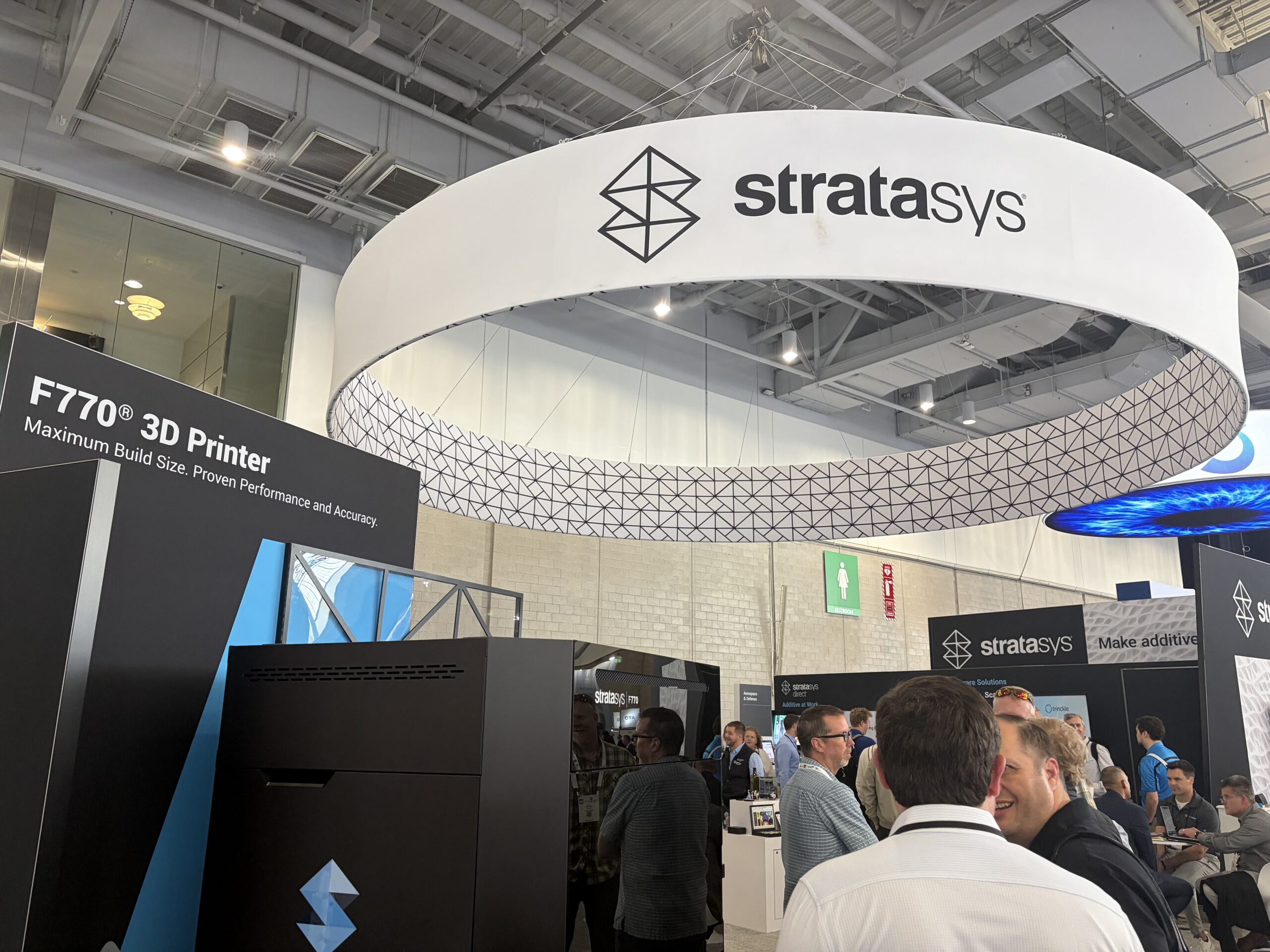
Stratasys booth at RAPID+TCT 2026. Image courtesy of Stratasys.
Aside from cash flow, Stratasys kept its full-year outlook the same. The company still expects 2026 revenue of $565 million to $575 million and adjusted EBITDA of $25 million to $30 million. Stratasys expects revenue and system sales to improve in the second half, along with a return to positive operating cash flow.
Markforged Adds Another Manufacturing Bet
Q2 earnings came less than two weeks after Stratasys announced plans to acquire Markforged in a $42.5 million cash deal. On Thursday’s call, management provided more detail on what it expects from the acquisition, and Zeif specifically explained that Markforged focuses on the same areas as Stratasys.
“They are completely aligned with our use cases. In additive, it’s all about applications. Our #1 is aerospace and defense and #2 is tooling; in the industrial space, they are focusing on the same, complete alignment with huge synergies, technological synergies.”
Zeif also pointed to Markforged’s continuous carbon fiber technology, which he said “can replace metal. It’s lighter, it’s less expensive and requires much less post-processing. In addition, the CEO stressed that they are getting “the best engineers in our industry and that will really strengthen our position in the high-end, high-requirements.”
Markforged generated roughly $70 million in revenue in 2025. Stratasys expects the acquired business to make a positive contribution to EBITDA within the first year after the transaction closes later this year.
The strategic focus is again manufacturing, particularly aerospace and defense. Markforged’s continuous carbon fiber technology gives Stratasys a way to address applications that might otherwise use metal, while its software adds simulation and distributed manufacturing capabilities. In fact, Zeif told analysts during the call that since announcing the transaction, Stratasys has received requests from four large companies interested in working with it on continuous carbon fiber and standards for using the material as a metal replacement. The acquisition is another step in Stratasys’ push toward manufacturing, particularly in aerospace, defense and industrial production.