
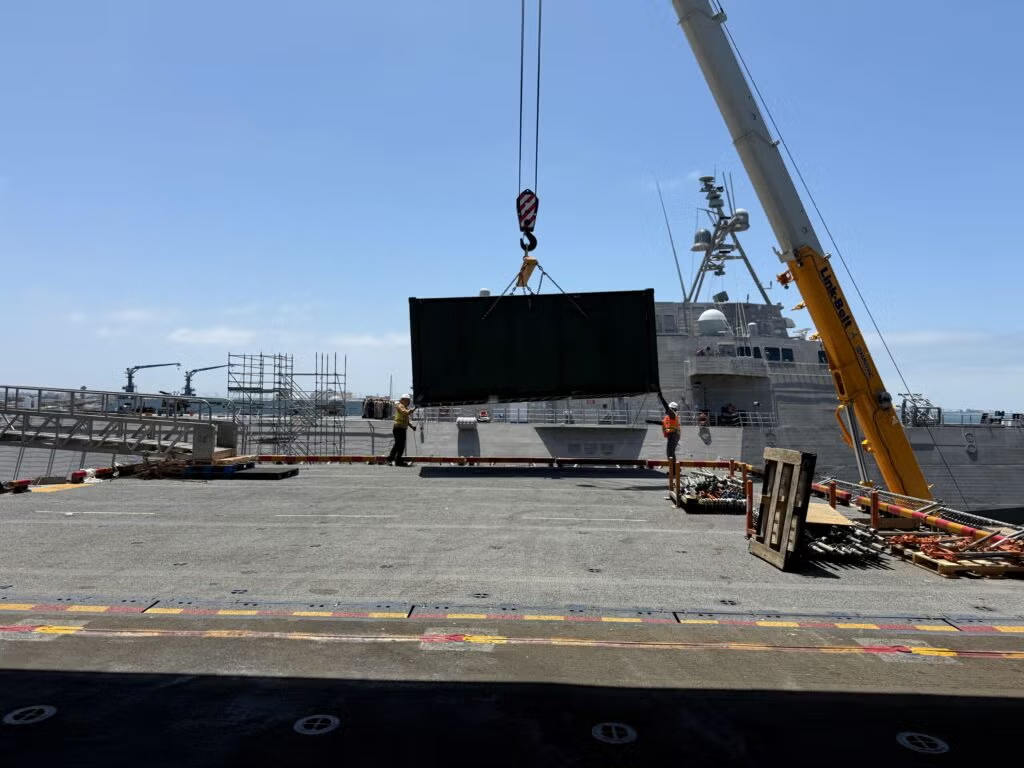
Representatives of the US Army’s DEVCOM Armaments Center trained Marines to use 3D printing for repair electronics components repair at the recent Valiant Shield event in the Indo-Pacific. Not long after, at the RIMPAC exercise (also in the Indo-Pacific), additive manufacturing (AM) software provider 3YOURMIND partnered with Phillips Corp. to demonstrate AM-enabled distributed supply chain capabilities aboard the USS Essex.
Meanwhile, AM also played a role in multiple other projects during the two exercises, warranting some follow-up discussion on both. First, there was Manufacturing Attritable Systems at Scale (MASS), an effort revolving around 3D printed vessels, both manned and unmanned. This was part of a showcase called ‘Print on the Move,’ the point of which is exactly what it sounds like: expeditionary manufacturing.
Marines, aided by participants from Naval Surface Warfare Center Carderock (NSWCC), used a large-format polymer 3D printer and a spray foam and coating system to produce multiple versions of a seven-meter raiding craft. The NSWCC team leveraged their experience making a similar five-meter hull, which initially took 16 hours, using $11,000 of materials, making the process both cheaper and faster than conventional methods.
According to Marissa Stecko, an engineer at NSWCC, “We have reason to believe that, once fully scaled, we could manufacture a 5-meter platform every four hours with a team of 12, and a 7-meter platform every six hours. We’re still in the prototyping phase, but there’s a tremendous amount of potential.”
They saved the most ambitious phase of MASS for last: the team started a print en route to the White Beach Naval Facility in Japan, then transferred the printer to the 3D printed vessel, where production of the component continued while in motion.
As I noted in a post from a few months ago, the US military is quite intent on using 3D printing to showcase expeditionary manufacturing capabilities specifically in the Indo-Pacific, with the subtext there being self-explanatory. One symptom of the military’s prioritization of this objective is accelerated adoption of containerized manufacturing systems, and Firestorm Labs is front-and-center in that context.
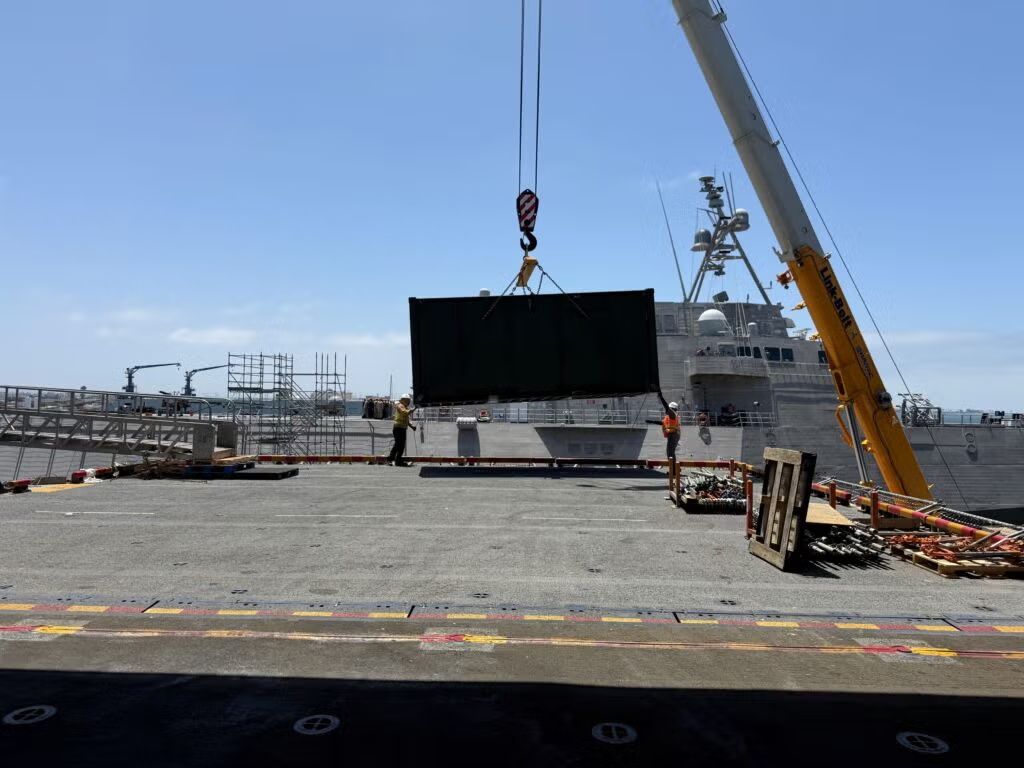
Firestorm’s xCell being lifted onto the USS Essex. Image courtesy of Firestorm.
Firestorm demonstrated its unique value proposition yet again on the way to RIMPAC, where representatives from the company used the xCell containerized manufacturing unit to train service-members from the Army, Navy, and Marine Corps how to print parts on the move aboard the USS Essex. Despite this being the first time that the xCell was demonstrated at sea, they managed to print more than 1,000 parts over the course of two weeks, including a dozen of Firestorm’s Squall FPV drones. Once the ship arrived in Hawaii, Marines flew the Squalls as part of a counter-UAS exercise, providing striking validation of what Firestorm’s ecosystem can do.
Firestorm’s CEO Dan Magy, said, “The Indo-Pacific logistics problem is real, and most of the answers on offer live in a pitch deck. We printed flight-ready aircraft and the parts a crew actually needed, in the conditions they’d actually face. That’s what manufacturing at the edge looks like when it works.”
This doesn’t even cover all of the 3D printing activity at both events, not to mention other events the US military has engaged in over the summer, but these examples seem to be most representative of (1) the things the Pentagon is currently trying to acquire more of and (2) how it’s using AM to speed up the process of getting those things. The US military services and the companies they’ve been working with to build up organic 3D printing capacity — mostly small startups — have shown consistent progress at these sorts of events over the last several years, but the activity this summer implies that all those efforts have started to hit critical mass.
If you compare this to RIMPAC 2022, for instance, that was the first time that the US Navy demonstrated 3D printing at sea aboard an operational vessel, also the USS Essex. Evolving from there to printing over 1,000 functional parts over a span two weeks, on a completely different system, just four years later, makes a statement.
Similarly, four years ago, maritime drones were barely on anyone’s radar. Already though, US service members aren’t merely printing different iterations of watercraft that can be modified between serving as manned and unmanned systems. They’re actually printing components in those vessels while they’re operational.
This establishes a pretty high bar for success. The next challenge is to achieve all of the same capabilities, at scale.
Featured image courtesy of DVIDS