
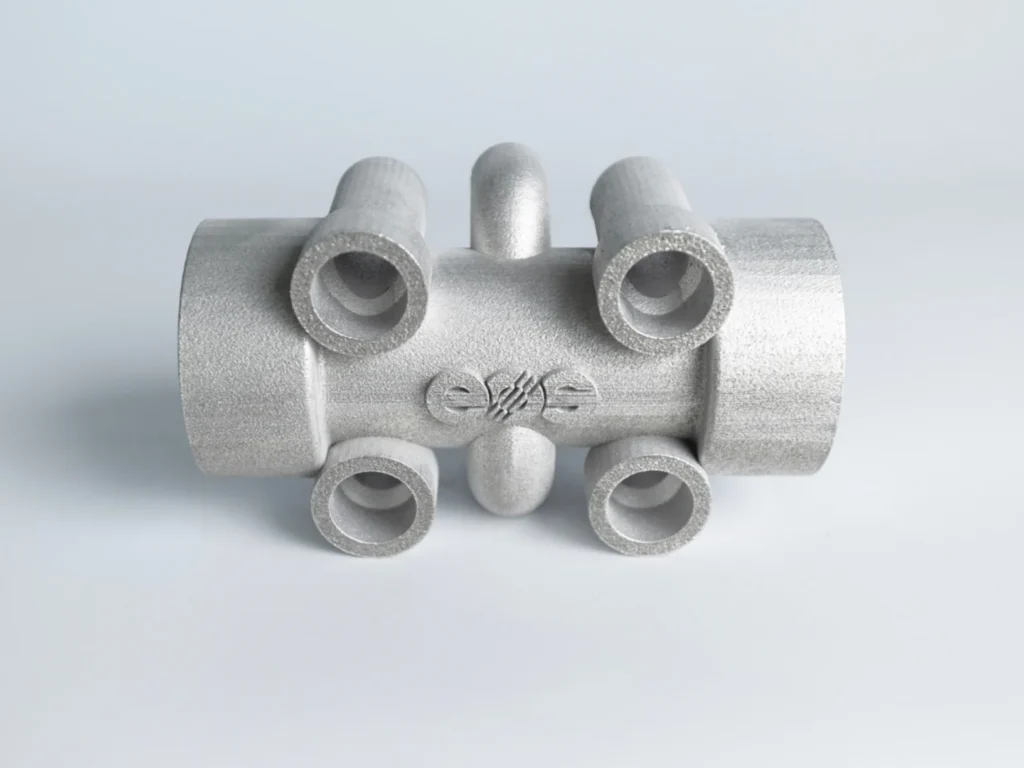
EOS is adding Constellium Aheadd CP1 to its materials offering. In EOS-land, the material will be called EOS Aluminium Constellium CP1. In addition to the new CP1, Constellium’s Al5X1 material will also stay in the portfolio, renamed to the snazzy EOS Aluminium Constellium Al5X1. The company also hopes that newer aluminium materials will enter into service on the back of this development. The two firms have made validated process parameters for the materials. What’s more, you can now get help from EOS’s Additive Minds team to scale up production in these powders quickly.
Ludovic Piquier, Senior Vice President, Manufacturing Excellence and Chief Technical Officer at Constellium, stated,
“This partnership represents a unique opportunity to bring next-generation aluminium alloys into industrial additive manufacturing at scale. By combining Constellium’s alloy development expertise with EOS’ leadership in AM, we aim to accelerate innovation and unlock new high-performance applications for customers worldwide.”
EOS CTO Joachim Zettler said,
“With EOS Aluminium Constellium CP1, EOS Aluminium Constellium Al5X1, and our partnership with Constellium, we are setting a new benchmark for aluminium in additive manufacturing. Together, we are enabling higher performance, greater productivity, and faster industrial adoption for our customers.”
This is great news for $8 billion revenue aluminium giant Constellium. It’s also yet another sign of the rise of what we call “designer aluminiums.” In a deep dark past, we had something called AlSi10Mg. I called this “stupid aluminium” because someone would ask me if we had something called the 6000 series, which by the way is not some BMW from the future or a graphics card, but a material. I would then feel kind of stupid when I told them that all we had is something called AlSi10Mg, which they would have invariably never heard of and not understand. They would ask about things like “six oh six one,” and I’d then kind of take the conversation back to titanium. Subsequently, people figured out that rather than being some niche thing, it could be super useful because we could do magical things with it. Beyond wrapping sandwiches, you see aluminium can be made to run super fast on LPBF machines, which makes it cheap. You can also have some that will let you anodize it or make post-processing easy and cheap. Slowly we’ve been coming around to this fantastic stuff with proprietary, unique flavors of it, like the Equispheres version.
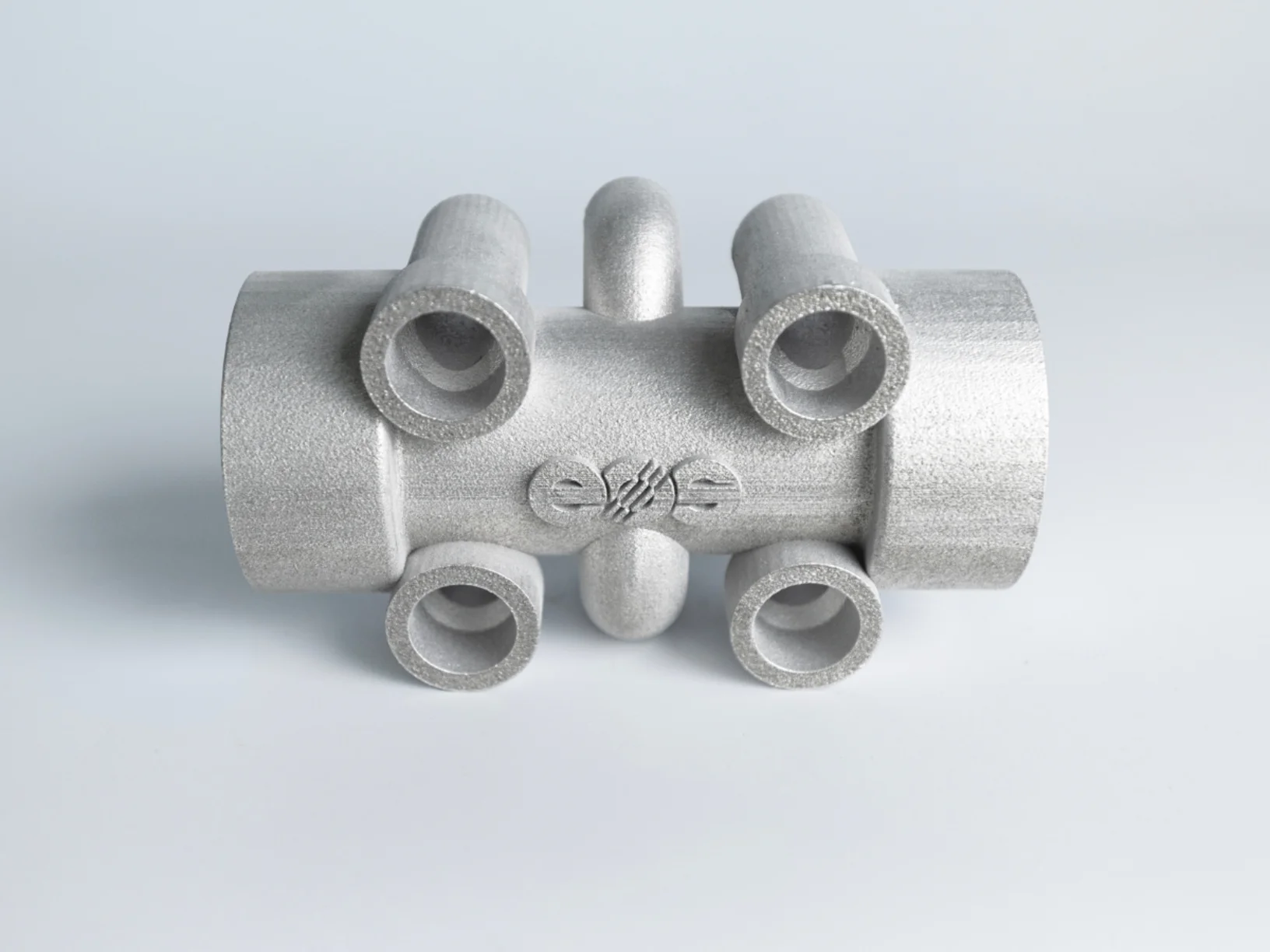
EOS Aluminium Constellium CP1 – Demo Hydraulic Manifold
Now CP1 is surging ahead as the most desired one. SLM’s Behrang Poorganji loved the material and predicted that it would get into more production applications at the beginning of the year, STELIA and Constellium wanted to use it for fuselages, America Makes paid SLM to make a dataset for it, and REM developed a specific finishing process to get it from out of deep pockets in complex channels.
EOS says that it likes EOS Aluminium Constellium CP1 because of its elongation, better strength, and thermal stability. The material’s lack of Mg and Zn help for “stable processing at high laser power and increased productivity,” and it also has good corrosion resistance and thermal conductivity. It’s also easy to anodize and polish electrochemically with easier heat treatment without quenching. These last few factors mean that it’s cheaper to process, taking out some process steps and making part failure less likely.
The company thinks that people will use it to make semiconductor heat sinks and wafer carriers, lightweight parts, and parts for corrosive places like plants. It also mentions heat exchangers, and this is likely where a lot of the excitement is centered on. Heat exchangers are great for 3D printing because they need different geometry throughout the changer, since the material will behave differently at different moments and stages. Thin walls are also important, as is thermal conductivity. You want to make them conformal, as small and efficient as possible, and improve flow with 3D printing. And if you can reduce processing steps and print them quickly, they’ll be nice and cheap too.
Heat exchangers are everywhere, and they can really affect the performance of an engine, a rocket, a really big machine made in Eindhoven, a complex system, anything really. In a lot of industries, heat exchangers are important. And if you’re already working with 3D printing for your wings and seeker, then the heat exchanger could also benefit from 3D printing. In critical applications and applications where mass matters, heat exchange performance separately also often matters. And of course you can get mass and other benefits from making your heat exchanger lighter and smaller. This is the most valuable when the craft is expensive or its performance is critical. So these advantages compound one another. And there are literally millions of heat exchangers in use in quite high end applications. This is a significant opportunity for us.
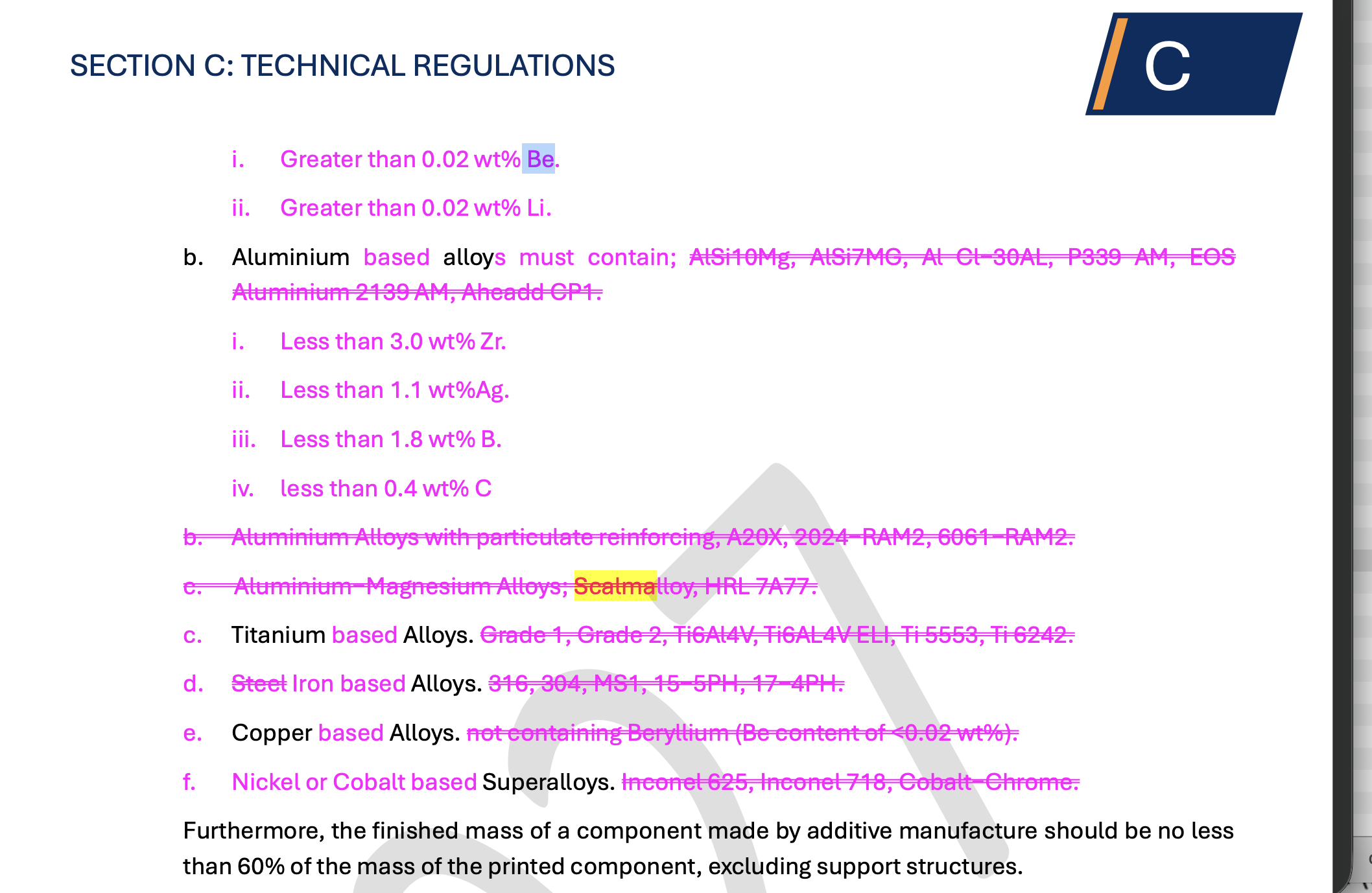
EOS is nice enough to say that “many existing AlSi10Mg applications can benefit from EOS Aluminium Constellium CP1’s improved processing characteristics and performance advantages, offering manufacturers an affordable, high-performance solution.” So let’s totally re-qualify all the stupid aluminum stuff! Meanwhile, “Al5X1 provides a high-strength, high-elongation, and anodizable solution for demanding aerospace, transportation, and motorsport applications.” That too has one-step, non-quenching heat treatment, and a “400 MPa and an elongation exceeding 13% after heat treatment.” It’s kind of better in shocks or with repeated stress maybe? Perhaps it’s like a space or satellite material? Or is it just some F1 hydraulics or intercooler thing? Maybe since you can now make 3D printed suspension uprights, it’s for that? The FIA has allowed CP1 previously, but seems to be more open to different alloys now, its long term hate campaign against beryllium notwithstanding. And of course, with the proviso that they’re not used in heat exchanger bodies.
I love this. EOS is opening up to software, adjustments, and materials. Many more people are going to be able to do more with their magic boxes. And CP1 to me just sounds like a perfectly sensible material for the future of additive in mature production applications.