
They’re a familiar sight at trade shows: Chinese powder companies with barren stands lacking parts. There’s maybe some glass vessel with powder in it and a semi-complete data sheet, but not much else. So far, Chinese powder vendors have offered cost savings but not much else. Often they have no machine settings or practical guidance on using the powder.
But we know that China is printing rockets and implants, and they will use a lot of machines for defense purposes as well. So there should be advanced powders, and there should be some Chinese powder vendors that know what they’re doing. But, kind of like Spanish wine, they really haven’t been exporting the good stuff. It doesn’t help that China has actively banned or dissuaded companies from exporting some powders and alloys over the last few years.
But we know that developing 3D printing is part of the past 14th Five-Year Plan (from 2021 to 2025) and is a foundational technology for China’s future, alongside 5G networks and AI. In the current Five-Year Plan, 3D printing is integrated into advanced manufacturing, but it identifies alloy standardization under national standards and focuses on developing new high-temperature and high-performance materials. China is trying to develop leading alloys itself and has a sovereign 3D printing capability. This effectively means there is near-unlimited funding available in China for new Additive alloys, as long as they outperform existing ones.
So we shall have to get used to new high-performance powders being available from and being developed in China. At the same time, this kind of an unlimited money fountain tends to bring out the worst in people and often unleashes a wave of claims that turn out to be hogwash. If you want a little more background, you can check out our “How China Works” article.
So with that as context, Vilory Metal Powder (formally known as Jiangsu Vilory Advanced Materials Technology) has announced a 3D printable titanium alloy that outperforms Ti6Al4V while being able to maintain ≥450 MPa at 700°C. The near-alpha titanium T70X uses Sn, Zr, Mo, Cr, Co, V, and Ni to reportedly reduce embrittlement up to 750°C. The company says this makes it a replacement for existing high-temperature Ti powders, such as TIMETAL 834, while enabling it to outperform at high temperatures. At the same time, the firm believes the powder is a lighter alternative to Inconel, weighing 45% less in high-performance parts.
The company says that the material is commercially available. It indicates that the processing parameters are normal and that it takes standard heat treatment. The firm also says it has a “production-scale supply” available. One of the applications the company says is well-suited is “hypersonic control surfaces, leading edges, thermal shields,” which is nice to know. VMP also believes that the same material can serve in turbomachinery, turbine blades, compressor disks, and other aeroengine components. At the same time, it may be used in automotive applications. So the pricing shouldn’t be too painful then? For things like an afterburner heat shield, it can offer “lightweight + printable complex cooling channels.”
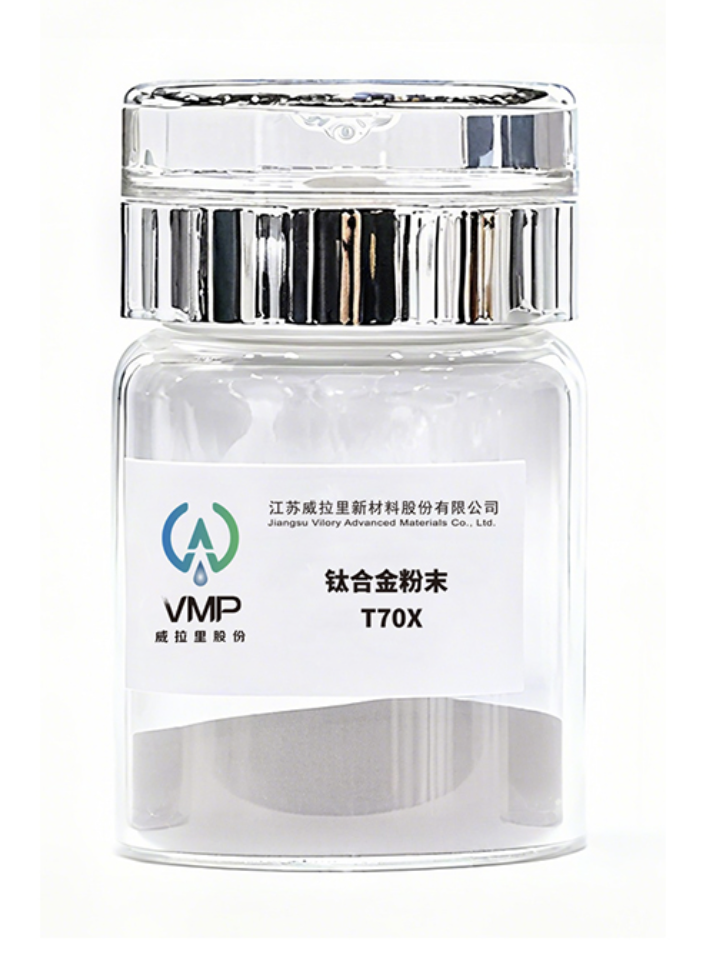
VMP T70X. Image courtesy of VMP.
The company states that, “Production-Ready. Not a Lab Curiosity. T70X is in commercial production at VMP, with powder specs that rival or exceed industry benchmarks.” Furthermore, the material is said to have “Low CTE + mid-temp strength retention,” which could be useful in “Engine nacelle thermal shields,” and to have “Lattice structures validated for this alloy family,” which could be useful there and elsewhere.
Now, for a while I’ve noticed that alloys are never really perfect. We discussed this in our RCAA article, Goldilocks Flywheel. It’s therefore nice that they mention that it is not for corrosion applications, cryogenic ones, or medical implants. So what to think of Ti-Al-Sn-Zr-Mo-Cr-Co-V-Ni? It could very well be that through reducing aluminum content to 3.6–4.0% the company has managed to make a perfect cocktail. Can we call this Valconi, by the way?
| Alloying Element | Function | T70X range |
|---|---|---|
| Sn | α-strengthener without α₂ risk | 1–5% |
| Zr | Solid-solution strengthening | 1.5–5.5% |
| Mo | β-stabilizer and creep resistance | 0.5–2.5% |
| Cr, Co, V, Ni | Grain boundary pinning | ≤1% each |
So this kind of weird intermarriage between a nickel superalloy and titanium would seem to be a very interesting material indeed. It would also, at face value, seem to be the most obvious RCAA-like material to develop. So maybe the company is optimistic? And the ORNL & NASA people have all been asleep at the wheel? This lovechild of Waspalloy and Ti seems super-duper obvious for people to try to play with? But given China’s industrial might, its stated goal of developing these alloys, and its needs in aviation, rocket engines, aircraft engines, missiles, and hypersonics, it will eventually develop an alloy very similar to this one.
| Temperature | TC4 | TA15 | IMI 834 | T70X (VMP) |
|---|---|---|---|---|
| 500°C | ~550 MPa | 747 MPa | ~800 MPa | ~800 MPa |
| 600°C | — | — | ~600 MPa | ≥650 MPa |
| 700°C | — | — | — | ≥450 MPa |
“Listen very carefully, I shall say this only once, René.” This is a very important moment in our 3D printing market. Western powder suppliers will have to work harder to innovate faster. The Goldilocks Flywheel article poses some interesting dilemmas but also a huge potential for those who conquer new alloys using computational methods and additive manufacturing. It is 100% that many Chinese firms will try this. It will take a genius to make this alloy work, but a kid with PowerPoint could get $10 million to try to make this work. And very simple minds will be able to figure out that with AI, AWS, additive, and RCAA’s you may be able to make a future family of alloys.
So real competition is coming, and it will be in advanced materials and rooted in real production cases. China is advancing not just in low-cost, bulk products but also in the most critical applications.