
This month, I attended a manufacturing industry event, like I often do. But instead of getting on a plane to New York City, or driving four hours to Youngstown, I only had to drive ten minutes for the inaugural Dayton Regional Ecosystem for Advanced Manufacturing, or DREAM, Symposium.
Spearheaded by Dayton area-based companies Hyphen Innovations, Dayton Photonics, Skuld LLC, and Laser Fusion Solutions, this small event in my Ohio hometown was conversational and relationship-driven, focused on the people working to build, test, fund, and deploy advanced manufacturing, many of whom are right here in Dayton. DREAM welcomed academia, industry, and government to discuss how emerging technologies make it to real-world deployment.
There’s a lot of manufacturing innovation going on in Ohio; it’s a core state of the Rust Belt, after all. In Dayton specifically, we’ve got the University of Dayton Research Institute (UDRI); Wright Patterson Air Force Base (WPAFB), which houses the Air Force Research Laboratory (AFRL); and plenty of manufacturing companies. This is where the Wright Brothers invented flight, and where Charles F. Kettering worked on the electrical starting motor and the “Bug” aerial torpedo!
DREAM kicked off the night before the symposium with a pre-networking party at a local brewery. In the morning, we all gathered at The Hub, a co-working space in downtown Dayton’s historic Arcade. The Arcade Innovation Hub is a formal joint venture between the University of Dayton and the Entrepreneurs’ Center, and is actually the largest university-anchored innovation center in the country.
Supply Chain
After opening remarks from Dayton City Commissioner Darius Beckham, who said that “our future is heavily tied to this room, to defense and aerospace and all the technologies that will define the next century,” Skuld CEO Sarah Jordan moderated a panel on supply chains between Hyphen’s Founder and CEO Dr. Onome Scott-Emuakpor and Skuld CTO Mark DeBruin. She first asked them about the concrete ways they’ve used advanced manufacturing technology to improve the supply chain.
“When it comes to manufacturing and supporting the supply chain, cost and time are always first and foremost,” Dr. Scott-Emuakpor said. “I look at basic equipment and figure out how to use it to make complex, high-level components. You can get plastic 3D printers for $1,000, while metal printers cost much, much more. We’re attempting to use plastic printers to print metal; all we’d need is an affordable furnace.”
The idea is to majorly lower the cost of the equipment in order to create a part that’s close to the same integrity as one that can be made with more expensive machines.
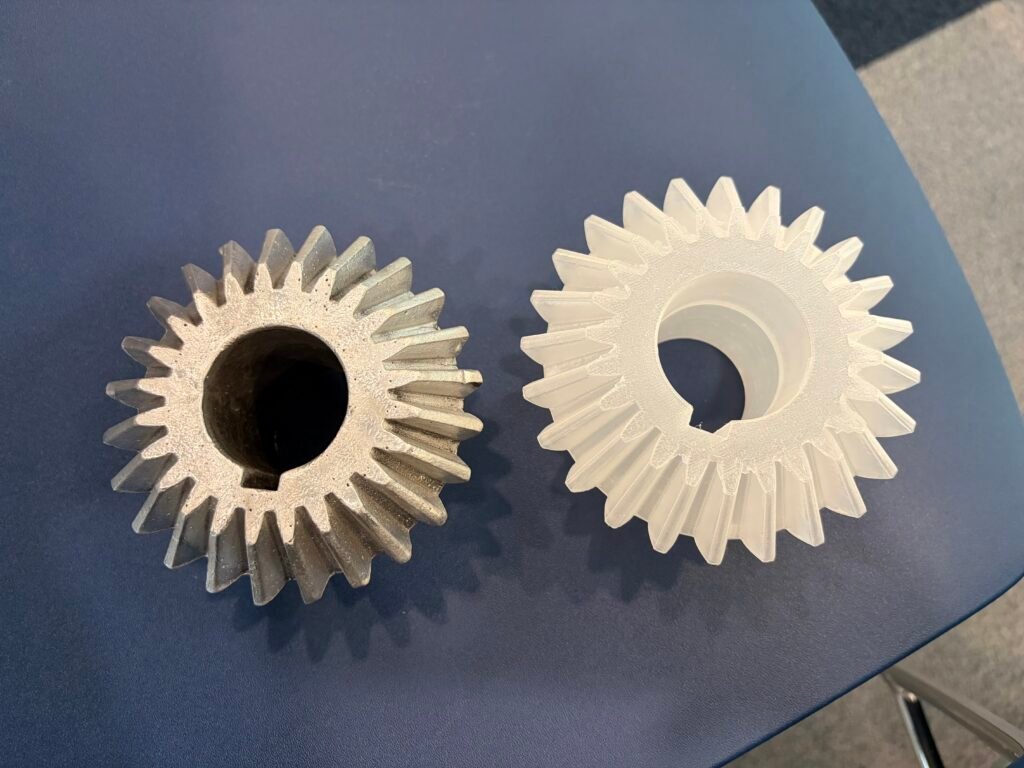
DeBruin talked about Skuld’s hybrid additive-enabled evaporative casting, or AMEC, technology. They print a polymer or foam pattern of the part, then place the pattern in a mold. The pattern disappears during casting, and leaves behind a metal part with the same shape. It has the same microstructure as casting, but it’s a much faster process than straight metal printing.
“We also have a lot of benchtop printers that we’re modifying for higher resolution,” DeBruin said.
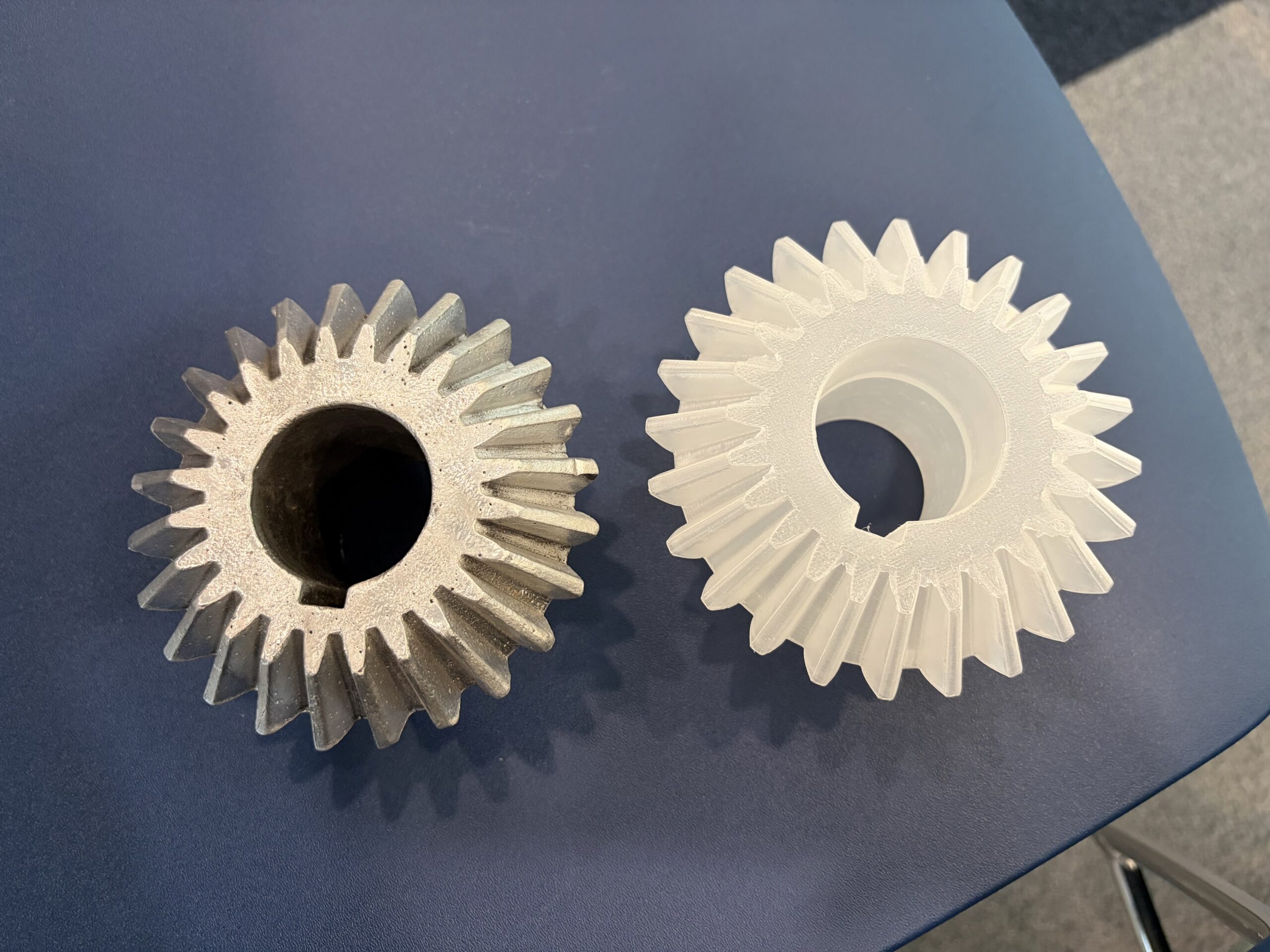
Skuld parts at DREAM Symposium
The panelists also discussed how they’re working to speed things up for the supply chain, like cutting down the manufacturing steps, as Dr. Scott-Emuakpor suggested. For instance, Hyphen’s iDAMP software enables them to print parts that don’t need a lot of post-fabrication steps.
“We can significantly impact the parts’ exposure to vibration, shock, or impact. Many parts that fail do so because of those issues,” he explained. “With our software, parts don’t have to be as strong, and it can reduce the time by 50%.”
DeBruin said sometimes, a conversation with the customer can be the most helpful.
“If there are very tight tolerances for machining, we can ask the customer, why do they need to be so tight? If you can eliminate some of those machining steps, like extra coatings, this can save time. Don’t push back on the customer, but just ask, does this make sense?”
Both Hyphen’s iDAMP software and Skuld’s AMEC process can be licensed out to other companies.
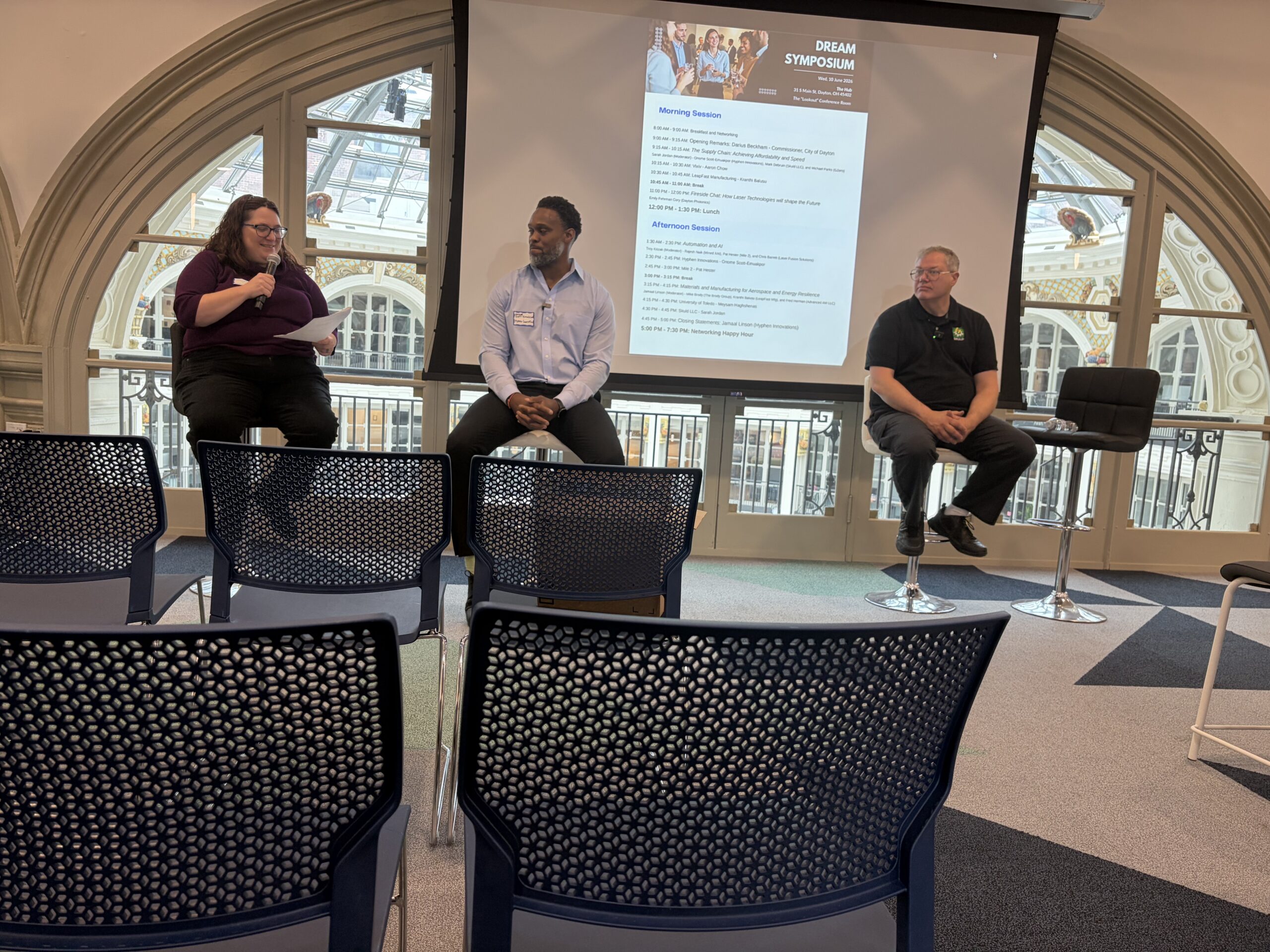
L-R: Sarah Jordan, Skuld; Dr. Onome Scott-Emuakpor, Hyphen Innovations; and Mark DeBruin, Skuld
Focusing specifically on Ohio, Jordan asked about the benefits of founding tech companies here, as opposed to larger, more well-known tech hubs like San Francisco and Boston. DeBruin noted that a large percentage of the U.S. is within a one-day drive of Columbus, and that there are plenty of military bases nearby that offer funding opportunities. Dr. Scott-Emuakpor also cited proximity, as well as affordability.
“Known tech hubs are expensive, first of all,” Dr. Scott-Emuakpor said. “Second, Ohio is saturated with high-quality tech companies. Just in this room, there are six different entities that I have collaborated with. I don’t think, in a different area, a newer company like ours would have six different collaborators in one room.”
When asked about their five-year predictions, Dr. Scott-Emuakpor said that he sees additive being more highly implemented into mainstream manufacturing, and also sees Hyphen “growing at the same rate as the implementation and usage of advanced manufacturing.”
“We’re developing a lot of our process to fit in shipping containers,” DeBruin said. “In five years, I’d like us to be the McDonald’s of advanced manufacturing, where we can train people to make the exact same pieces over and over.”
Technology Showcases & Fireside Chats
Peppered throughout the day were several brief Technology Showcases from participating Ohio-based companies. Vixiv offers AI-enabled, predictive engineering design software: users define the requirements and parameters, while the company handles all of the analysis and predictions. CEO and founder Aaron Chow said the software is able to compress the design cycle down from 4-6 months to just 2-3 minutes.
LeapFast Manufacturing offers a solid-state additive process called Bobbin-Friction Stir Deposition (B-FSD). Instead of melting, it uses friction to soften high-strength aluminum alloys, and deposit the material before it gets to the liquid state. CTO and co-founder Kranthi Balusu said B-FSD can cut lead times by up to 98%.
In a fireside chat, Emily Fehrman Cory, PhD, the CEO of Dayton Photonics, discussed the startup’s solid-state laser beam steering technology, as well as their fiberless optical communication system THEIA.
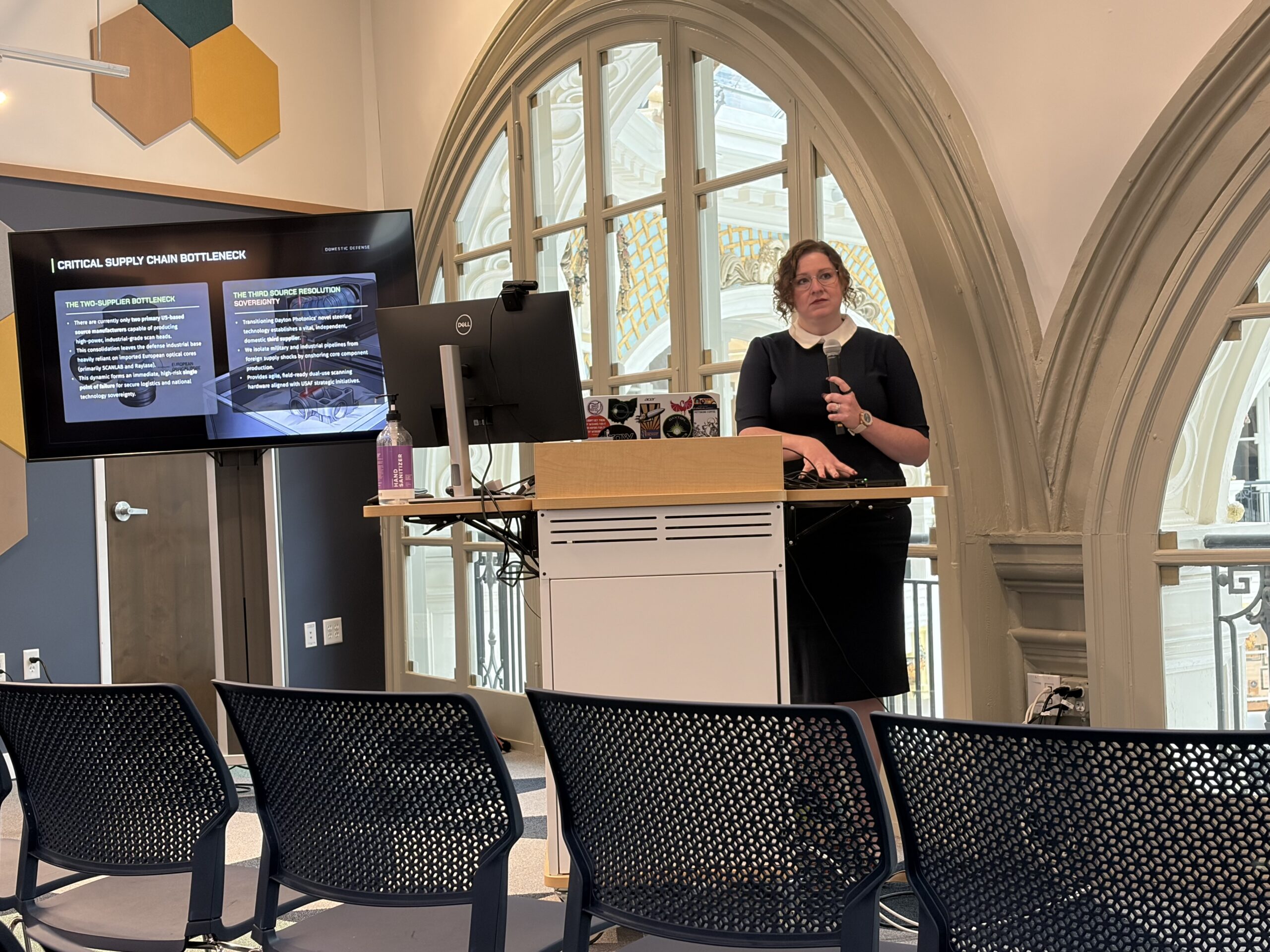
Emily Fehrman Cory, PhD, Dayton Photonics, at DREAM Symposium
Dr. Scott-Emuakpor spoke about Hyphen, which he said is “highly focused on physics-based models.” One of the company’s key technologies is an accelerated fatigue test machine, and another is their previously mentioned i-DAMP software.
Mile 2, a custom software development company, works primarily with the DoW on “mission-ready decision intelligence,” as Principal Machine Learning Engineer Patrick Hester, PhD, explained. He said that the company developed the first DoW-approved Google Cloud Platform environment that met Zero Trust (ZT) cybersecurity requirements.
Meysam Haghshenas, an Associate Professor in Mechanical Engineering at the University of Toledo, is the director of the university’s Fatigue, Fracture, and Failure Laboratory (F3L). He explained that the durability of 3D printed parts is a major qualification challenge, because AM materials are internally defective, and discussed his lab’s research on long vs. ultralong fatigue of AM materials.
Jordan talked about Skuld, and she even brought some additive casting examples. She discussed some of the materials the company is working on, like new aluminum, iron, and steel options, as well as some of its government-funded projects, like DARPA’s Rubble to Rockets (R2R).
Automation & AI
After a lunch break, we re-convened for a panel about automation and artificial intelligence (AI), moderated by Hyphen’s Lead Research Engineer Troy Krizak. He first wanted to know the state of the technology the panelists are seeing in the industry. Chris Barrett, the CEO of Laser Fusion Solutions, said a lot of the AI they see in machine shops “comes in on the software side, not at the machine level,” while automation is used for quality control and inspections.
Rajesh Naik, CEO of Mined XAI, said that because automation and AI are both such buzz words, they don’t always even explicitly say that they’re an AI company.
“But getting some data that’s well-structured is important,” he explained. “Start small, determine your key pain points, and build from there. We’ve talked to many clients who’ve shelved AI projects after 6 months because the return on investment isn’t immediate.”
Hester said on the automation side, someone is ultimately responsible for the system, and the decisions it makes. With AI, cognitive effort is redistributed, not removed.
“The burden is still on you to make the decision – do we continue to observe, collect more intel, quit? These [automation and AI] help us become more effective if deployed correctly, but they’re not taking anyone’s job.”

L-R: Troy Krizak, Hyphen Innovations; Patrick Hester, Mile 2; Rajesh Naik, Mined XAI; and Chris Barrett, Laser Fusion Solutions
Krizak wanted to know where they saw AI having the biggest impact in the manufacturing community, and Hester said it was the idea that you can wrangle huge amounts of data, make sense of it, and quickly get the relevant information out.
“The amount of data we’re generating in organizations is beyond the comprehension of what one person can understand. So AI helps.”
Naik thinks of these “massive amounts of data” in terms of the supply chain, with “hundreds of thousands of SKUs, supplied by multiple vendors, shipped to 600-700 businesses across the nation, then to distribution centers.” AI can help build resiliency in the system, so instead of multiple dashboards, all of that important information is in one place.
Materials & Manufacturing for Aerospace & Energy Resilience
The final panel was moderated by Hyphen’s Strategic Growth Lead, Jamaal Linson. With panelists Fred Herman, Principal Consultant with Advanced Additive Manufacturing, LLC; LeapFast’s Balusu; and Mike Brody of The Brody Group, Linson discussed how expensive manufacturing equipment is, and how they’re able to get funding. Herman noted that during COVID, many called on Defense Production Act Title III, which provides economic incentives to modernize, expand, and protect the domestic industrial base.
“When it comes to CapEx, in realistic terms, you can fund it yourself or through investment partners, and you’ll likely get an immediate loss due to the Big Beautiful Bill,” Brody said, then suggested that manufacturing companies could use NASA’s Internal Research and Development (IRAD) program, which funds cutting-edge scientific and engineering concepts.
From the audience, Jordan said Skuld purchases a lot of equipment at auctions, or builds their own. Kimberly Gibson, Industrial Base Integration Director at America Makes, asked if there could ever be a way to collateralize data as an asset, because banks working with manufacturers don’t typically cover something that’s not a hard and fast machine. A banker in the audience didn’t have an answer for that specific question, but did suggest the possibility of leasing equipment, or using a specialized bank; Gibson said that “we need to help the banks help us collateralize data.”
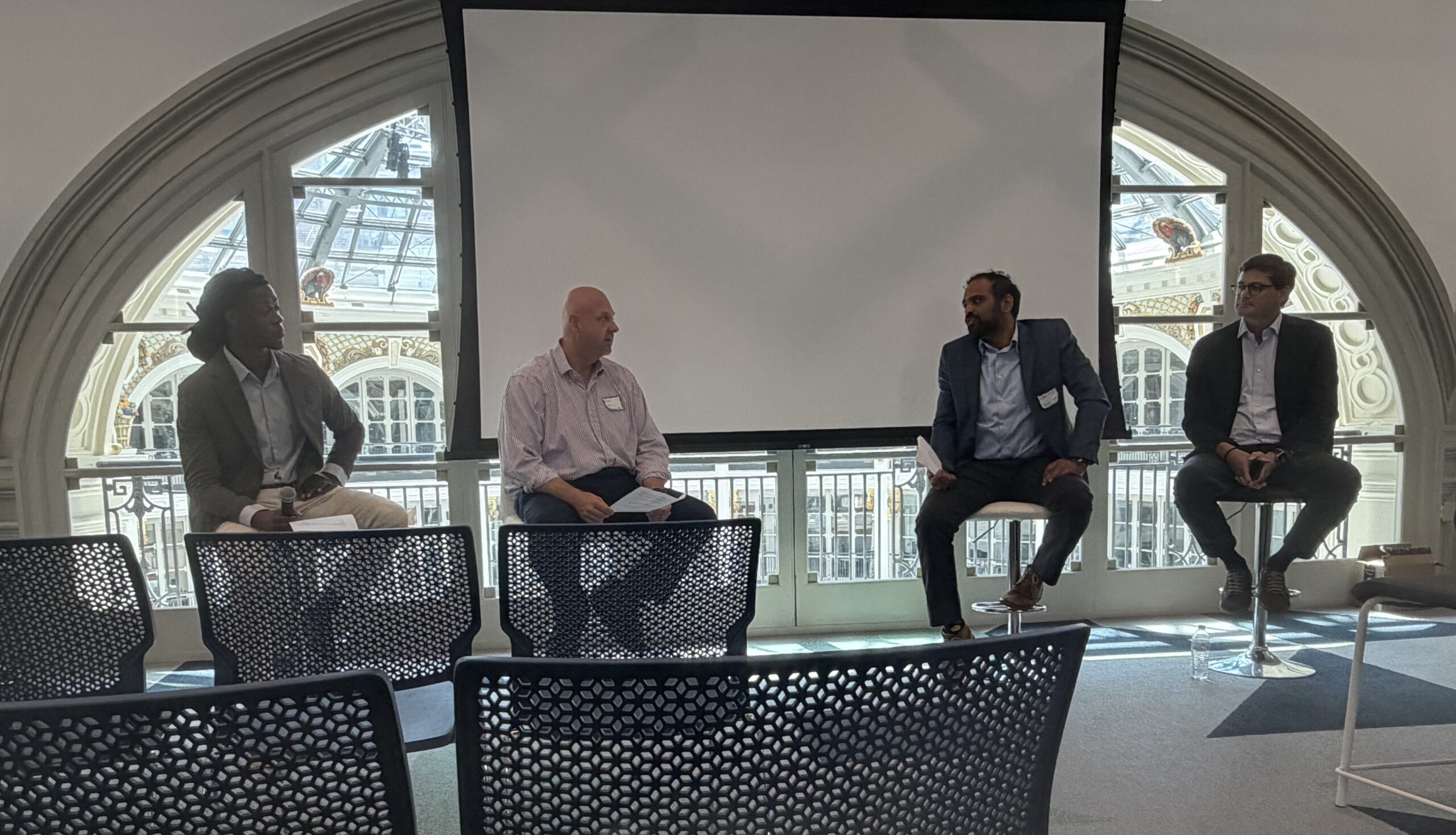
L-R: Jamaal Linson, Hyphen Innovations; Fred Herman, Advanced AM LLC; Kranthi Balusu, LeapFast Manufacturing; and Mike Brody, the Brody Group
Moving on, Linson asked how we can get the future generation excited about manufacturing careers. Balusu said he believes that kids are pushed away from this work, because they’ve “seen their grandparents lose their jobs in dark factories. But it’s not like that anymore.” Brody said companies need to donate printers and software to schools, and help them create learning labs, and that we need to tell kids it’s okay to get a manufacturing trade degree or go to a two-year school.
A younger audience member said that most graduating college students just want job security, while a public school teacher said that often, educators don’t even see 3D printers or CNC machines, “so there’s no spark, we can’t teach it.” Another member of the audience, who works with IACMI – The Composites Institute in Tennessee, shared that they are rolling out free STEM kits for students in grades K-5, making videos to show teachers how to use the technology, and showing kids footage from manufacturing industries so they can see how the technology is used in real life.
Linson also asked the panelists about manufacturing capabilities that our competitors understand better than we do. Brody’s answer was rare earth minerals and mining. Herman said that it’s not necessarily the capability, but “the mental, long-term perspective.” From the audience, Skuld’s DeBruin agreed, noting that “China and Vietnam look in generations, and the U.S. looks in months and years.” Balusu said that China has a long roadmap, “and they plan for resilient supply chains to manufacture at scale.”
Final Thoughts
Overall, the first DREAM Symposium was a worthwhile event. I thought the panel discussions, and the audience feedback throughout, were very interesting, and I kept thinking about some of the things people had said long after I’d gone home for the day. It was also great to connect with people and companies in my area, and I plan on having follow-up conversations with many of them.
“Our goal was to create a small, intimate room to encourage bonding,” Linson said. “We’ve laid a great foundation for the future.”
I can’t wait for the next one!
Images courtesy of Sarah Saunders for 3DPrint.com