

As China’s national college entrance examination (Gaokao) concludes, millions of students and parents are once again focused on university admissions and future career choices.
Computer science, artificial intelligence (AI), and renewable energy remain among the most popular fields. Yet within the additive manufacturing (AM) industry, another trend is quietly gaining momentum: China is systematically building a new generation of engineers specifically trained for 3D printing. And this effort is happening faster — and on a larger scale — than many people realize.
From One University to Twenty-Nine in Five Years
In 2026, China’s Ministry of Education approved six additional universities to offer undergraduate degrees in Additive Manufacturing Engineering, including Beijing University of Technology, Northeastern University, Hunan Institute of Technology, Suzhou Institute of Technology, Wuhan Vocational University of Technology, and Sichuan Engineering Technical University.
With these additions, the number of Chinese universities offering dedicated Additive Manufacturing Engineering programs has reached 29 nationwide.
That growth trajectory is striking. When the major was introduced in 2021, only one institution, Xinxiang University, offered the program. Five years later, 29 universities have adopted it.
The list now includes some of China’s most prestigious engineering schools, such as Harbin Institute of Technology, Northwestern Polytechnical University, and Nanjing University of Aeronautics and Astronautics, alongside numerous regional and application-oriented universities. Proving this is no longer an educational experiment but the beginning of a nationwide talent-development strategy.
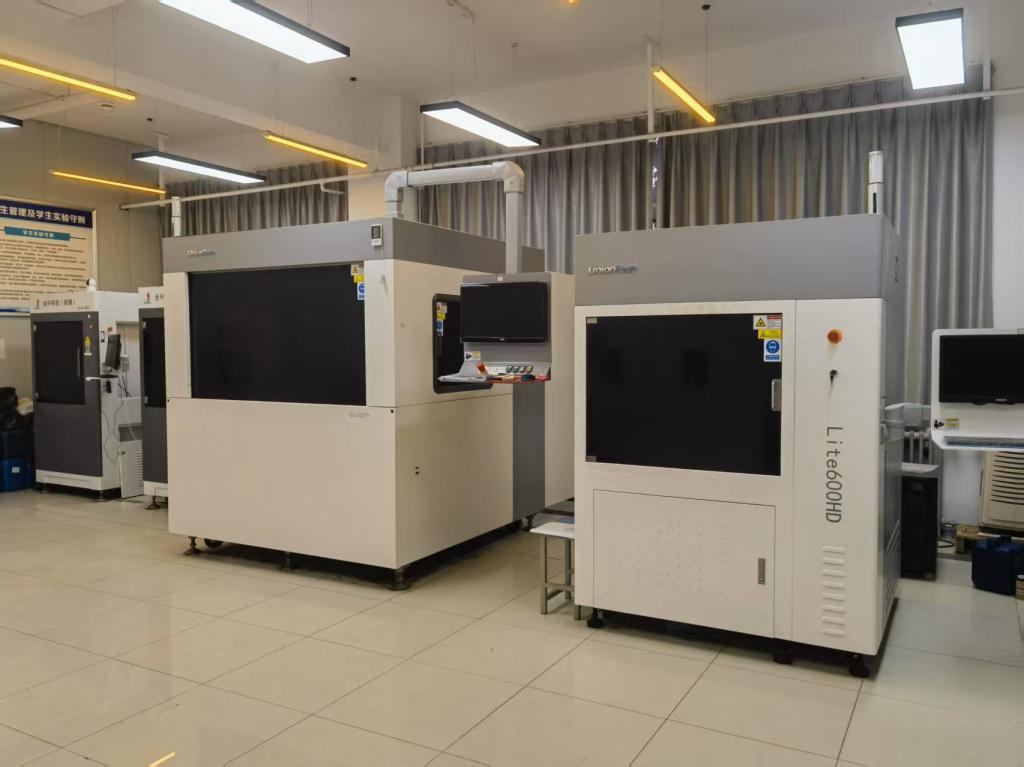
3D printing laboratory at Xinxiang University’s School of 3D Printing, one of China’s earliest dedicated educational programs focused on additive manufacturing. Image courtesy of Xinxiang University.
The Industry Moved First, Universities Are Catching Up
The rapid expansion of these programs reflects a simple reality: China’s AM industry has grown faster than its talent pipeline.
Over the past decade, Chinese 3D printing has evolved from a prototyping technology into a manufacturing technology.
Metal AM is increasingly used in aerospace structures. Automotive companies are shortening development cycles through rapid production and tooling. Medical applications continue expanding through patient-specific implants and devices. Meanwhile, consumer 3D printing has experienced explosive growth, driven by companies such as BambuLab, Creality, Anycubic, and Snapmaker.
Today, China is widely recognized as one of the world’s largest markets for both 3D printing equipment production and AM applications. But as the industry matures, a critical challenge has emerged. The shortage is no longer machines. It is people.
Companies Need More Than Machine Operators
Over the years, conversations with numerous AM companies have revealed that the challenge is not finding mechanical engineers, but finding engineers who truly understand AM. Modern AM professionals are expected to understand design optimization, material behavior, process parameters, simulation tools, software workflows, and, increasingly, automation and AI.
In high-value sectors such as metal AM, aerospace components, and advanced materials, the demand for multidisciplinary talent is especially acute. In fact, many job descriptions now resemble what could best be described as “cross-disciplinary engineering” roles.
Typical compensation levels reflect this demand. AM Process Engineers with a Master’s degree or PhD earn between RMB 20,000 ($3,000) and 40,000 ($5,900) per month. Metal AM materials and process engineers with one to three years of experience earn RMB 15,000 ($2,200) to 25,000 ($3,700) per month. Advanced process development, software, algorithm, and AI-related positions can command compensation equivalent to RMB 40,000 per month or more, often paid over 14 salary cycles. Entry-level operational positions at equipment manufacturers generally range from RMB 8,000 ($1,200) to 12,000 ($1,800) per month.
Similarly, technical operators typically earn RMB 8,000–12,000 per month, while process engineers earn RMB 15,000–25,000 per month. Senior R&D, materials, and advanced engineering specialists can earn between RMB 25,000 and 60,000 ($8,900) per month.
Yet despite these opportunities, many companies report difficulty filling positions. The problem is not a lack of openings, but a shortage of candidates with the right combination of skills.
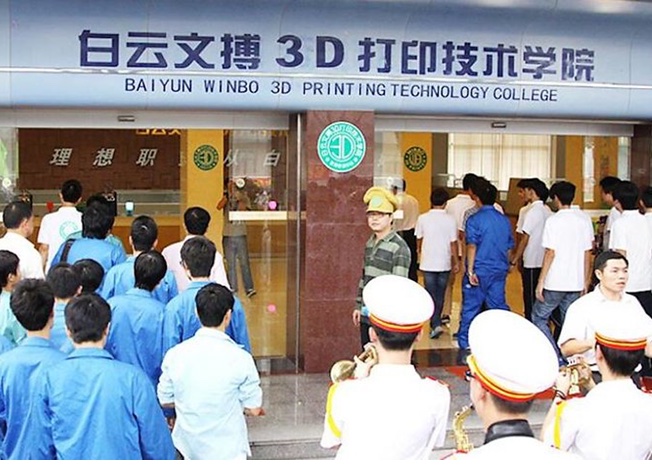
The Baiyun Winbo 3D Printing College in Guangzhou. Image courtesy of Baiyun Winbo 3D Printing College.
China and the U.S. Are Taking Different Educational Paths
Interestingly, China’s approach differs significantly from that of the United States.
Most American universities have not established standalone undergraduate degrees in AM. Instead, AM is typically integrated into traditional disciplines such as mechanical engineering, materials science, aerospace engineering, and industrial engineering.
Institutions including Penn State, MIT, Carnegie Mellon University, Ohio State University, and the University of Texas at El Paso maintain internationally recognized AM research programs. However, specialization generally occurs at the graduate or research level.
The two countries are taking different approaches to AM education. In the United States, students typically build a foundation in disciplines such as mechanical engineering, materials science, or aerospace engineering before specializing in AM. China is increasingly training AM specialists at the undergraduate level through dedicated degree programs. One approach emphasizes research and specialization later in the educational process, while the other focuses on developing a larger AM workforce from the start.
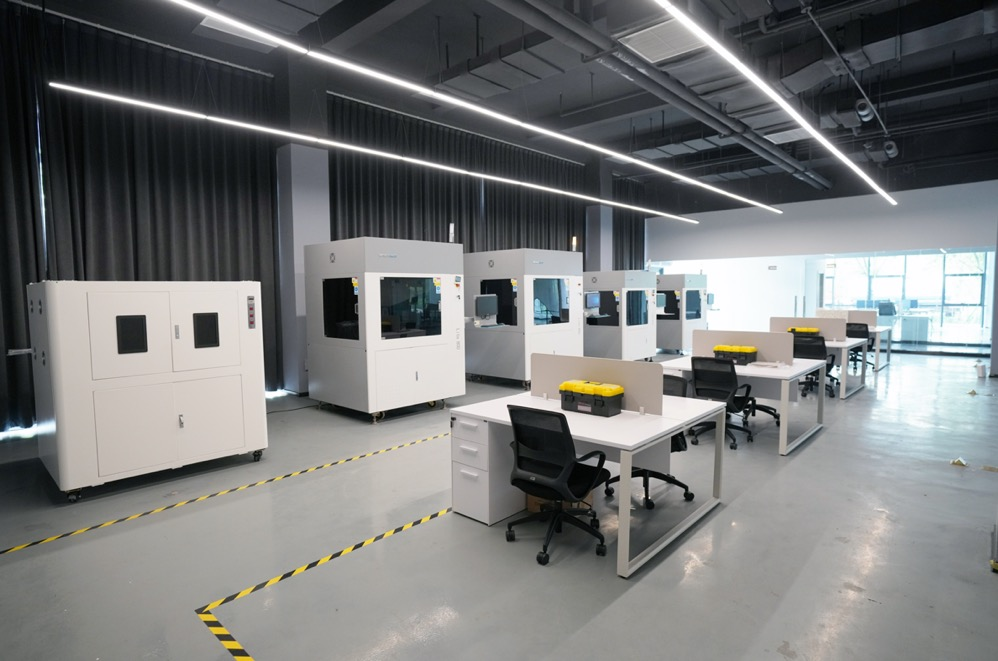
The 3D Printing Lab at Tsinghua (Qingdao) Academy of Arts and Science Innovation Research. Image courtesy of Tsinghua (Qingdao) Academy of Arts and Science Innovation Research.
The Future of AM Depends on People
After spending years in the industry, I have become convinced that the next major competitive advantage in AM will not come from machines, materials, or software alone. It will come from talent.
Machines can be purchased. Software can be upgraded. Processes can be learned. But developing a truly skilled AM engineer takes years, sometimes decades. That is why the rapid emergence of 29 dedicated university programs may be more significant than the launch of any new printer platform. This is not simply an upgrade in technology, but the beginning of a new generation.
Many observers still evaluate AM through the lens of technological breakthroughs. Yet from an industrial perspective, the more important question may be: Who is being systematically trained to drive the next phase of growth?
As increasing numbers of students begin studying design for AM, materials science, process control, and digital manufacturing within dedicated university curricula, the industry enters a new stage of maturity.
Five years ago, AM Engineering was offered by a single university in China. Today, it is taught at 29. Of course, the industry’s talent shortage will not be solved overnight. But China has moved quickly from treating AM as a niche specialty to making it part of formal engineering education.
About the Author
Xu Fanglei is an industrial designer, entrepreneur, and industry commentator focused on additive manufacturing and digital fabrication. He is the founder of SCRAT3D and 3D Printing Technology, one of China’s emerging media platforms covering the global 3D printing industry. Over the past decade, Xu has worked across industrial design, product innovation, and advanced manufacturing, while building connections between designers, manufacturers, researchers, and technology companies. His work explores the impact of 3D printing on manufacturing, education, consumer products, and entrepreneurship. Xu regularly publishes industry analysis and interviews, with a particular focus on developments within China’s rapidly growing additive manufacturing sector.