

We’re starting with some exciting news in today’s 3D Printing News Briefs: Stratasys just celebrated the opening of its new North American headquarters in Minnesota. Moving on, Nanoscribe is scaling manufacturing capabilities for some of its most popular 3D printing photoresins, and RIC Robotics is working to scale adoption of autonomous additive construction. We’ll end with news about 3D printed shoes.
Stratasys Holds Grand Opening Event for Americas Headquarters
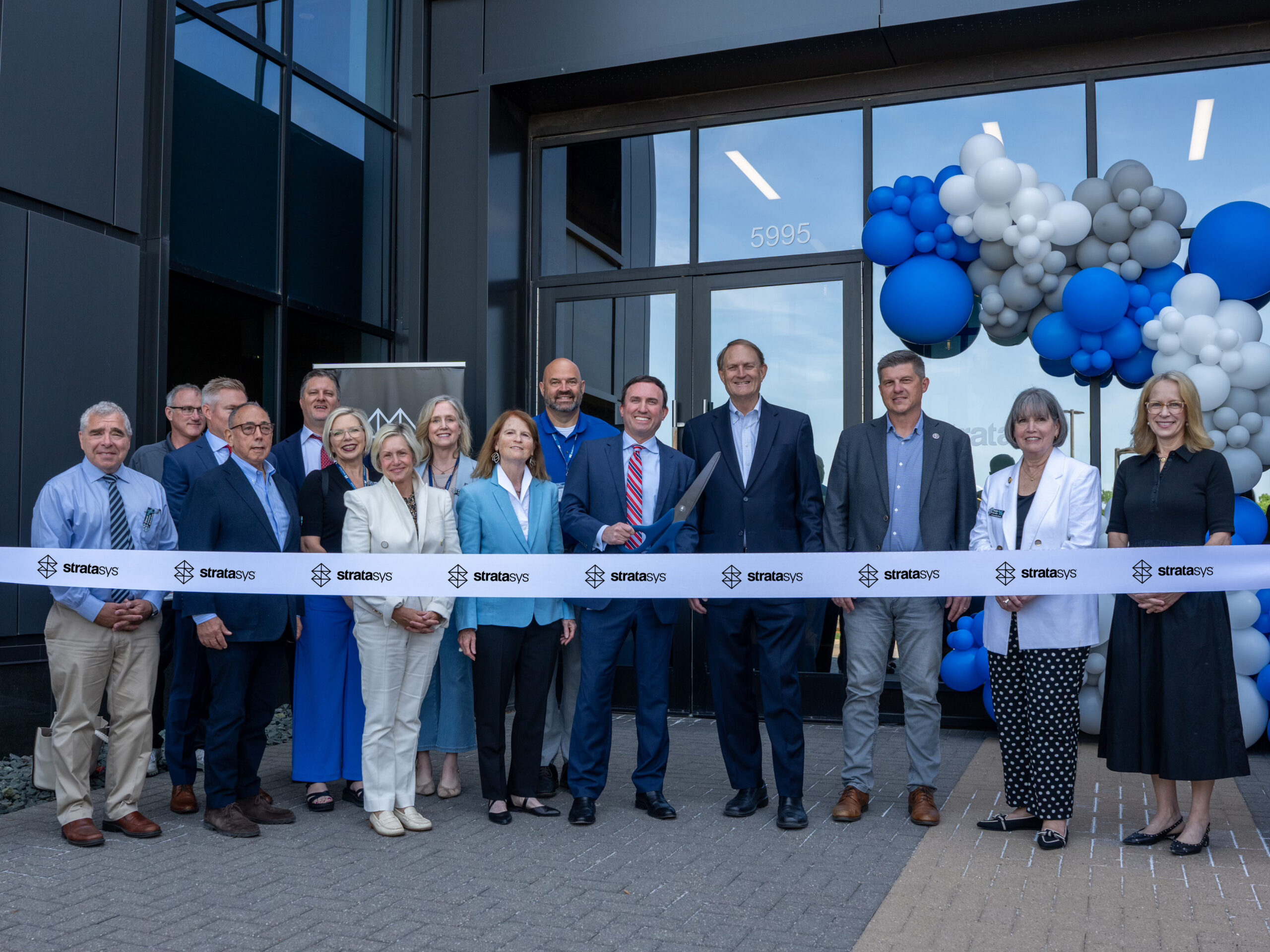
Ribbon-cutting ceremony at the grand opening of Stratasys’ Americas Regional Corporate Headquarters in Minnetonka, Minnesota, with Stratasys leaders, partners, and community guests, including Rich Garrity, Scott and Lisa Crump.
Days after announcing its acquisition of Markforged, 3D printing leader Stratasys celebrated the grand opening of its new Americas Regional Corporate Headquarters (ARCH) in Minnetonka, Minnesota. In addition to company leadership, partners, customers, and community stakeholders, several VIPs made the guest list, including United States Representative Betty McCollum, United States Representative Brad Finstad, United States Representative Kelly Morrison, EVP of the National Association of Manufacturers (NAM) Erin Streeter, and Stratasys Board Member Scott Crump, who invented fused deposition modeling (FDM), and his wife Lisa Crump, Stratasys Co-Founder. ARCH is a 200,000 square-foot facility, housing advanced R&D, applications expertise, engineering, customer collaboration capabilities, and on-demand manufacturing business Stratasys Direct. The opening comes after an independent audit of the company’s Environmental, Health, and Safety (EHS) management systems at the campus in Minnetonka; the audit confirmed alignment with ISO 14001 and ISO 45001 standards. ARCH drives home just how committed Stratasys is to the U.S. market.
“Bringing our teams together under one roof has a meaningful impact on how we operate, innovate, and serve our customers. ARCH gives us the scale and workspace to accelerate collaboration across engineering, manufacturing, and customer facing teams, enabling faster delivery of high-quality solutions,” said Rich Garrity, Chief Business Unit Officer of Stratasys and NAM Board Member.
Nanoscribe Invests in Expanding Manufacturing Capabilities for Key Photoresins
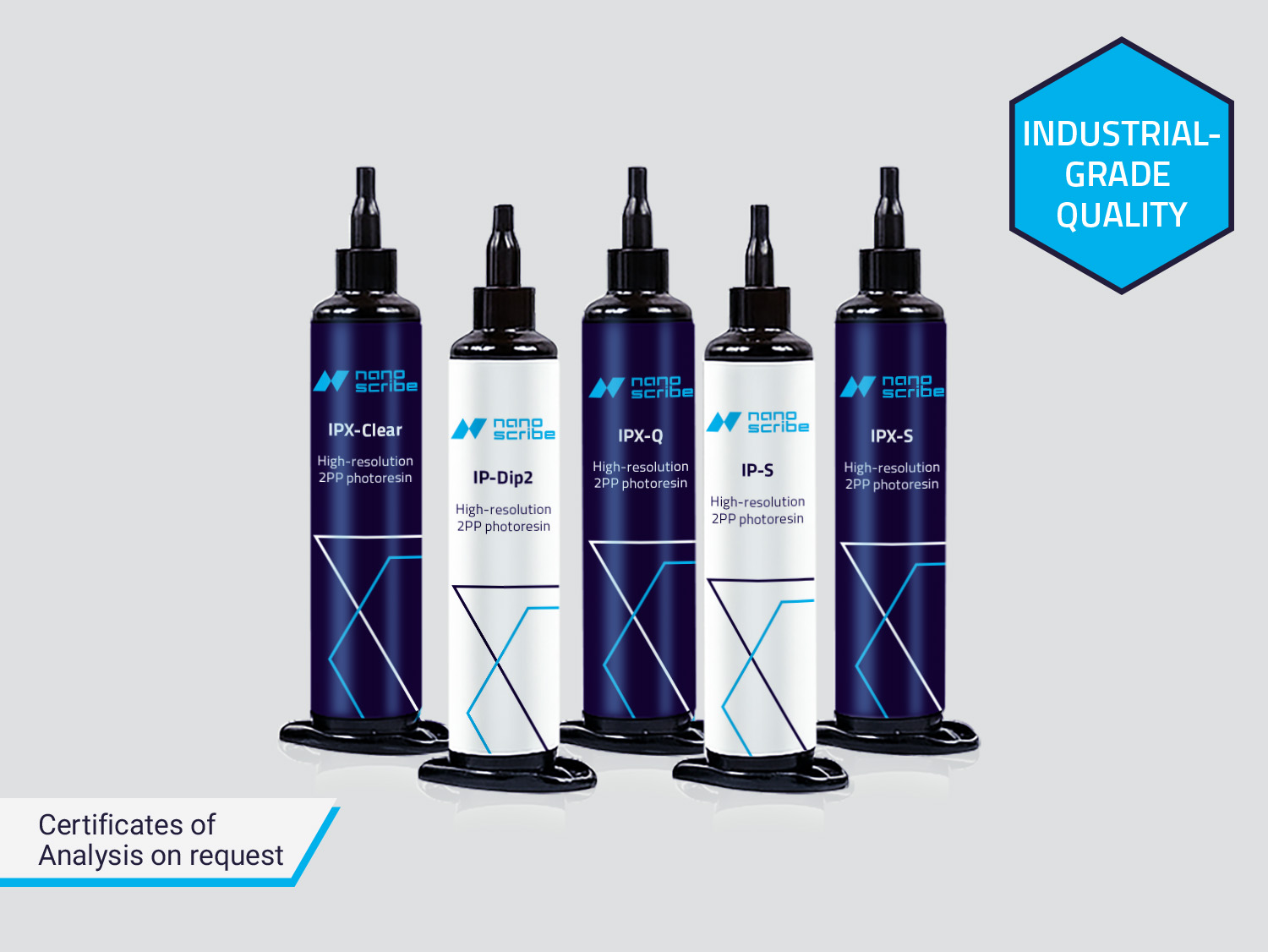
Selected high-demand photoresins, now manufactured with industrial-grade quality and available with batch-specific Certificates of Analysis (CoA).
High-precision 3D microfabrication market leader Nanoscribe is seeing increased industrial demand for its photoresins, and is meeting that demand by scaling up manufacturing capabilities for five of its requested materials. Early demand for its two-photon polymerization (2PP) and two-photon grayscale lithography (2GL) systems mostly came from academic research facilities, but last year, every third system the company sold went to industry, particularly in photonics packaging and optics manufacturing applications. So Nanoscribe has responded with extra manufacturing capabilities for IP-Dip2, IP-S, IPX-Q, IPX-S and IPX-Clear, though the names of the resins, their chemical composition, material handling, and print parameters will stay the same. Plus, for customers that need batch-specific traceability, Nanoscribe can provide Certificates of Analysis (CoA) on request. Measurements are taken by an independent external service provider, and the certificate acts as an extra record for batch-specific documentation, which can be helpful for purchasing, internal quality management, or incoming inspection.
“The five key photoresins are already used in a wide range of applications and markets,” explained Dr. Alexander Quick, Head of Materials at Nanoscribe. “Our investment in expanded manufacturing capacity supports industrial-grade material quality while maintaining material properties and established customer workflows. This benefits customers from both academia and industry.”
RIC Robotics Aims to Scale Additive Construction Adoption with RaaS Platform
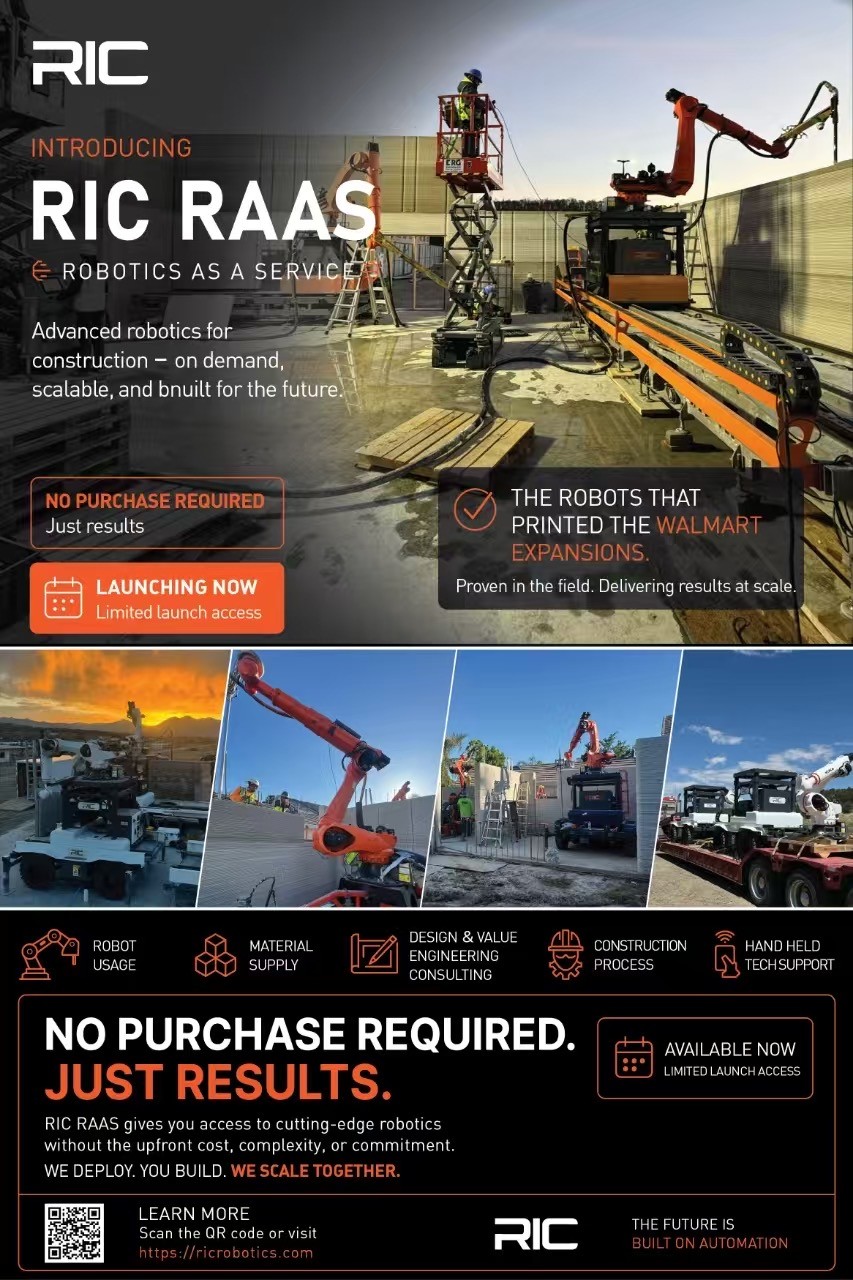
RIC Robotics recently announced the launch of its Robotics as a Service (RaaS) ecosystem, in order to help scale adoption of autonomous construction. The company, which specializes in large-scale additive construction robotics and autonomous building technologies, has supported some major commercial projects, including 3D printed Walmart expansions. Its new RaaS offering is a flexible deployment model, meant to help contractors, developers, and construction firms efficiently integrate robotic construction into their real-world projects. The platform will expand access to the company’s proprietary mobile robotic construction systems and 3D concrete printing technologies, in order to make these technologies more accessible for both residential and commercial applications. In addition to its systems, RIC Robotics says it also offers clients hands-on training, project execution, material solutions, and implementation support, and that it’s investing in training infrastructure and workforce development to support long-term adoption of robotic construction.
“Construction is entering a period of significant technological transformation, but widespread adoption depends on making these technologies more accessible and operationally practical for real-world projects. Our Robotics as a Service platform is designed to lower barriers to adoption while giving developers and contractors the flexibility, support and deployment expertise needed to successfully integrate robotic construction systems into active projects,” said CEO of RIC Robotics Dr. Ryan Cox, who also served as COO of Alquist 3D, where he oversaw major 3D concrete printing projects, including the Walmart expansion developments.
Nike & Zellerfeld Rolled Out Version 2 of 3D Printed Air Max 1000
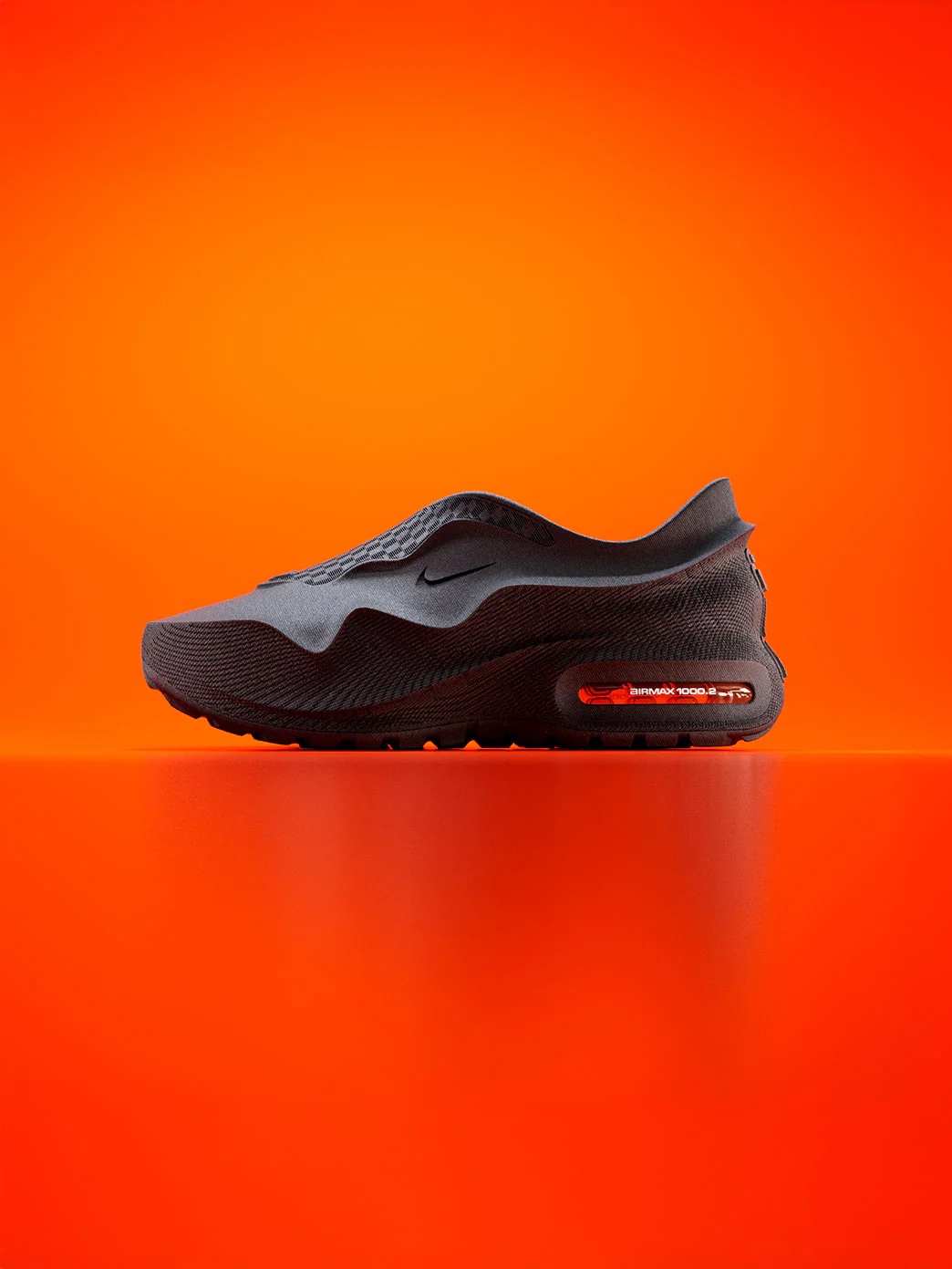
Image courtesy of Zellerfeld
Once again, Nike and Zellerfeld have teamed up for the 3D printed Air Max. There was the single-color Air Max 1000 in 2024, the Air Max 95000 last year, and the multicolor Air Max 1000 this winter. Last month, they dropped version 2: the Nike Air Max 1000.2 Black Hyper Crimson. Printed out of zellerFOAM TPU material, the shoe kept the triple-black upper from the first 1000.2, but added a Hyper Crimson red to the Air bubble in the heel. This makes the branding really stand out on the see-through window. The design of the shoe mostly stayed the same, but the geometry was refined, and the lugs and outsole of the Air Max 1000.2 Black Hyper Crimson were both reshaped, resulting in what Zellerfeld says is an “improved feel.” These changes made it faster to produce the one-piece 3D printed shoe, and also introduced new colorways to the market much sooner.
“What hasn’t changed is the soft, responsive design that blends a utilitarian build with plush support and one-of-a-kind looks,” the Zellerfeld website states. “Wavy patterns and textured tooling throughout the upper mimic the original Air Max 1 mudguard, creating depth and complexity. The laceless design makes it simple to slip into the familiar feeling of Max Air-infused bliss.”
Unfortunately, the $179 Nike Air Max 1000.2 Black Hyper Crimson was only available through an EQL raffle from Zellerfeld that ran from May 25-28, so the website says they’re sold out. But, you can visit the Zellerfeld website and subscribe to get access to exclusive products, new arrivals, and be among the first to know about future limited drops.