
We’re kicking things off with materials news in this weekend’s 3D Printing News Briefs. Then it’s on to a hybrid manufacturing system for a maritime exercise, an expansion of industrial metal 3D printing, and an interesting acquisition in Dubai. We’ll end with 3D printed ceramic implants that mimic bone.
Neuenhauser Maschinenfabrik is an Official Processor of LUVOCOM 3F

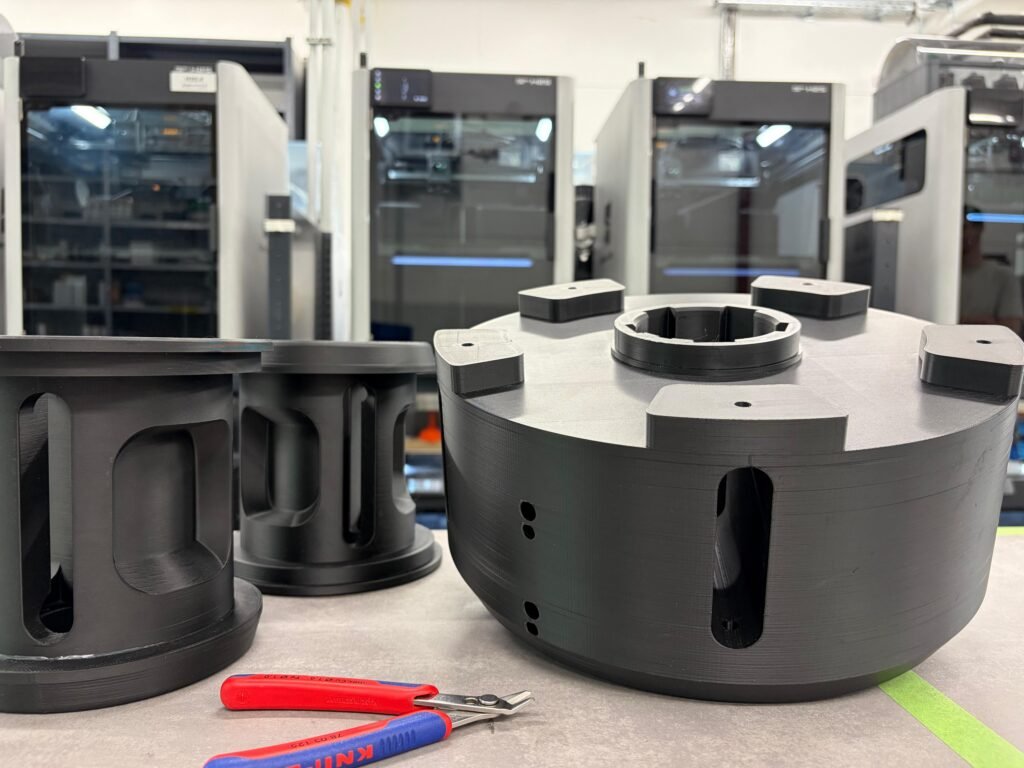
Machine parts printed with LUVOCOM 3F
Neuenhauser Maschinenfabrik delivers solutions in mechanical and plant engineering, and specifically uses additive manufacturing (AM) to expand and optimize industrial production processes. The company is now expanding its AM activities by becoming an official processor of the LEHVOSS Group’s LUVOCOM® 3F focus materials for industrial FFF 3D printing. Neuenhauser Maschinenfabrik has operated a dedicated 3D printing infrastructure for several years, and the LUCOVOM 3F focus materials have now been qualified in its modernized print farm. There are three focus materials for technical applications in series production, designed for process stability and reproducible quality: a high-strength, carbon fiber-reinforced PET with temperature resistance and low moisture uptake; an unreinforced polyamide with excellent surface quality, high toughness, and warp-free printing; and a carbon fiber-reinforced PPS meant for metal replacement, with chemical and flammability resistance and high stiffness and strength. This collaboration allows the company to offer in-house applications and services for customers based on these qualified, high-performance materials.
“Our goal is to establish additive manufacturing as a reliable production tool in mechanical engineering,” said Mathis Kleinert, Head of Additive Manufacturing at Neuenhauser Maschinenbau GmbH. “The LUVOCOM® 3F focus materials offer a very good combination of industrially relevant properties and stable, reproducible printability.”
Snowbird Technologies Participating in RIMPAC with Meltio’s Technology

Snowbird Technologies will be one of the participants at the 30th iteration of the Rim of the Pacific Exercise 2026 (RIMPAC), a biennial maritime exercise that will be held in and around the Hawaiian Islands from June 24-July 31. Forces from 31 different nations will participate, and the exercise will include roughly 140 aircraft, 40 surface ships, five submarines, and over 25,000 personnel. Snowbird Technologies will be part of the distributed advanced manufacturing experiment by Naval Postgraduate School Consortium for Advanced Manufacturing Research and Education (CAMRE) at RIMPAC 2026, thanks to NPS CAMRE’s Partnership Intermediary Agreement with FLEETWERX. Just like at RIMPAC 2024, Snowbird Technologies will showcase its modular SAMM Tech, or Snowbird Additive Mobile Manufacturing Technology, a hybrid system that integrates plastic AM, CNC subtractive capabilities, and metal AM from Meltio into one compact, containerized unit. At the last RIMPAC, SAMM Tech produced and machined a replacement bushing for a ship’s reverse osmosis generator in less than 48 hours.
“SAMM Tech’s containerized, all-in-one design enables seamless transition from maritime to onshore operations. We’re proud to support the 30th iteration of RIMPAC and look forward to validating our capabilities in new environments to better serve the warfighter at the tactical edge,” said Karl Wojtkun, Vice President of Business Development at Snowbird Technologies.
RIMPAC 2026 is hosted by the Commander of the U.S. Pacific Fleet and led by the Commander of the U.S. 3rd Fleet.
Unionfab Expands Industrial Metal AM Services in U.S., Canada, & Germany

Unionfab reduces low-volume metal parts production from 30 days to as fast as 5 days with six-laser metal printing systems.
Digital manufacturing platform Unionfab, which is affiliated with 3D printing equipment manufacturer UnionTech, provides end-to-end manufacturing services to hardware developers, integrating CNC machining, injection molding, sheet metal, rapid casting, and 3D printing in its facility. Now, as demand grows for a technology that can offer complex geometries, lightweight structures, and faster iteration, the platform is further expanding its industrial metal AM services for customers in the U.S., Canada, and Germany. Unionfab has deployed over 100 industrial metal 3D printing systems, including both 4- and 6-laser SLMS machines now in scaled production. The company says multi-laser platforms can increase print efficiency by up to 40%, and decrease manufacturing costs by about 30%. With these systems, and an AI-driven manufacturing platform, Unionfab says it’s able to reduce the time for selected low-volume parts production from over 30 days to just five.
“Over the past few years, China’s metal 3D printing industry has undergone rapid technological iteration and industrial maturation,” said Unionfab CEO Allen Yang. “Continuous innovation among equipment manufacturers, material supply chains and manufacturing service providers is driving rapid improvements in printing efficiency, process stability and overall manufacturing costs. We believe now is an important time for global manufacturers to reassess how they develop and produce complex metal parts.”
Mint Group Announces Acquisition of 3D Printing Service Bureau Generation 3D
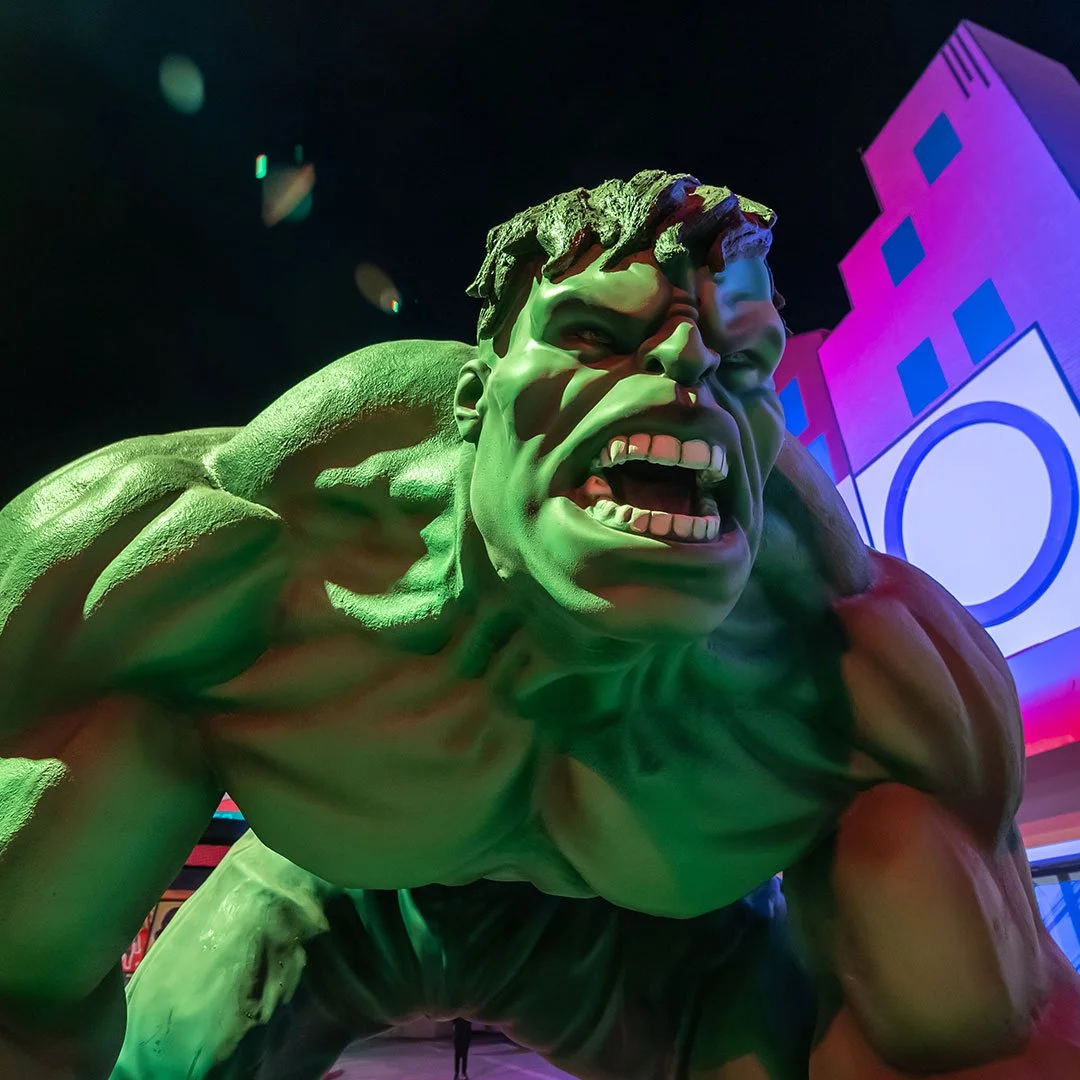
Image courtesy of Mint Group
Fabrication and fit-out company Mint Group announced that it has acquired fellow Dubai-based company Generation 3D, a 3D printing service bureau. Mint Group, officially Mint Creative Production, specializes in architectural theming and 3D printing, with a portfolio that includes projects in the cultural, entertainment, and retail sectors of the Middle East. By acquiring Generation 3D, Mint Group plans to start building out an integrated production platform for the Middle East’s theming industry, which is an intentional step in its strategy to consolidate production capabilities. It’s also reflective of a wider change in what customers expect from regional production partners, and reminds us that the value of AM in project-based sectors, like entertainment, and even more specifically, theme parks, is continuing to be evaluated for use in end-to-end production.
“This is not just about 3D printing. It’s about how we rethink production. Historically, fabrication, fit-out, and advanced production have operated in parallel. What we are building now is a model where these components are fully integrated, from design intent through to final delivery,” said Amin Rashmani, the CEO of Mint Group.
“The expectation today is not just quality. It is consistency, speed, and control at scale. By integrating Generation 3D into Mint’s ecosystem, alongside scenic production and fit-out through Code A, we are moving toward a more structured, coordinated, and predictable delivery model. The shift is clear: from fragmented execution to a unified platform. That is where the real value lies.”
Researchers 3D Printing Ceramic Implants that Mimic Real Bone
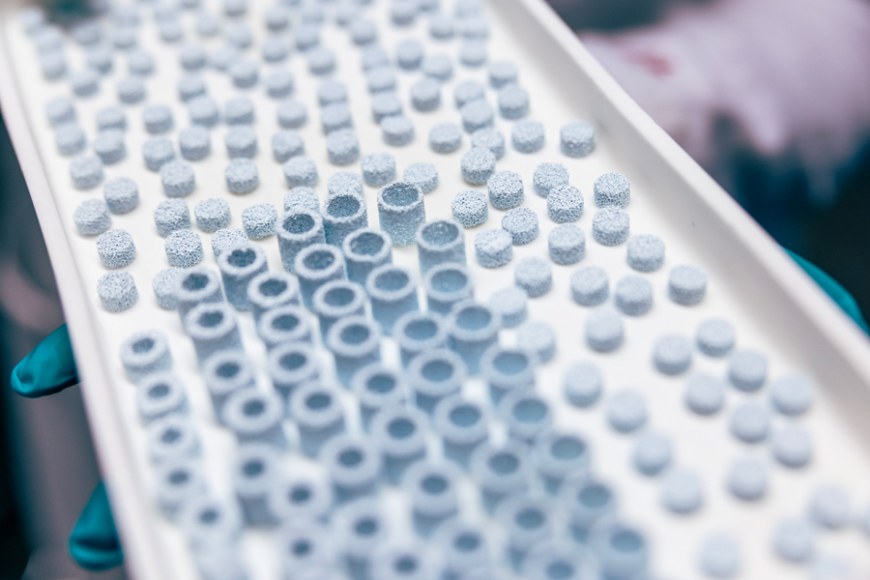
3D-printed scaffolds that mimic the chemical composition and architecture of natural bone tissue. Photo: Jonne Renvall, Tampere University
According to researchers at Tampere University, bone grafting is the second most common tissue transplantation procedure in the world. Typically, these treatments use bone taken from a donor or the patient themself, but this often involves extra surgeries, long recovery times, and a high risk of complication. The Tampere team wanted a safer, more effective alternative, and developed 3D printed ceramic implant material that mimics actual human bone. Using 3D printing and hydroxyapatite—the same compound that forms the mineral structure of real bone—the team created bone-like scaffolds, which support the human body’s capacity for tissue regeneration. 3D printing enabled precise control of the scaffolds’ internal architecture, and the researchers determined that implants with internal pores of about 400 micrometers and 45% porosity were an “optimal bone-like structure.” This novel technology is the end result of the AffordBoneS project funded by the Horizon Europe Marie Skłodowska‑Curie Postdoctoral Fellowship program, while the ongoing GlassBoneS project hopes to further this work.
“By using the same material that nature uses and shaping it through ceramic 3D printing, the implants can be precisely tailored to match a patient’s individual bone defect, without relying on drugs or growth factors that may cause side effects,” explained Antonia Ressler, Postdoctoral Research Fellow at the Tampere Institute for Advanced Study, who led the research.