
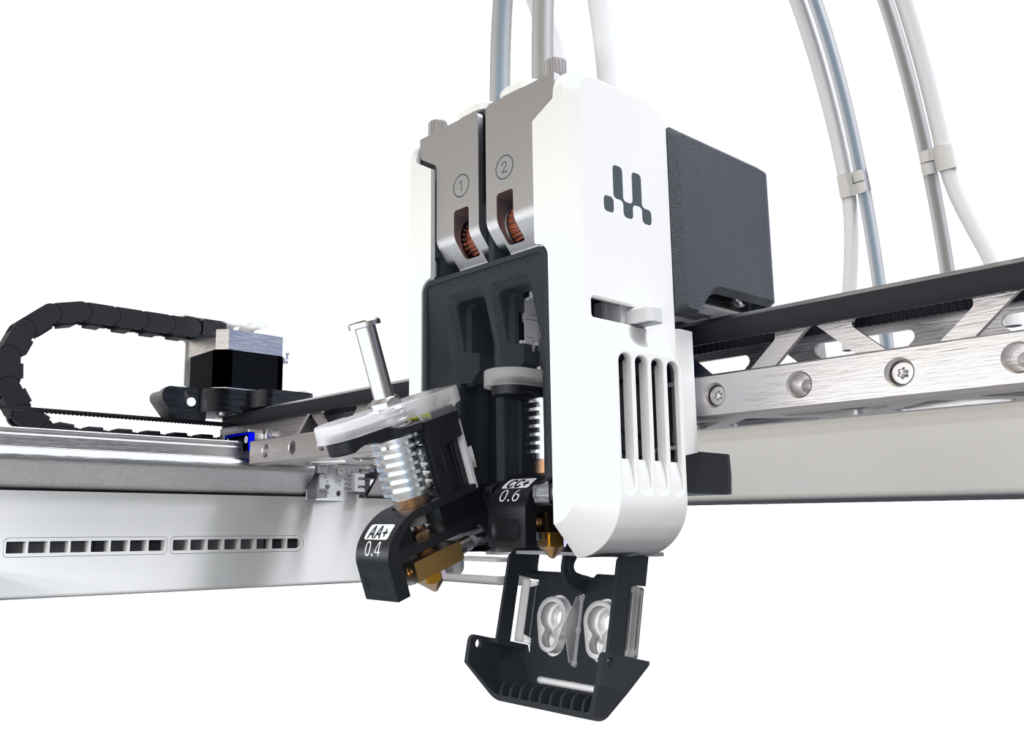
UltiMaker has announced the new Factor 4 Plus. The printer, which sits above the S series, has a 330 x 240 x 300 mm build volume and a 120-kilo dual-nozzle material extrusion system. The printer has UltiMaker’s standout feature: swappable print cores that significantly reduce downtime and operator time.
The machine will sell upwards of $15,000 and is aimed at manufacturing applications. The company now has new traceability features in place and says the system is twice as fast as the previous one. The TRACE (Technical Reporting and Certification Engine) is an automated feature that tracks every print and is said to improve QA. The system generates a CAD validation report for every print. The system is meant to be robust and rugged.
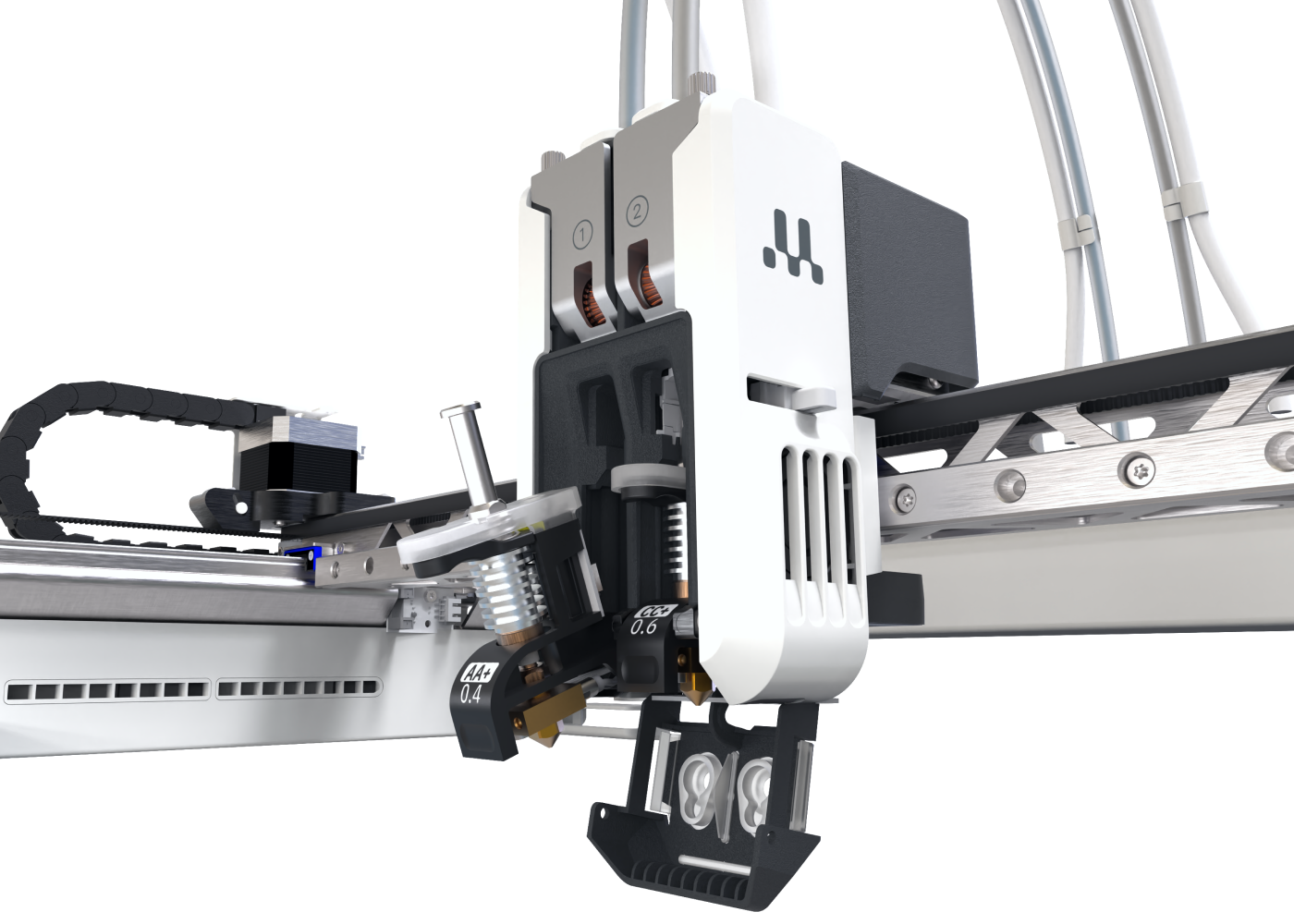
Improved lifetime-tested Gantry for the UltiMaker Factor 4 Plus. Image courtesy of UltiMaker.
UltiMaker CTO Arjen Dirks explained,
“When I talk directly with our customers, one message comes through consistently: speed is great, but proving the quality of the part is the real challenge. TRACE was built directly in response to that feedback and I’ve seen firsthand what an incredible improvement it makes. Pulling validation data straight from the hardware gives customers the confidence and traceability they need to scale
additive manufacturing into true production environments.”
And UltiMaker’s SVP EMEA Andy Middleton added,
“The Factor 4 Plus reflects UltiMaker’s focus on solving the real production challenges facing manufacturers and defense teams today. This is not about adding another machine to the portfolio. It is about listening closely to the market and delivering the speed, traceability, resilience, and affordability customers need to scale additive manufacturing in demanding, real-world environments.”
The company hopes that it will be used in the field, particularly in defense. The company even thinks that it can be used forward-deployed. The company also made a Cheetah motion planner that is said to reduce vibration and better account for stepper motor acceleration and head torque than other motion planners. The company says that it has a “commitment to delivering practical, scalable additive manufacturing solutions for both industry and defense while remaining significantly more cost-efficient than other industrial 3D printing platforms.”
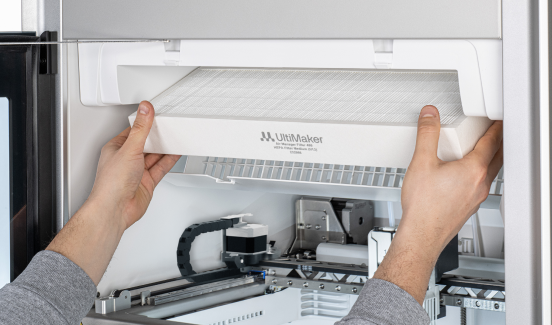
HEPA filters for the Factor 4 Plus. Image courtesy of UltiMaker.
UltiMaker’s current line-up is still very confusing, and it’s unclear which system is for whom. The company is known for a good UI, a good overall user experience, and making long-lasting printers. The focus on defense, therefore, is logical. Indeed, there are many fewer European 3D printing companies now. Previously, Europe dominated the desktop market for Pro and mid-tier systems. UltiMaker could therefore build a reliable, long-lasting, well-running system for industrial firms, large enterprises, and the military.
Defense 3D printing and forward-deployed 3D printing are becoming more important and will give them steady clients and revenue. For many, however, lower-priced Bambu and other systems will continue to be the most obvious choices. If UltiMaker can demonstrate that it can run for extended periods in rugged conditions, it could find a very profitable niche for itself. If it could perform on oil installations, for example, at construction sites, and with the military, it could develop a cult following once again. Longevity, reliability, and being designed with the user in mind have traditionally made UltiMakers good systems. Generally, they’ve been the longest-lasting systems for most people. Claiming that heritage, living up to it, and somehow demonstrating it to buyers will be key for the company’s future.