
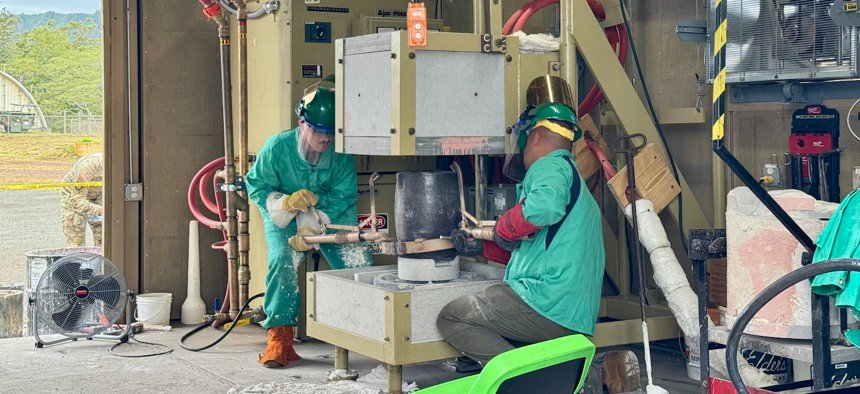
In the summer of 2025, the US Indo-Pacific Command (INDOPACOM) opened a new advanced manufacturing facility at Schofield Barracks, the Hawaiian home of the US Army’s 25th Infantry Division. INDOPACOM gave a humble name, ‘The Forge,’ to the site, which is located in a formerly abandoned warehouse that was inhabited by feral pigs before the US military filled it with 3D printers and other advanced manufacturing equipment.
INDOPACOM appears to now be using that same designation (‘The Forge’) to refer to the team comprised of personnel from both the Army and the Marines, which has been deployed in at least one instance to train US allied forces. At the annual Balikatan exercise, in which the US military and other Western forces participate in joint training operations with the Philippines military, the INDOPACOM unit set up a similar facility to the one at Schofield Barracks, “inside a warehouse at [a] jungle training area.”
According to the team’s senior enlisted leader, The Forge and its partners achieved rather striking results during Balikatan: over the course of three weeks, they completed 36 different jobs, representing a savings of well over $20,000. Even more importantly, given the urgency of resupply specifically in a military context, the team cut the lead time for delivery of those parts by months.

The original Forge facility at Schofield Barracks. Image courtesy of Defense One/Jennifer Hlad
Regarding one use case — a batch of simple bolts for a construction vehicle, which were reverse-engineered and then 3D printed — Chief Warrant Officer 2 Kevin Ton, who commands The Forge unit, noted that ordering the parts from external sources would’ve meant a wait time of 8-10 weeks. In a live combat scenario, that wait time might as well be forever.
In addition to more routine jobs like that one, involving a situation where the need is just to replenish an item that has run out, the advanced manufacturing specialists also demonstrated the ability to innovate on the fly. For instance, during Balikatan, the standard issue bipods that participants were using for the new Army M250 machine gun failed repeatedly. By designing a 3D printed adapter for an older, more reliable bipod model, The Forge successfully addressed the problem.
The main limitation for The Forge was a prohibition on arms component manufacturing for foreign militaries. But even in that case, digital manufacturing solutions provide a workaround: by sharing digital files with allied militaries, allowing the latter to make the parts themselves, INDOPACOM’s advanced manufacturing specialists stay on the right side of US military regulations.
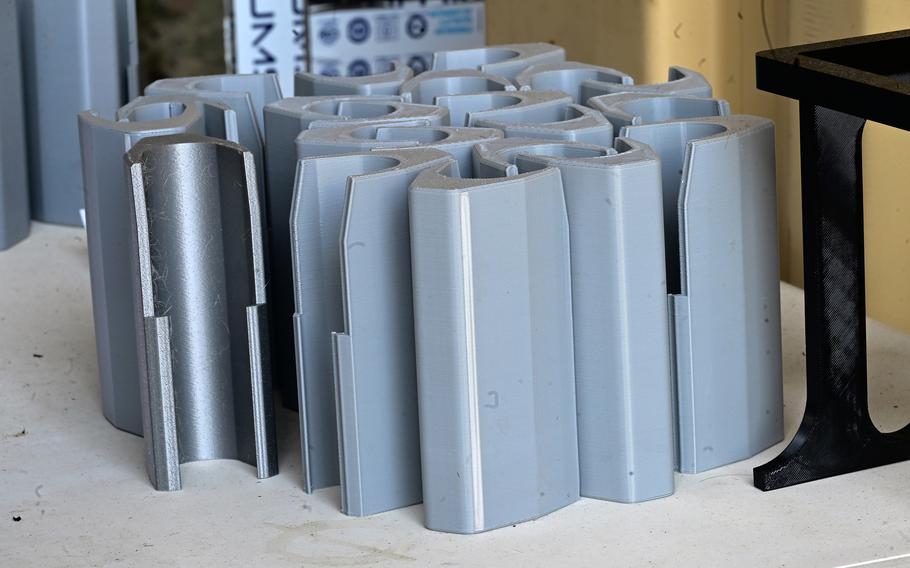
3D printed bipod adapters. Image courtesy of Stars and Stripes
The Forge comes from the same Army installation housing the unit that reportedly 3D printed a lethal first-person view (FPV) drone last year for the first time, so it’s not surprising to see that it’s Schofield Barracks which is responsible for executing such a high degree of forward thinking. And it’s encouraging to see that the name ‘The Forge’ is being applied to the team, not exclusively to the facility where the team originated. This puts the emphasis where it most properly belongs: on the human know-how required to enact the strategic vision.
Similarly, ‘Balikatan’ means ‘shoulder-to-shoulder’ in Tagalog, which, in this context, serves as another reminder that however central a role new technologies may play in the equation of expeditionary manufacturing, sufficiently trained human labor remains the key to making the whole system work. As I’ve explained in my coverage of how AM can change the semiconductor supply chain, the combination of ahead-of-the-curve human know-how and the smaller infrastructure footprint implied by advanced manufacturing equipment points to a future where technology integration services are a leading growth catalyst for the manufacturing sector.
It would seem to not be a coincidence that the US military seems to be most interested in demonstrating this capability in the Pacific region, above all. Along those lines, the US has also been building an INDOPACOM advanced manufacturing hub in Guam. There’s no reason why what’s being done via the public sector with manufacturing for defense can’t translate to similar activity, via the private sector, in collaboration with the US’s highest-priority trading partners across China’s backyard.
Featured image courtesy of Stars and Stripes