

Shares of Xometry (Nasdaq: XMTR) surged on Thursday, May 7, after the company reported record first-quarter 2026 results and announced a major partnership with Siemens. The stock climbed as much as 46% during trading, reaching a high of $81.51, before closing up roughly 39% at $78.50. The focus was still on Xometry on Friday morning’s pre-market trading after the stock posted one of its biggest single-day gains in years following the earnings release.
The strong market reaction followed better-than-expected Q1 earnings, driven by accelerating marketplace growth, rising profitability, and growing demand for Xometry’s AI-powered manufacturing platform. Revenue climbed 36% year-over-year to $205 million, while marketplace revenue jumped 40%. Earnings per share came in at 12 cents, beating Wall Street expectations, and adjusted EBITDA improved sharply to $10.5 million from just $0.1 million a year earlier.
While much of the earnings call focused on AI, digital sourcing, and Xometry’s new partnership with Siemens, executives also talked about improvements to the company’s quoting systems, production lead times, and manufacturing capabilities across the platform.
Although Xometry did not specifically break out additive manufacturing results this quarter, the company remains important to the 3D printing industry because its marketplace includes a range of on-demand manufacturing services, including AM, alongside its more traditional offerings of CNC machining, injection molding, sheet metal fabrication, and urethane casting.

Xometry’s Gaithersburg, Maryland site. Image courtesy of Xometry.
The earnings call also gave investors a closer look at Xometry’s upcoming leadership transition, with current CEO Randy Altschuler discussing the results alongside President and incoming CEO Sanjeev Singh Sahni, who will take over in July.
Altschuler described Xometry several times as an “AI-native marketplace” built around custom manufacturing. During the call, he said the company’s growth reflects “the success of our AI-native marketplace in the massive, complex, and highly fragmented custom manufacturing market.”
One of the biggest announcements from the quarter was the new strategic partnership with Siemens. The industrial software giant is investing $50 million in Xometry and integrating Xometry’s quoting and sourcing tools directly into Siemens’ design software ecosystem. According to the company, engineers using Siemens software will be able to receive real-time manufacturability feedback, pricing, lead times, and sourcing options without leaving their design workflow.
That is very important for AM because many engineers already use Siemens tools during product development. Embedding manufacturing quoting directly into CAD and PLM environments could make it easier for users to evaluate whether parts should be CNC machined, injection molded, or 3D printed earlier in the design process.
Altschuler called the partnership “a continuous digital thread from design decision to delivered part.”
While Singh Sahni said the goal is to “remove friction from manufacturing procurement and create a simpler user experience for engineers. The engineers, procurement buyers, and supply chain lead roles are now filled with dynamic, digitally native individuals. They expect the same frictionless journey at work that they have in their personal lives.”
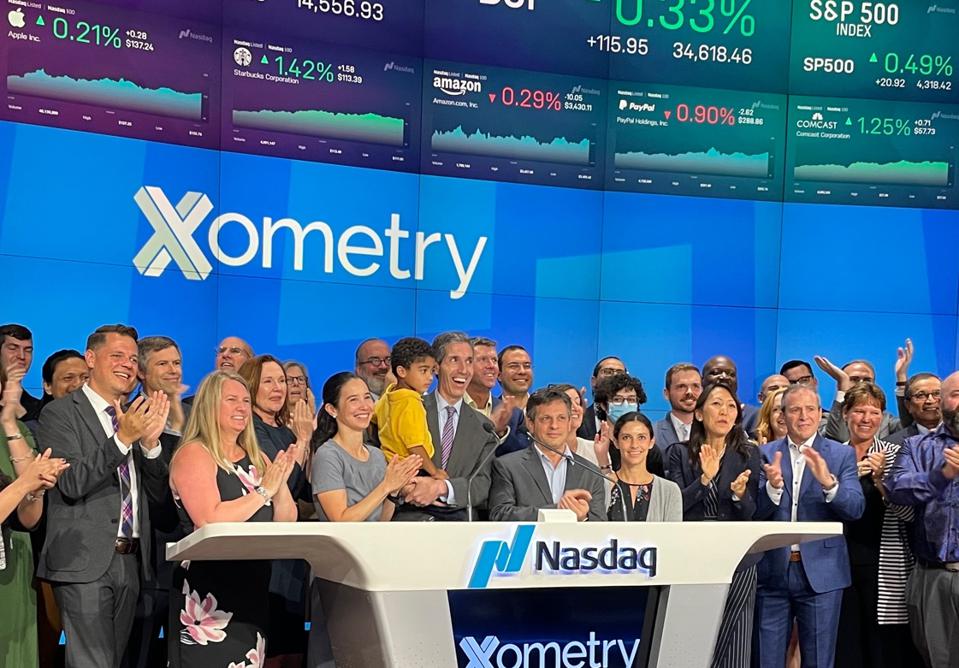
Xometry celebrates going public at the Nasdaq on June 29, 2021. Image courtesy of Xometry.
Xometry does not publicly break out revenue by manufacturing technology, so it is not fully clear how much of the company’s quarterly growth came specifically from AM versus services like CNC machining or injection molding. Still, executives discussed continued improvements to Xometry’s instant quoting and manufacturing systems, which are widely used across 3D printing and other custom production workflows. Sahni said the company’s updated lead-time prediction model now relies on a dataset “four times larger than its predecessor” and includes additional materials, certifications, and finishing options.
Outside the earnings call itself, Xometry’s recent platform updates also suggest that 3D printing continues to play an important role in the company’s broader manufacturing strategy. Over the last several months, many of Xometry’s announced updates have focused specifically on new 3D printing materials and processes. For example, in April, the company expanded its Direct Metal Laser Sintering (DMLS) offerings with new materials, including Inconel 625, Inconel 718, maraging steel, and titanium Ti6Al4V Grade 5, targeting aerospace, industrial, and medical applications. Earlier updates added new materials for Carbon DLS, Metal Binder Jetting (MBJ), SLS, SLA, and MJF systems.
That type of expansion, along with continued investments in quoting automation and lead-time prediction, points to a push toward faster and more production-ready AM workflows. The company also pointed to growing demand for certified manufacturing work.
The company also pointed to a growing demand for certified manufacturing work. According to Xometry, jobs requiring certifications increased 35% on its platform in 2025. That trend could have implications for aerospace, defense, and medical manufacturing, where qualified AM suppliers continue to become important.
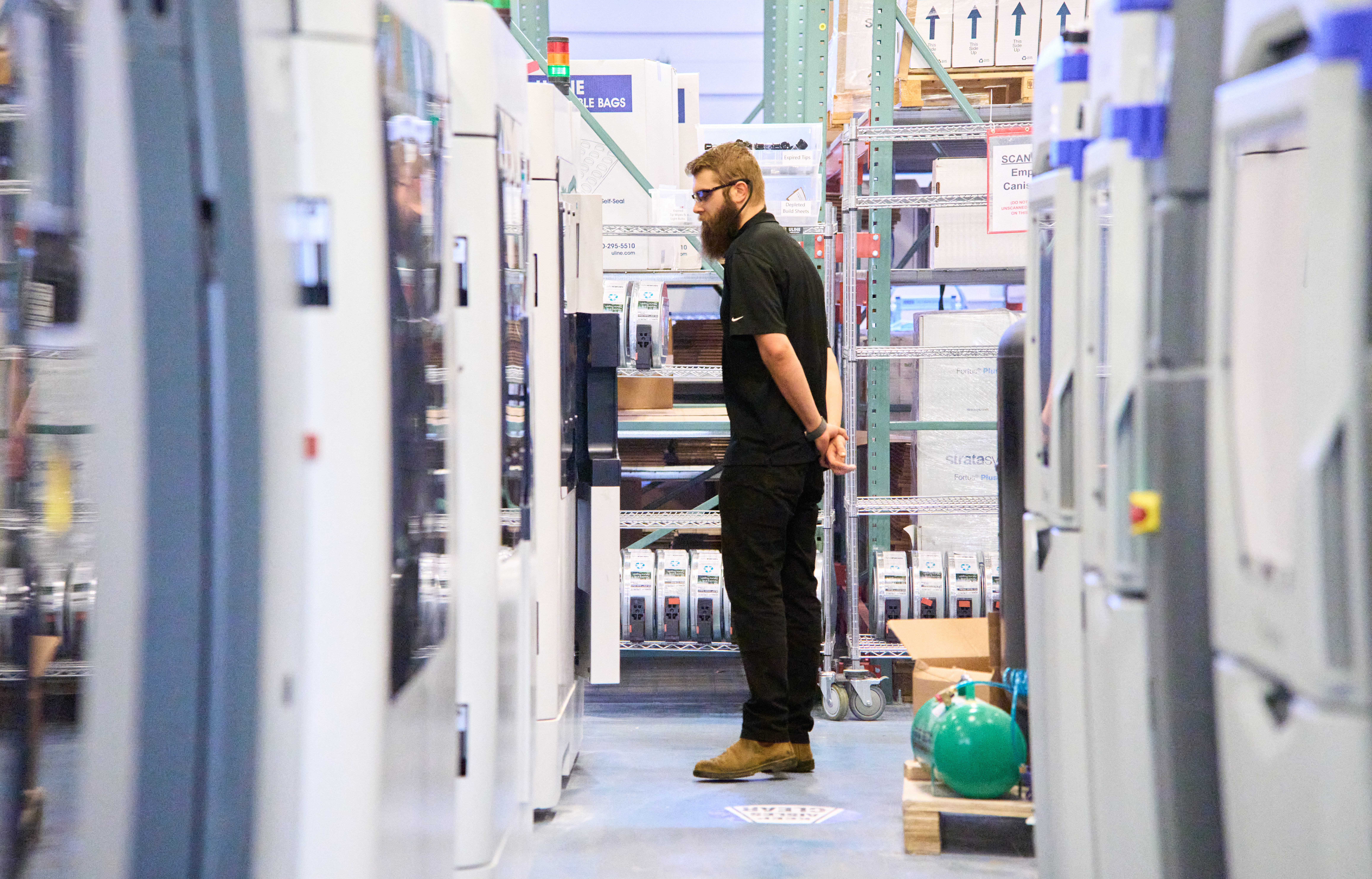
Xometry’s Gaithersburg, Maryland site. Image courtesy of Xometry.
During the analyst Q&A session, executives also pointed to strong momentum across aerospace, defense, and industrial markets. When asked about demand trends, Altschuler said growth was “very broad-based” across industries and customer segments, while noting continued demand for more resilient, flexible supply chains.
Altschuler also said the company continues to benefit from ongoing supply chain disruptions and demand for more flexible manufacturing networks: “I think it just underscores to buyers the need for resilient supply chains, the need for digital supply chain flexibility, and that’s what Xometry is.”
Overall, the results marked one of Xometry’s strongest quarters yet. Gross profit rose 39% year-over-year to $78.5 million, while marketplace gross profit dollars increased 53%. Marketplace gross margin improved to 34.7%.
The company also moved closer to profitability. Xometry reported adjusted net income of $6.9 million for the quarter, compared to an adjusted net loss of $2.5 million a year earlier. Under GAAP, however, the company still posted a net loss of $5.3 million for the quarter.
Xometry expects strong growth to continue through the rest of 2026. The company raised its full-year forecast and now expects revenue growth of 27% to 28%, up from its earlier guidance of 21%. Executives said the company continues to see strong activity across its marketplace business as more customers adopt digital manufacturing and sourcing tools.