

SWISSto12 is to work with HPS/LSS. High Performance Space Structure Systems and Large Space Structures are two separate firms that work together on large antenna reflectors. The two will work on the large deployable reflector subsystem (LDRS) for the NEASTAR-1. That satellite will be a geostationary direct-to-device broadcaster based on the compact HummingSat. This kind of platform could quickly find many applications in direct-to-device communications for the military, rescue operations, company communications, remote connectivity, and even as a kind of Starlink replacement.
Helping them on this project are ASP, AST, DLR, Tesat, Thales Germany, Jena Optronik, and Rockwell Collins Germany. SWISSto12 is continuing to leverage its 3D printing expertise to develop highly performant compact RF components, then compact satellites, and, as a European capability, now offers an alternative to US dominance in satcom.
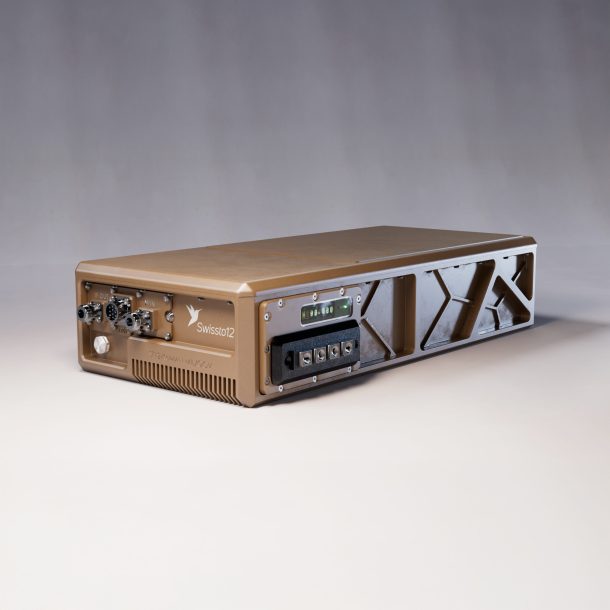
The HummingLink-SOTP, SWISSto12’s partially 3D-printed GEO satellite user terminal. Image courtesy of SWISSto12.
The European Space Agency’s (ESA) Advanced Research in Telecommunications (ARTES) program came up with the antenna, while this embodiment, NEASTAR-1-LDRS, will be mainly funded by ESA and the German Aerospace Center (DLR). SWISSto12 is hoping to win more contracts in secure communications from Germany, which seems to be looking to SWISSto12 to develop sovereign secure communications. Beyond this, there could be other countries in Europe that can no longer rely on the US for communications or sensing that could be interested in more solutions from SWISSto12.
Swissto12 CEO Emile de Rijk said that,
“Collaboration with HPS/LSS was fast and effective from the first day. We value their culture of precision engineering, deep-tech innovation, and commitment to excellence along with a drive for fast and efficient execution. They have demonstrated a strong technical heritage and proven track record in building LDRS, notably for ESA missions, underscoring the progress of ESA and DLR’s vision to develop resilient, sovereign space capabilities.”
While HPS CEO Ernst K. Pfeiffer mentioned that,
“In addition to the successful signing of another major HPS/LSS contract, we are proud to contribute to European technological sovereignty through this Swiss‑German collaboration; we are delivering tangible business results just four months after German ESA‑CM25 decisions were made.”
And Laurent Jaffart, Director of Resilience, Navigation and Connectivity at ESA, noted,
“ESA’s long-term investment in innovation and partnerships enable cutting-edge technologies to be brought to market, crucially boosting Europe’s global competitiveness, while strengthening autonomy and resilience. By leveraging Europe’s industrial excellence within two of our key Member States, this contract is a prime example of how strong collaboration will be translated into advancing the next-generation of connectivity – particularly within the direct-to-device domain.”
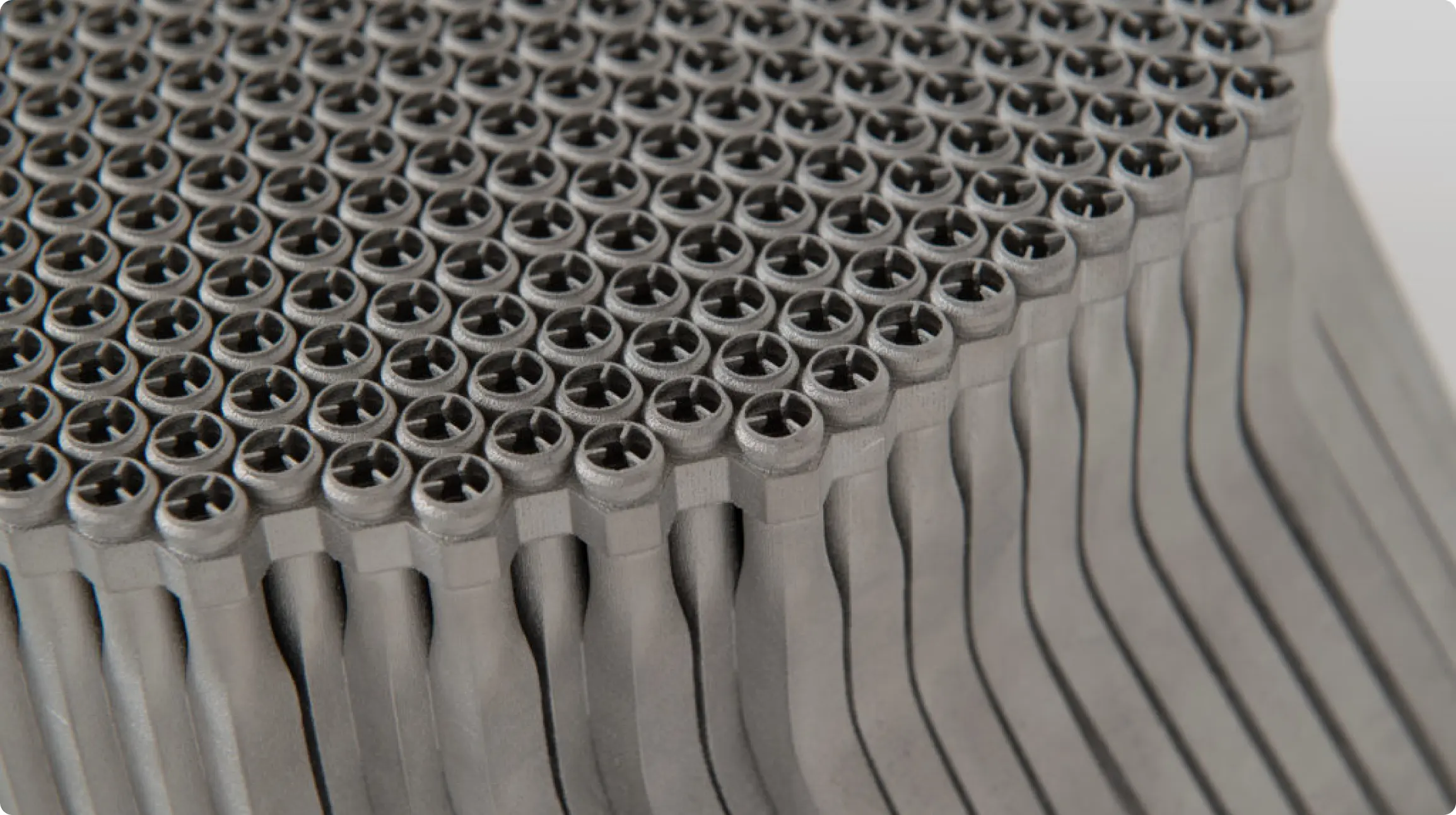
SWISSto12 uses MetalFabG2 metal 3D printers from Additive Industries to produce RF components such as this X GEO multibeam cluster. Image courtesy of SWISSto12.
This is a very timely move by ESA and SWISSto12; traditionally, European nations have relied on American signals intelligence, satellites, and communications networks. It was always assumed that the US lead in space would mean that NATO’s data and communications infrastructure would be bolted onto US infrastructure. The US has cut off aid to Ukraine, cut off intelligence sharing to Ukraine, and cut intelligence and communications access repeatedly at crucial moments. This was done with such capriciousness that no nation worldwide can rely on the US anymore. Any nation that wants to communicate securely with its own embassies or military overseas will therefore need to develop its own capability. The French, Chinese, Russians, and Israelis are probably the only nations that have this capability. For other wealthy countries, there are few options because US firms dominate parts of the global satellite industry. SWISSto12 has a unique opportunity, therefore, to offer a relatively lower-cost solution to countries worldwide.
I’m a huge fan of what they’re doing. SWISSto12 doesn’t sell machines, parts, or a solution. It makes RF and other components that fit into larger solutions, and runs an integration project in which many firms together build a satellite based in part on its technology. It’s no surprise that the company received 73 million in funding and is embedding itself in other constellation projects as well. Across the world, SWISSto12 is leveraging its 3D printing and RF expertise to become an indispensable player in the satellite market. At the same time, it becomes a lifeline for nations wishing to develop their own sovereign satellite capabilities. This is a far better strategy and far better business than most anyone in additive.