
Chromatic 3D Materials makes cost-effective, tough elastomeric materials. Its process is being used to make industrial parts at scale. Now the film has turned into rocket propellant. The firm is fire testing its propellant at the Integrated Solutions for Systems (IS4S) test site. Rocket propellant, solid rocket motors, and the structures inside rockets and missiles are a major bottleneck for Western powers at the moment. The US has for some stockpiles depleted key land attack and cruise missiles by half or a third. If the US were to attempt a large war or long conflict, it would quickly run out of rockets. With precision munitions seen as a key underpinning of US operations and strategy, there is an exploding market for rocket propellant and solid rocket engines.
Firehawk got a $60 million contract to make thermoplastic rocket propellant, while Ursa Major and others have also received major contracts. The race is on to build automated solid rocket engine production lines using additive to help shore up the US’s ability to defend itself. It’s all very money-no-object, really.

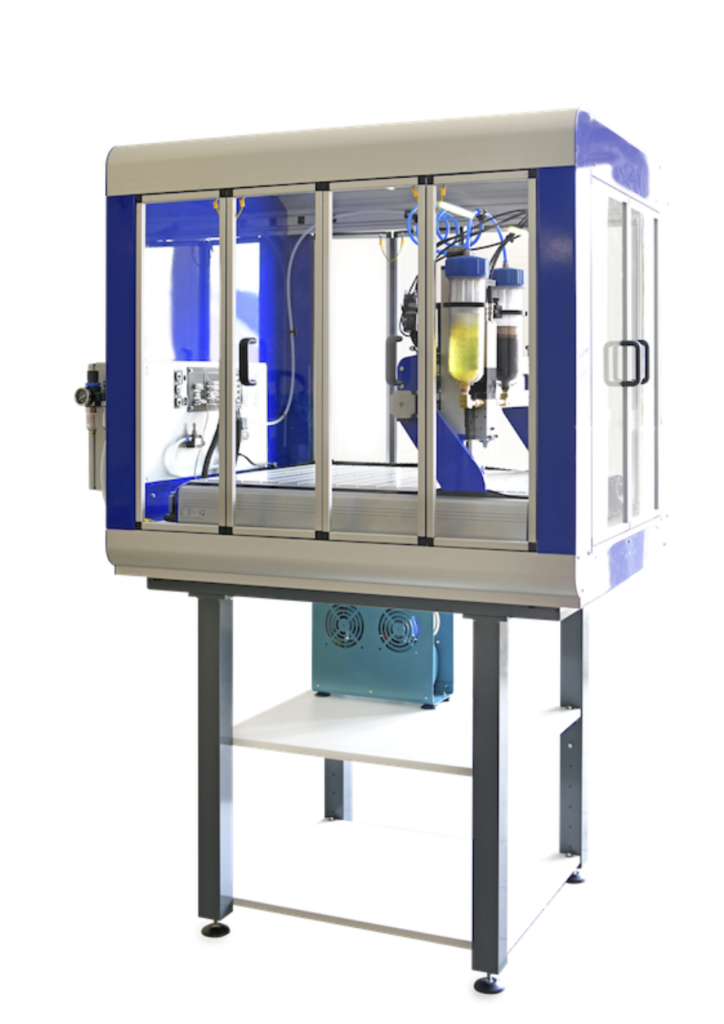
3D printer for polyurethane parts.Image courtesy of Chromatic 3D.
Chromatic states that it’s “propellant achieves energetic loading levels comparable to top-performing conventional propellants while delivering the structural integrity required to withstand highpressure combustion environments…1800 psi without structural failure.”
CEO Dr. Cora Leibig described how,
“These results demonstrate that additive manufacturing is not only viable for defense propulsion — it can drive meaningful performance gains across at least 90% of the U.S. rocket arsenal. We’re showing that it’s possible to maintain compatibility with existing systems while opening the door to rockets that fly farther, hit harder, and can be produced faster.”
The company hopes that design improvements and multi-material printing will let them surpass what is currently available. They also say that structural components could be made from propellant, opening the way to 3D printed autophage missiles we speculated about in 2024. Autophage designs could be very advantageous because parts could be even more compact, conformal, and mass-saving, while the rocket structure would largely eat itself during flight.
Chromatic hopes to extend range and increase thrust by using its Reactive Extrusion Additive Manufacturing process and polybutadiene propellant binder chemistries. These liquid prepolymers are already in use in the Ariane rocket, New Glenn, Vulcan, Sidewinder, ATACAMS, MLRS, and many other platforms. Through using chemistries (HTPB, CTPB, PBAN?) familiar to rocket engine and missile developers, Chromatic can tap into a considerable market.

Chromatic 3D printing. Image courtesy of Chromatic 3D.
Especially for missiles, 3D printed autophage rockets could be a paradigm shift in performance improvements over existing platforms. For heavy-lift rockets such as the Trident, architectures are more set in stone, so a move to those would take longer. But with Blue Origin and others in a race for the skies, some heavy-lift players could be toying with this or with the much simpler, more conformal, and compact 3D printed structures to gain an edge on competitors.
Spanish firm Supernova has a subsidiary that produces energetic materials using Vat Polymerization. That firm got a $2 million contract from DoD IAC through the Defense Technical Information Center, part of Mantech. Perhaps Chromatic could secure similar contracts. Chromatic has a European arm, too. There should be European interest in this as well. But there isn’t really any Europe that seems content to have history wash over it while it eats sandwiches. Chromatic could have a real winner of a product if their results bear out. Low cost, familiar chemistry, and better performance are really what everyone needs right now. Chromatic can print on relatively simple machines as well, so scaling this to high-value, high-speed production at volume should be very doable. Rocket propulsion availability is a huge headache for many forces worldwide, while it is also a huge opportunity for many space companies. We should see this segment heat up in the coming months.