
Researchers at the University of Oxford are getting closer to building brain-like tissue with 3D printing, improving how cells can be organized into structures that resemble the human brain. The update comes as the Oxford Martin Programme on 3D Printing for Brain Repair reaches the end of its five-year run, offering a clearer picture of what the team has been able to achieve so far, and what still remains out of reach.
Launched in 2020, the program explored how additive manufacturing (AM) could one day help treat brain injuries and diseases. Now concluded, it points to a series of research advances, rather than a single clinical breakthrough or product. The team isn’t repairing brains yet, but they are learning how to build something that looks a lot more like real brain tissue than before.
At the center of this progress is structure.
For years, scientists have been able to grow brain cells in the lab. They’ve even used 3D printing to place those cells into soft, gel-like materials, though the results often looked more like clusters than actual tissue. But the human brain is highly organized. In the cortex, neurons are arranged in layers, with different types of cells and connections stacked in a precise way that allows the brain to process information.
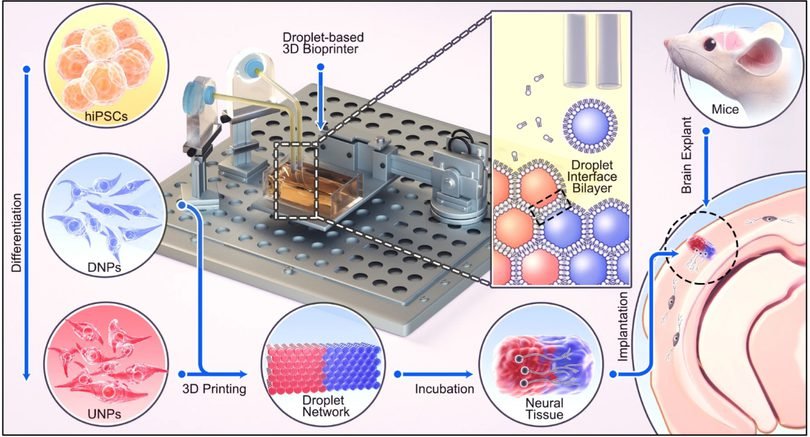
What the Oxford team has done is start to recreate that organization. Using human stem cells, the researchers generated different types of brain cells and used 3D printing techniques, combined with microfluidic systems, to place them into layered arrangements that resemble parts of the brain’s cortex.
Instead of relying on a commercial bioprinter, the team used a custom-built droplet-based system that ejects tiny cell-containing droplets, giving them finer control over how the tissue is assembled. So at the end of the day, instead of having random blobs, the result is something much closer to a controlled, multi-layered structure. The approach combines aspects of bioprinting with controlled fluid delivery, allowing cells to be positioned more precisely than in earlier scaffold-based or organoid-style models.
And importantly, the cells stayed alive, held their shape, and even started to interact. Some cells extended connections while others moved between layers. It’s still early, but these are the kinds of behaviors researchers expect to see in real tissue, not just a lab model. For now, the work is happening entirely in vitro, in the lab, with no animal or human testing yet.
That progress addresses one of the biggest challenges in bioprinting: not just printing cells, but organizing them correctly. While the program has produced multiple research outputs over its five-year span, the latest update reflects a broader body of work rather than a single newly published paper, pointing to what the team is calling “incremental gains in structure, cell behavior, and reproducibility.”

The printed cerebral cortical tissues were cultured in vitro for functional studies and implanted into the mouse brain for studies of brain repair. Image courtesy of Zhou et al., Advanced Materials, 2020/University of Oxford.
Right now, the most immediate use for this kind of work is research, because better brain-like tissue models could help scientists study how the brain develops, how diseases progress, and how different drugs affect human cells. That matters because the brain is one of the hardest parts of the body to study directly. So having more realistic lab-grown models could speed up research in areas like neurodegeneration, trauma, and developmental disorders. This is where much of the bioprinting field already operates today, with printed tissues increasingly used in drug discovery and testing, even as more complex organs remain out of reach.
The work is part of a broader effort led by neuroscientists Zoltán Molnár and Francis Szele, in collaboration with Professor Hagan Bayley, a leading figure in molecular bioengineering at Oxford, and Oxford Martin Fellow Linna Zhou.
The long-term vision for the field, of course, is more ambitious. If scientists can reliably build structured brain tissue, the next question is whether that tissue could one day be used to repair damage caused by stroke, injury, or disease. Reaching that point would require major advances, including vascularization, long-term functionality, and safe integration into the body—challenges that researchers across the field are still working to solve. So no, this is not brain repair. Not yet. But it is a sign that bioprinting is moving into a more advanced phase. The field has already shown it can print tissues for testing, and is now pushing toward more complex ones (like brain tissue) that need to be structured and functional. Work like this reflects that shift, where the focus is less on whether cells can be printed, and more on whether they can be organized into something that truly behaves like living tissue.