
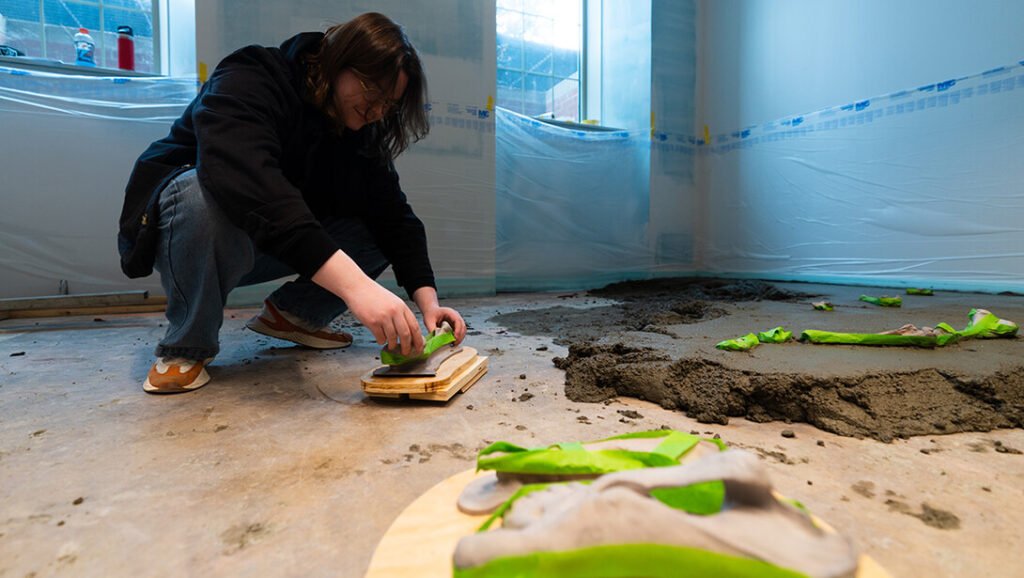
At the University of Nebraska–Lincoln, a team inside the Frontier Tech Lab has built one of the most engaging examples of additive manufacturing (AM) in education right now. Led by lab coordinator Isaac Regier, the team created a fully hands-on fossil dig experience inside the museum. Using 3D printing, they reproduced real fossils from the museum’s own collection, along with the surrounding rock and sediment, so visitors can dig up bones just like paleontologists would. The work is part of a broader renovation of the museum’s Paul D. and Betty Marx Discovery Center, set to open in June, which is adding more hands-on activities focused on “nature’s engineers.”
Instead of placing rare, fragile fossils in a pit where they could be damaged, the team recreated them using 3D printing, creating a space where visitors, especially kids, can dig, touch, and explore without limits. And to this team, that’s the key idea, having access to these fascinating experiences. Because nothing drives interest in things like ancient fossils quite like being able to actually handle them. It’s a change we’ve been seeing for some time in museums around the world, moving beyond the “look but don’t touch” rule toward spaces built for real, hands-on discovery, or play, even.
Real fossils are incredibly delicate. Many are one-of-a-kind, and we’ve seen some so valuable they’ve sold for hundreds of thousands, even millions of dollars. You don’t hand them to a six-year-old with a brush and say, “Go for it,” right? But with 3D printing, you can create accurate replicas that look and feel real, or real enough, to teach the same lessons, without the risk of having the fossil break.
The Frontier Tech Lab worked closely with museum scientists to produce lifelike fossil replicas and even entire fossil beds, turning what could have been a more traditional exhibit into something hands-on and immersive. To recreate the fossil bed, the team produced more than 100 realistic fossilized bones. Many of these are based on Menoceras, a rhino species from the Miocene era discovered at Agate Fossil Beds near Harrison, Nebraska.
A museum built for discovery
This “experience replication” meant the team didn’t just scan a fossil from the collection and hit “print.” In fact, they recreated the entire context: the way paleontologists find fossils in the ground, the textures, even the arrangement, so visitors can understand how these incredible, headline-making discoveries actually happen.
And that’s because in paleontology, the story isn’t just about the fossil. It’s about where it’s found, how it’s uncovered, and what surrounds it. By printing these entire dig environments, not just objects, the lab is using 3D printing to tell a story. And it works really well.
They’re using a mix of realistic fossil types tied to Nebraska’s paleontology, which is actually pretty rich. That includes ancient mammals (Nebraska is well known for Ice Age fossils like mammoths), smaller vertebrates, and general fossil fragments that reflect what a real dig site looks like. So rather than “digging up a full dinosaur,” visitors are uncovering partial bones and pieces, which is much closer to how real paleontology works.
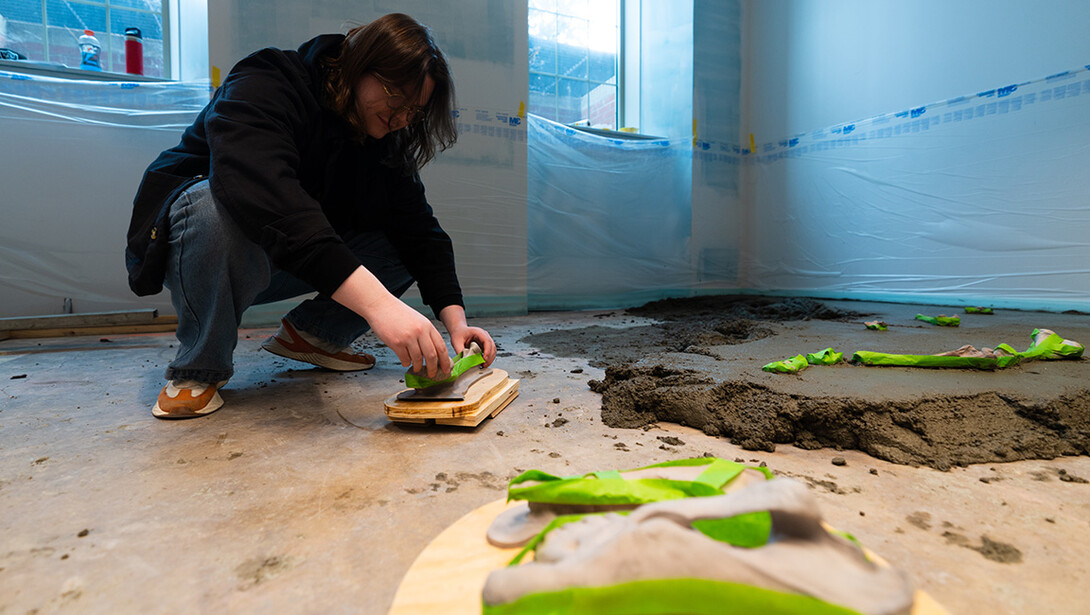
Isaac Regier, lead and design coordinator for the Frontier Tech Lab, sets down one of the “bones” the lab 3D printed for a new fossil dig in the redesigned Marx Science Discovery Center at Morrill Hall.
The museum, part of the University of Nebraska State Museum, has been around since 1871 and houses one of the largest vertebrate fossil collections in the United States. In fact, it’s known for its massive displays, like its mammoth skeletons in Elephant Hall, and for telling the story of life across millions of years.
But like many museums, it faces a common challenge, and that is how to make ancient history feel real to someone walking in today. And this 3D printed fossil dig changes that whole perspective. Instead of looking at bones behind glass, visitors become part of the process. They have to kneel down, use brushes to remove the sediment, and find something. Visitors will find this hands-on fossil dig experience inside Morrill Hall, as a type of interactive station built right into the museum floor.
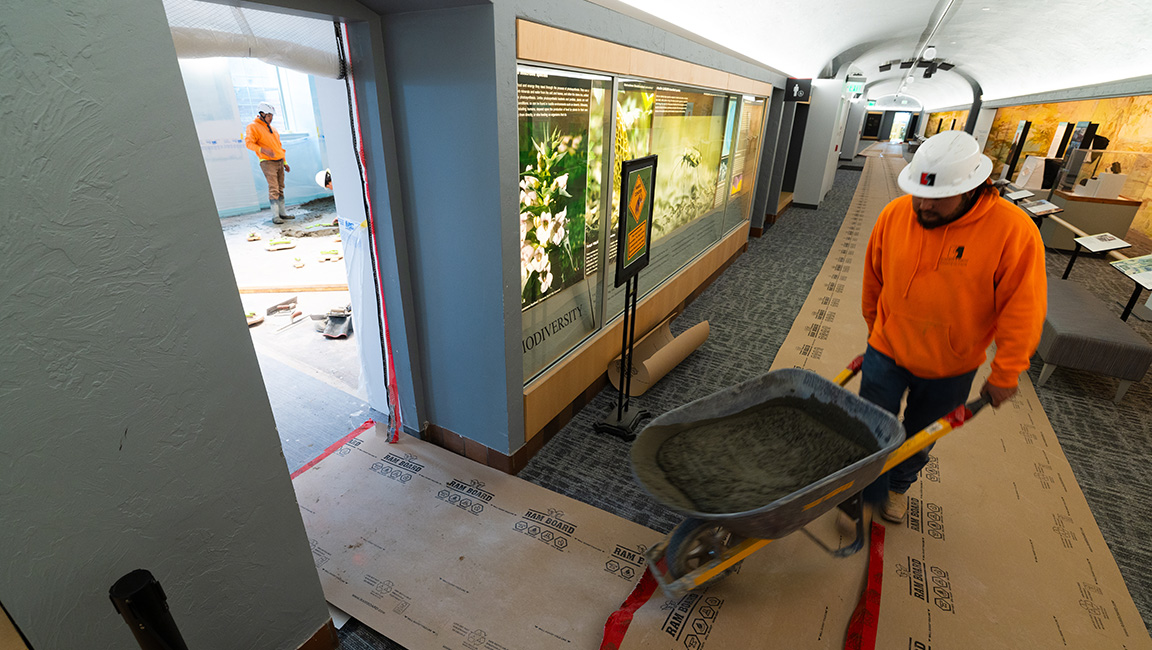
3D printed fossils.
The Frontier Tech Lab itself is part of Nebraska Innovation Studio, a collaborative space where engineers, designers, and researchers work with advanced manufacturing tools, including 3D printers. Launched in October 2025, the lab operates as a full-service prototyping, design, and fabrication center, working with campus units, municipalities, businesses, and individuals.
The team had to take real scientific data and turn it into something people can actually use, strong enough to handle, simple enough to understand. That’s not easy. A fossil replica has to look real, but it also has to hold up after being dug up over and over again. That level of accuracy required close coordination with museum experts, including Susan Weller, who noted the complexity behind even the smallest details.
“They worked closely with our scientists to create the bones and ensure they were placed in the correct order and orientation,” Weller said. “There are many tiny bones when you think about the vertebrae or toe bones, and they can get very confusing to those of us who don’t work with those bones. (Frontier Tech Lab staff) went above and beyond, and they delivered everything on time and on budget.”
In this case, 3D printing is enabling something different. It’s making the inaccessible accessible. And here, that means giving someone, maybe a child visiting for the first time, the chance to uncover a fossil and feel, even for one single moment, like they’re discovering the past for themselves. It’s not just a better exhibit, it’s a better way to learn.
Images courtesy of the University of Nebraska–Lincoln