
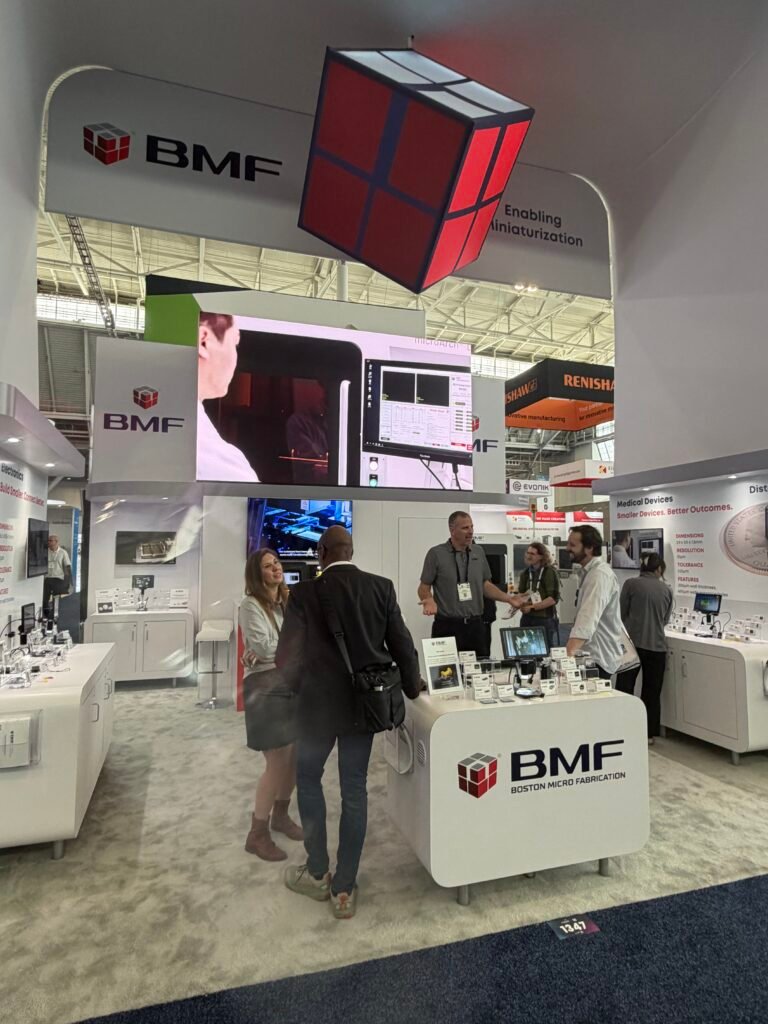
They say that good things come in small packages, and that’s certainly the case when it comes to Boston Micro Fabrication (BMF). A leader in micro-precision additive manufacturing, the company uses its proprietary PμSL (Projection Micro Stereolithography) technology to power its range of 3D printers. I spoke to CEO John Kawola at RAPID+TCT 2026 to learn more about the company’s latest innovations.
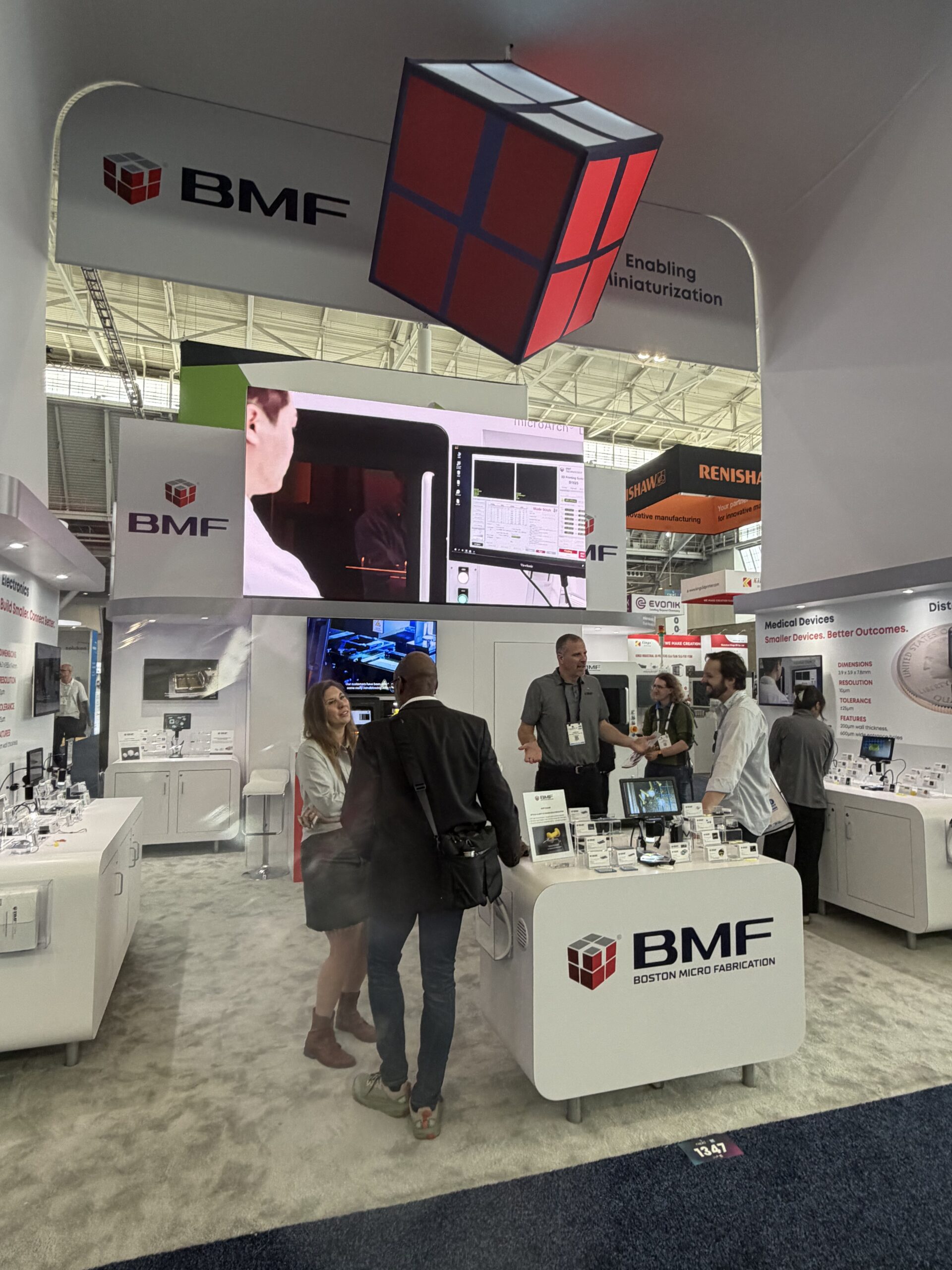
BMF booth at RAPID+TCT 2026.
BMF’s place in the industry is for “very, very high precision” parts, with small features and high tolerances, “typically the types of tolerances that are beyond the reach of Formlabs or 3D Systems or others.”
“Typically, because of that level of precision, it also means generally smaller parts, where people need very fine features or holes or need to hold tolerances in the tens of microns type of size,” Kawola explained.
Just last month, the company launched its microArch S150 Series of 3D printers. Kawola told me that the two compact, 25 µm systems in the series are “much more benchtop, simpler to set up and use.”
“The main purpose of this is it’s much easier to use, much easier to calibrate, with more consistent results,” Kawola told me.
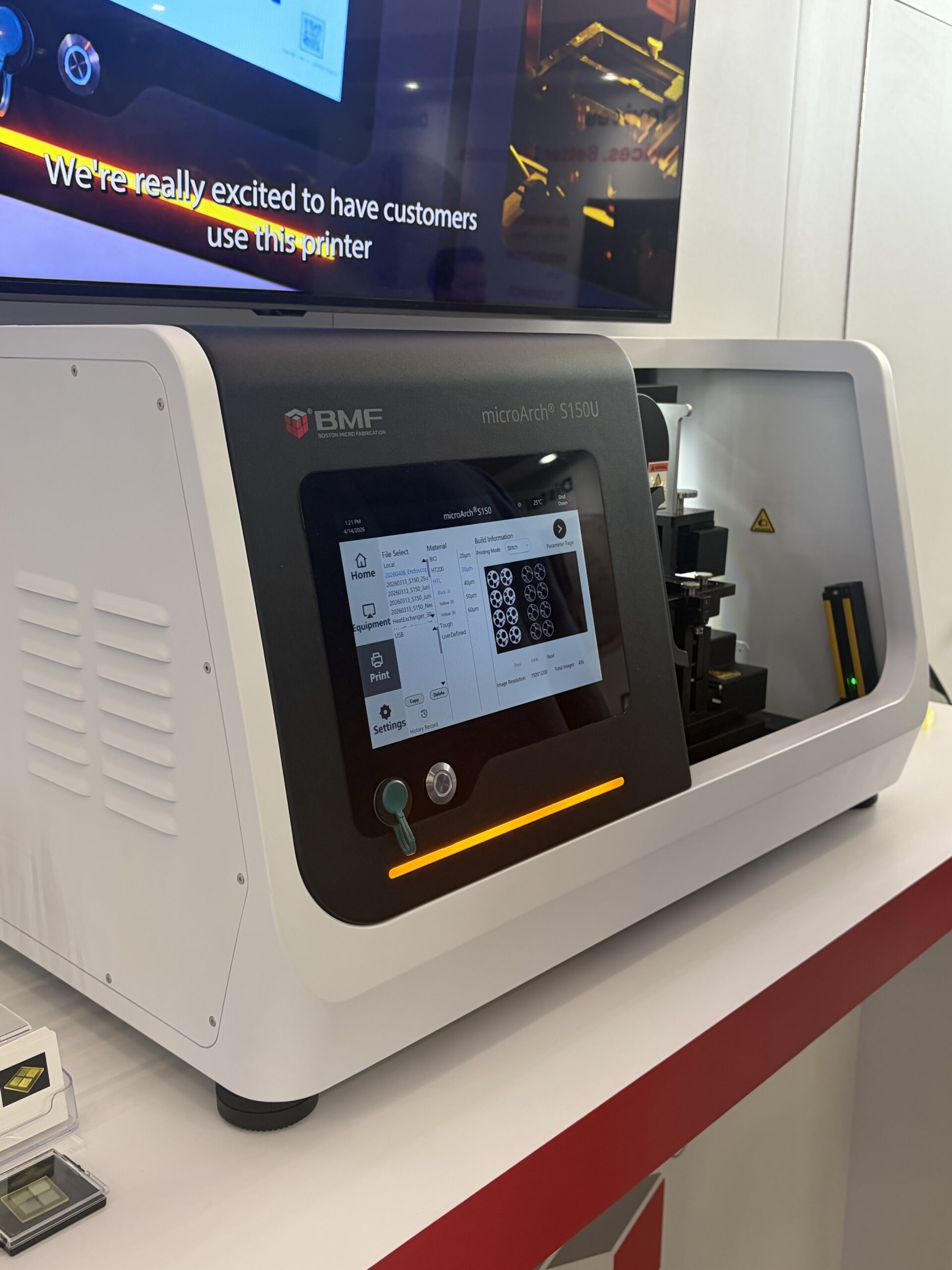
BMF’s microArch S150 at RAPID+TCT 2026.
There are two versions of the desktop microArch S150 3D printer. The S150 works with BMF’s normal range of materials, while the S150 Ultra has a more limited material range, but operates nine times faster than the S150.
Kawola explained that with many DLP technologies, the speed of the printer is “driven by how thick the resin is.”
“If the resin is thick, it takes a longer time to refill and recoat. So that slows things down,” he said. “If the resin is thin, it goes faster.”
BMF booth at RAPID+TCT 2026.
There aren’t many discernible differences between the microArch S150 and S150 Ultra, but BMF customers know what they want, and can request the Ultra if they need that extra speed.
“Depending on what they care about the most, whether it’s higher throughput of a number of parts, or they need more parts per week or per day, they might opt for the faster one,” Kawola said. “It also depends on what they’re going to do with the parts, if they’re prototyping or doing more long-range testing.”
The new S150 series is available in the $50,000-$60,000 range, “depending on which one you choose.”
Other features include:
- 80 x 48 x 50 mm build volume
- 10–100 µm layer height
- 25 µm optical resolution
- ±3 µm positional accuracy
- Automated calibration & leveling
- CE-certified
- HEPA13 filter
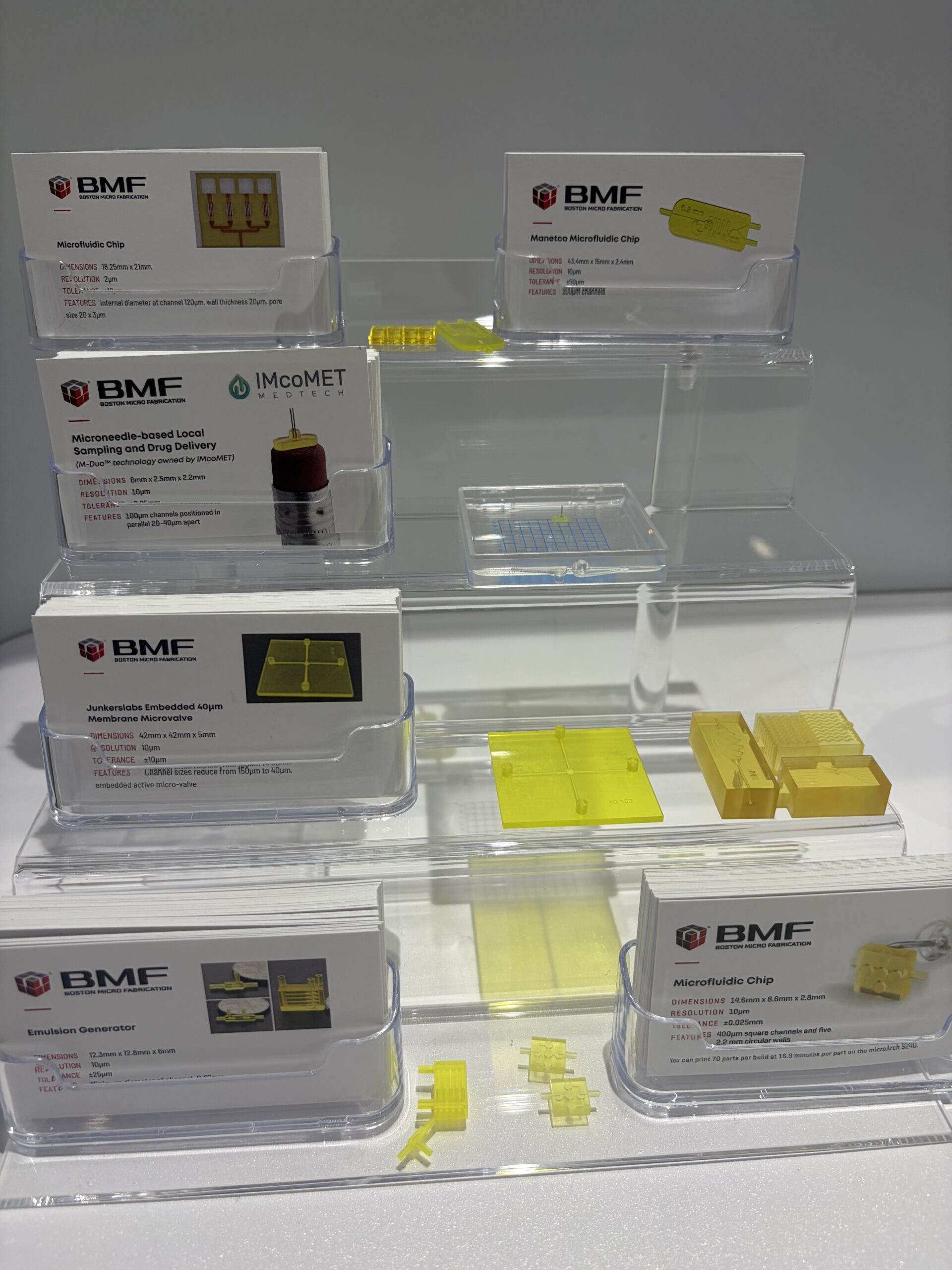
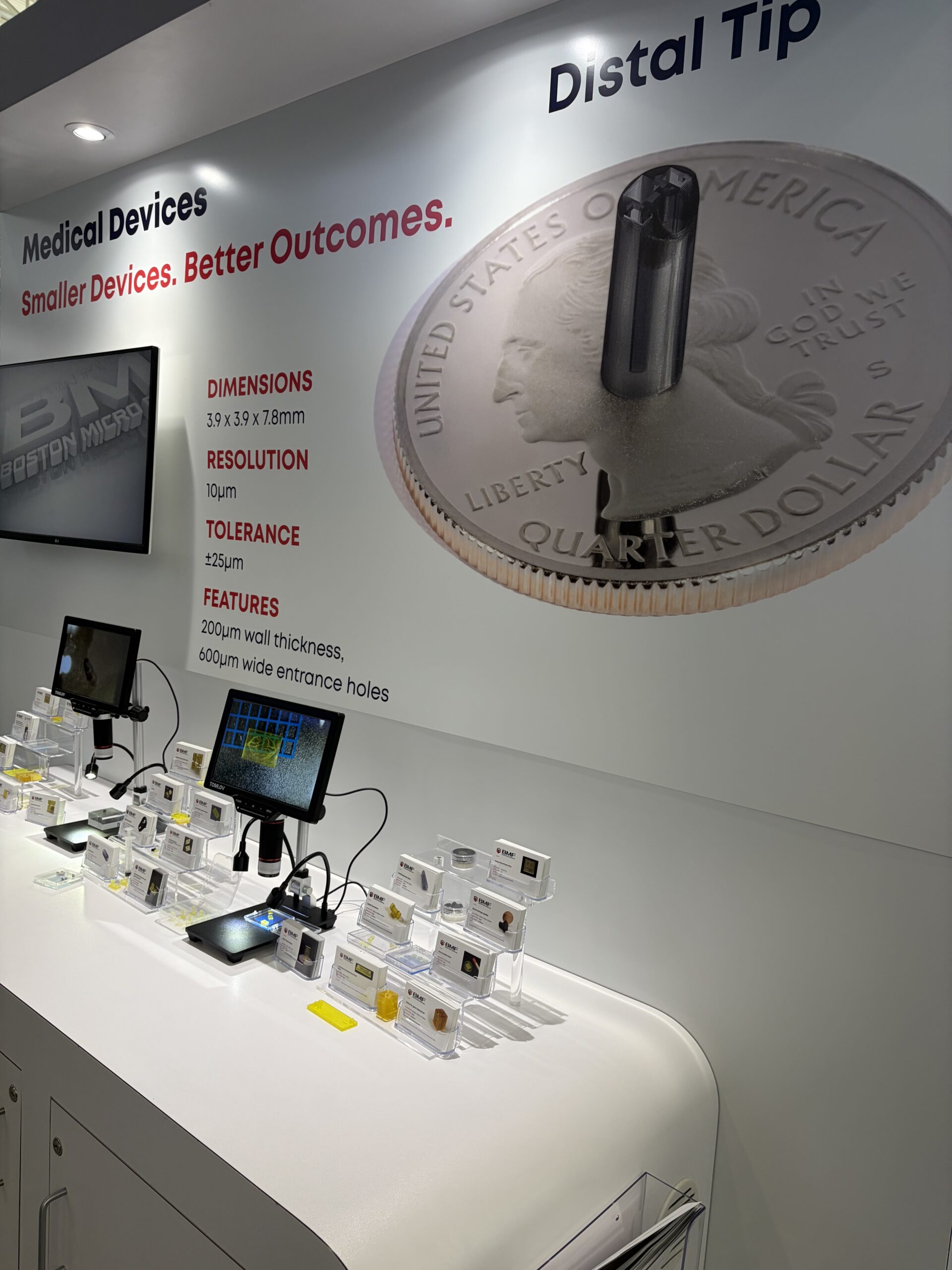
Medical device applications at BMF’s RAPID+TCT 2026 booth.
There are two main applications for BMF’s printers, and especially the new S150 series, one of which is medical devices. BMF prints a lot of drug delivery devices, sensors, and medical tools. One example is a distal tip, which is a disposable item that goes on the end of an endoscope and is thrown away once once the endoscopy is complete.
Microfluidic devices for drug screening and testing, as well as liquid connectors, are some other examples.
“We can do very thin channels, down to 50 µm diameter, which is valuable,” Kawola said. “We have a whole range of customers that are doing devices, and the tool to insert the devices, for the eye, the ear, and also in some cases, neurosurgery.”
No matter which one of these devices customers are working on, the main point is “they want these things to be small,” so they’re less invasive, and the recovery time is faster.
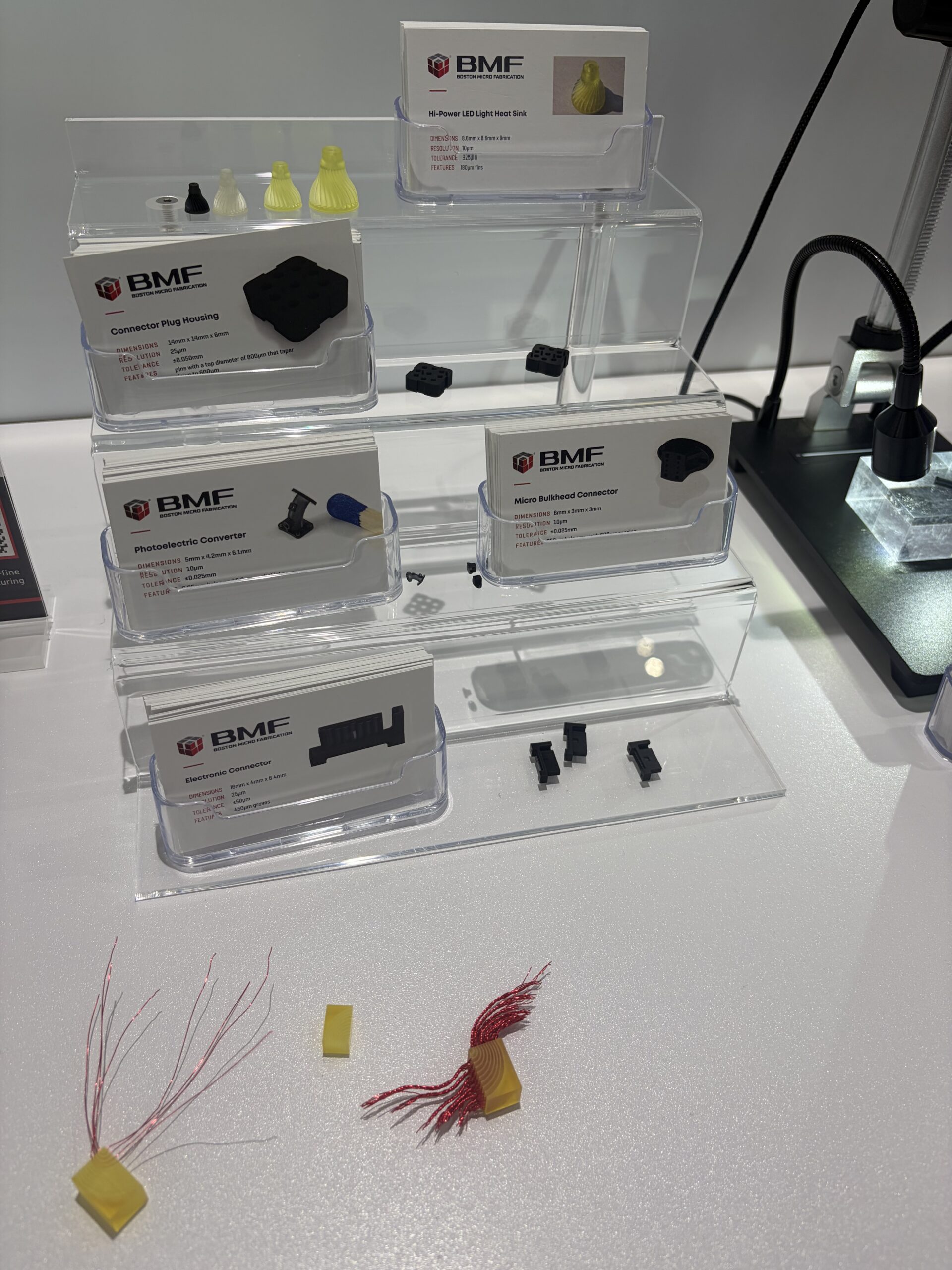
Electronics applications at BMF’s RAPID+TCT 2026 booth.
On the opposite side of the booth were examples of the company’s other main application: electronics. Kawola showed me tiny parts like electrical connectors, housings, and chip sockets for “a whole range of customers in the electronics area.”
“Again the theme is, things are getting smaller,” he said. “Or, if the end device is not getting smaller, there’s more stuff in it. There’s more connectors, there’s more memory, there’s more chips.”
Kawola said that while most of BMF’s work is in resins, “trying to approximate plastic,” the company also has a whole range of applications in ceramic materials, like alumina ceramic and zirconia ceramic, for highly abrasive or high-temperature parts. He showed me a chip with a 100 µm diameter and 20 µm wall thickness, which is “very difficult to do in other ways.”
BMF doesn’t offer metal 3D printing, but it can metallize parts by plating them with materials like copper or nickel. Since the company doesn’t have this capability in-house, Kawola said they generally use a Maryland company called RePliForm to plate 3D printed parts.

BMF Clear is an optically transparent photopolymer resin delivering 90% light transmission and micron level accuracy for complex, internally structured micro scale devices. Image courtesy of Boston Micro Fabrication.
Speaking of materials, the company also launched its new BMF Clear just before RAPID. It’s a biocompatible, optically transparent resin capable of 10 µm layer heights, and a great choice for optics, photonics, sensors, microfluidics, biomedical devices, and more.
It’s historically been very challenging to achieve full transparency in 3D printing, especially at the micro level, because of material absorptivity and surface roughness, which causes light to diffract. But BMF says its new resin offers greater than 90% light transmittance, which means that there will be opportunities for scalable manufacturing with applications like complex micro-scale devices and integrated optical features.
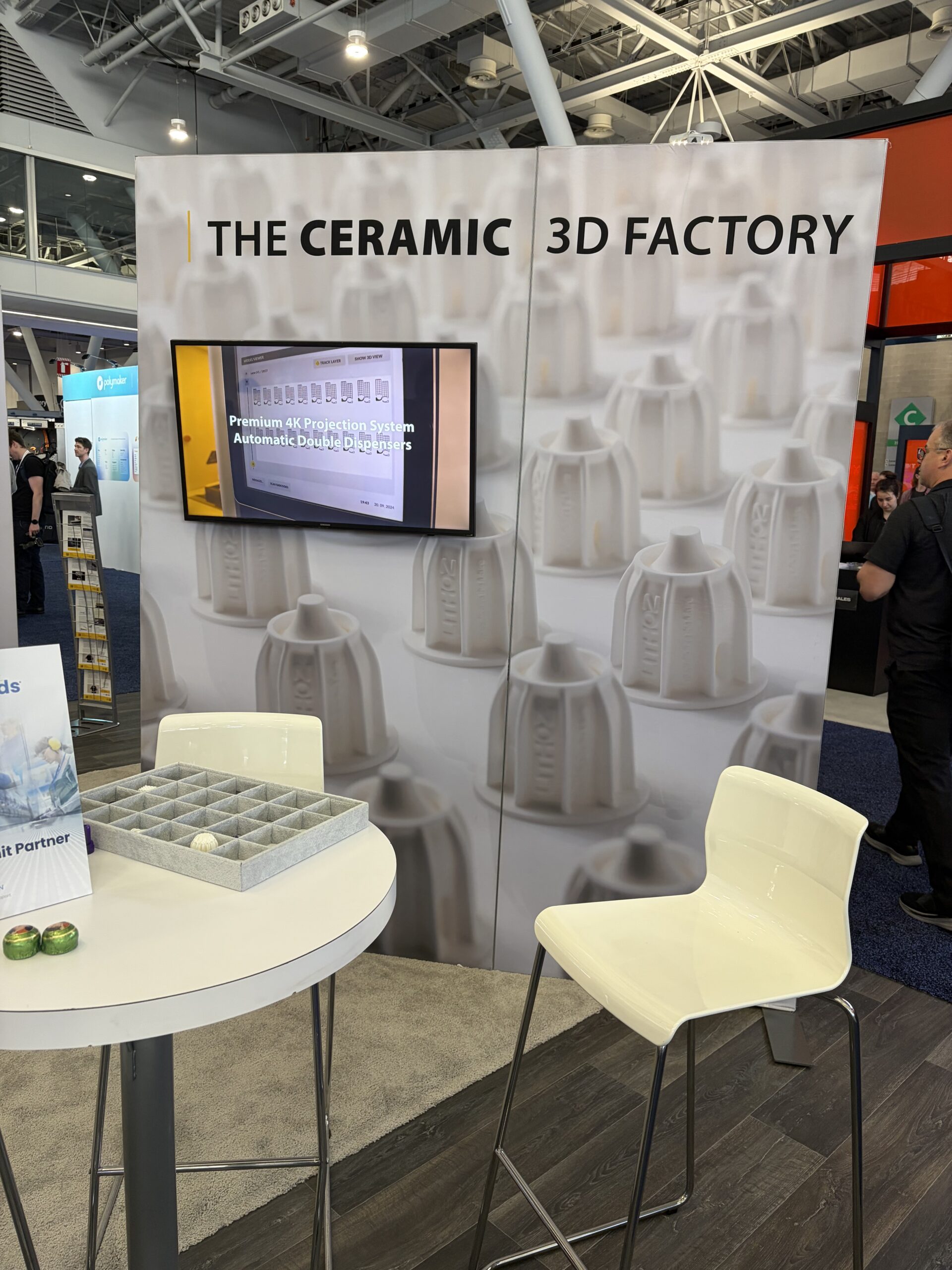
Lithoz booth at RAPID+TCT 2026.
While ceramics 3D printing is just one material option with BMF, it’s the main focus at Lithoz, a leader in ceramics 3D printing based in Austria and the U.S. Norbert Gall, Head of Marketing and Public Relations for Lithoz, showed me some of the applications on display at the RAPID booth.
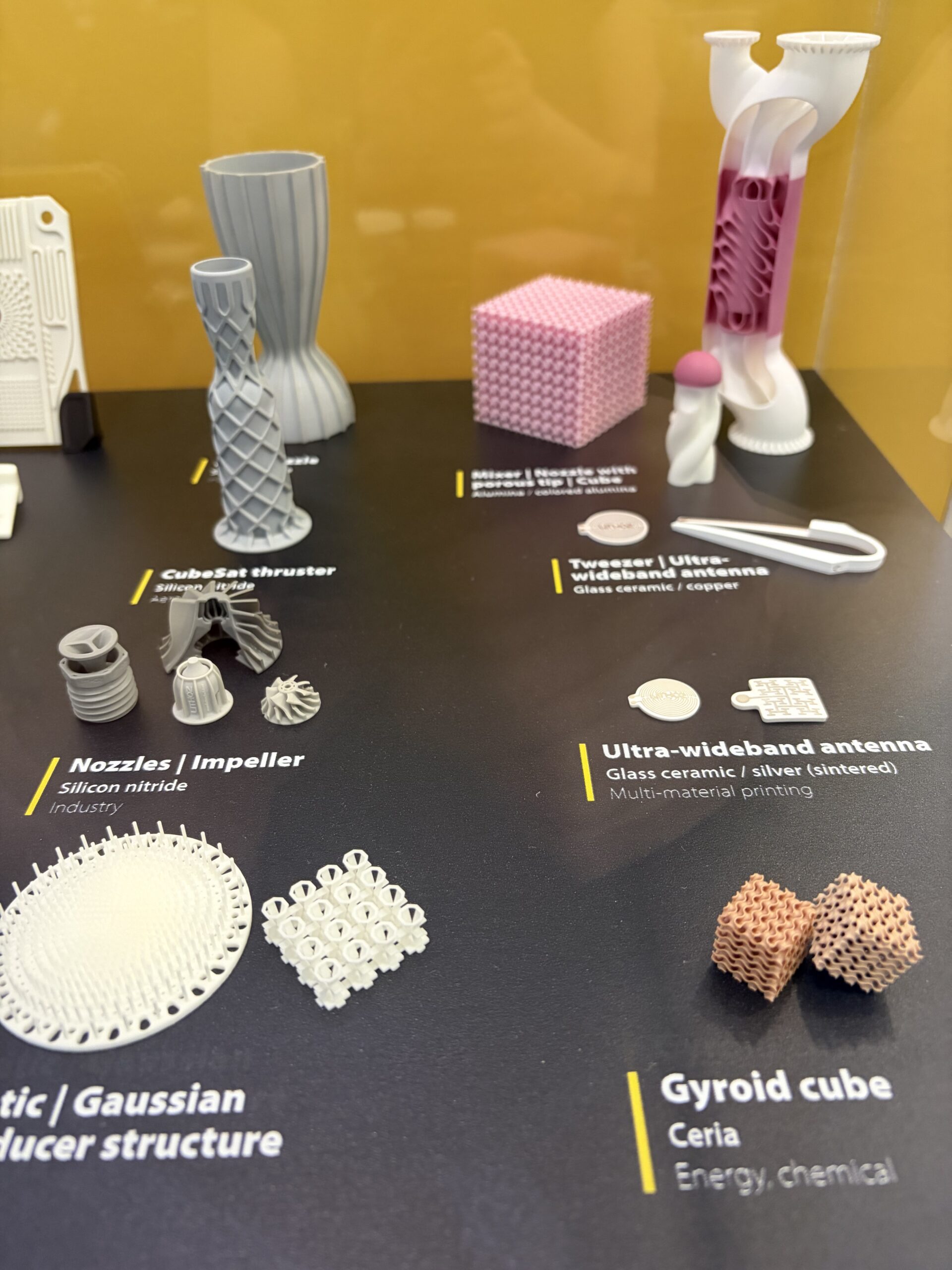
Lithoz booth at RAPID+TCT 2026.
Several of the parts are for the medical sector, such as bioresorbable implants. This included a very tiny 3D printed implant for one of the three ear bones (auditory ossicles).
“All of these are used in case the body is not able to recreate itself on its own,” Gall said about the company’s implants. “Surgeons talk about critical size defects, which means that if it’s too large, the body cannot make sure that it can grow by itself. So we have to bridge it with this type of bone-like structure, so the body has a support, like a ladder that it can climb along. The human tissue can grow through it, and will replace the actual implant.”
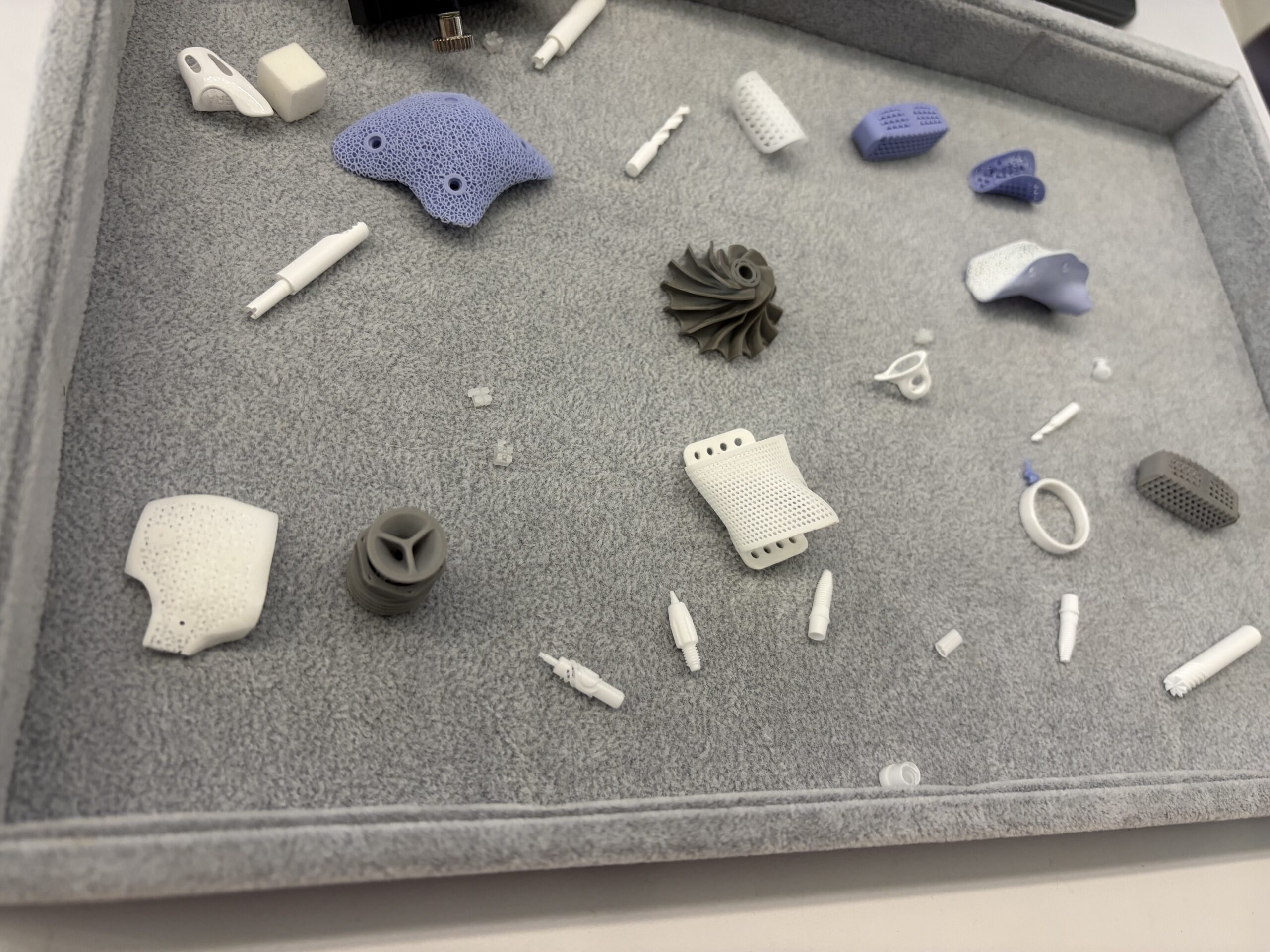
Ceramic 3D prints at the Lithoz RAPID+TCT 2026 booth.
He explained that the structures of these implants can be designed in such a way that you can control the speed of healing. This makes a big difference, especially when it comes to the age of a patient. Because children grow so quickly, a surgeon would likely want a faster healing process to quickly close the defect, while elderly patients can take more time healing because their bones are no longer growing.
Another positive about bioresorbable implants is that they naturally dissolve in the body. So patients only need one surgery to actually get the implant, and then that’s it, they don’t need to have the implant removed later.
“In the case of a five-year-old child, you would probably have to replace your titanium implants a couple times. And you can imagine the traumatization,” Gall said. “Those children suffer lots, and they will remember their whole life.”
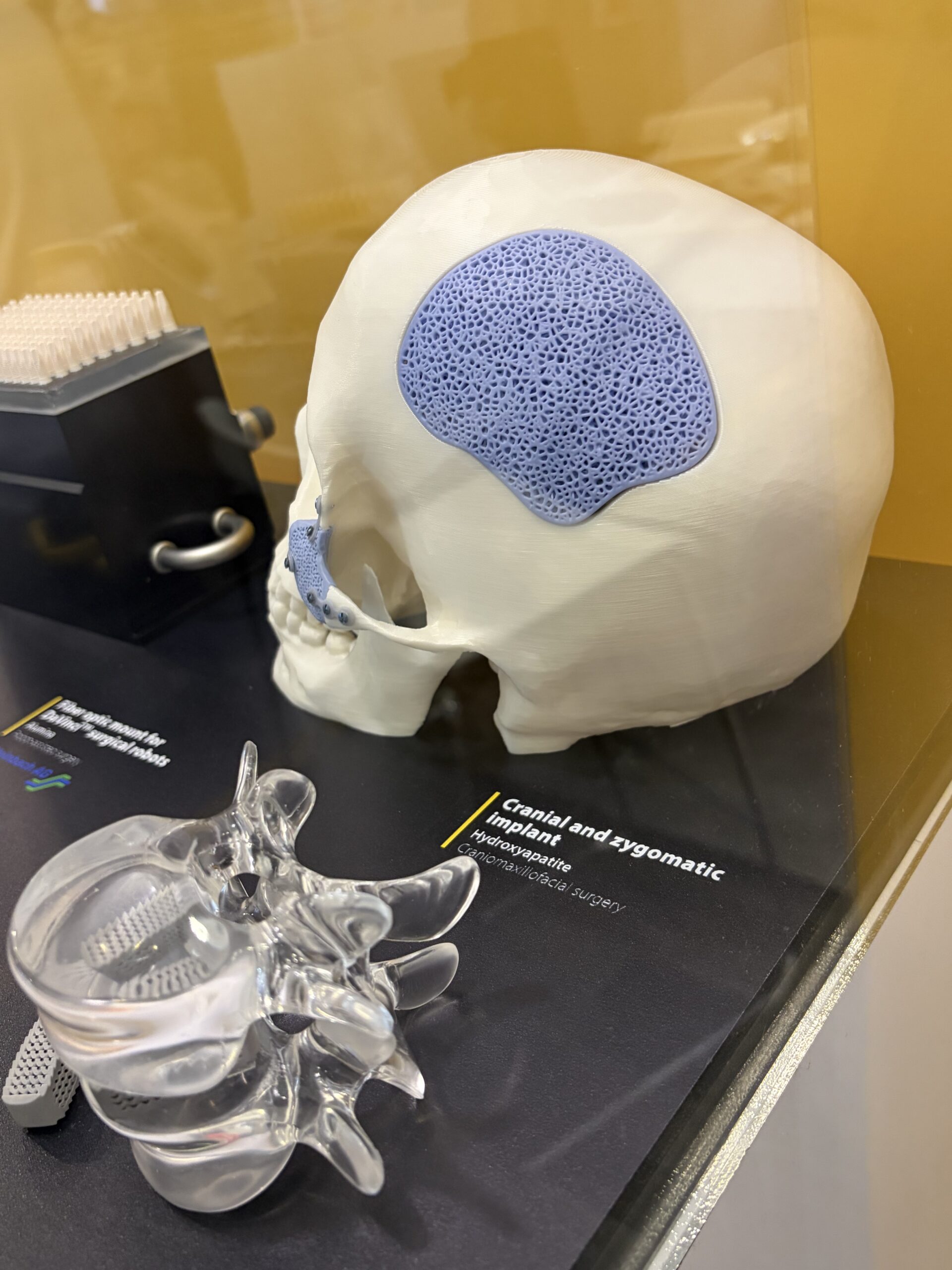
This is “Herb,” at the Lithoz booth at RAPID+TCT 2026.
Gall brought up longtime Lithoz customer KLS Martin, which says it has used these ceramic 3D printed implants “approximately 350 times in real patients in Europe,” and is actively working to break into the U.S. and Australian markets. He also said that “the curve of distribution of this product” for KLS Martin is “double digit growth per month,” which is pretty impressive.
“I think it’s one of the best examples of how we can really innovate a sector, because it’s an emotional topic, and you can imagine suffering is something that everyone knows. In terms of different kinds of surgical tools and components, everyone says, ‘Yeah, it’s fascinating,’ but it doesn’t really move you, ” he said.
I fully agree with this.
Gall also explained that Lithoz and KLS Martin are working together to try and make bigger versions of the 3D printed cranial implant you can see on “Herb” in the above image.
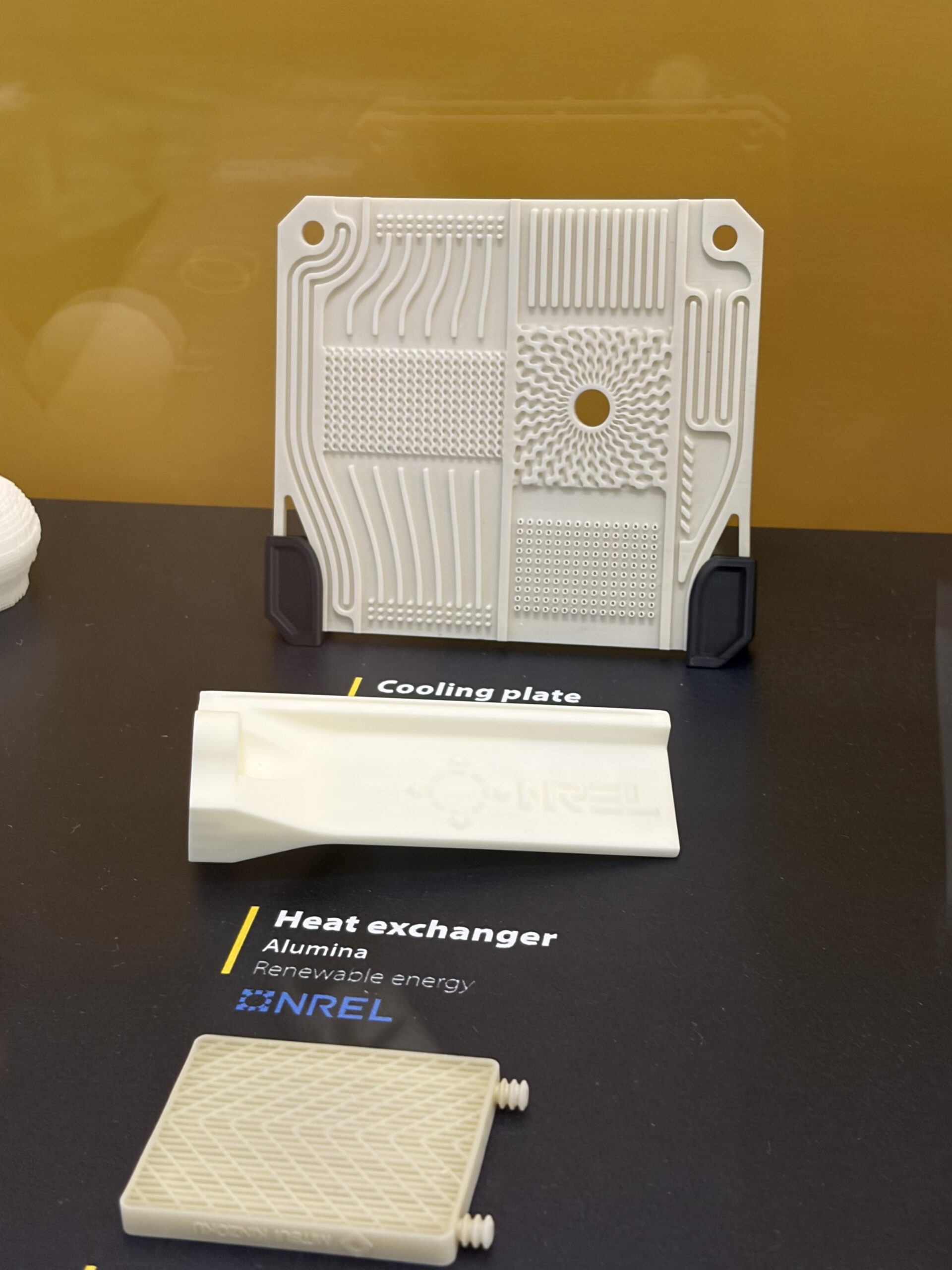
Aluminum nitride cooling plate demonstrator at the Lithoz RAPID+TCT 2026 booth.
Lithoz doesn’t just work in the medical sector. Gall also showed me a cooling plate for the semiconductor industry that the company 3D printed out of its aluminum nitride (AIN) material, LithaFlux. The one he showed me was a demonstrator, not a functional part, as the various patterns on the plate are not realistic for the actual application.
Measuring 100 x 100 mm, the real cooling plate, with its precise inner channels, is the biggest AlN part printed on a Lithoz CeraFab printer.
“It’s the biggest aluminum nitride part we have ever created,” he said. “People are really impressed by the size, combined with the magic of 3D printing.”
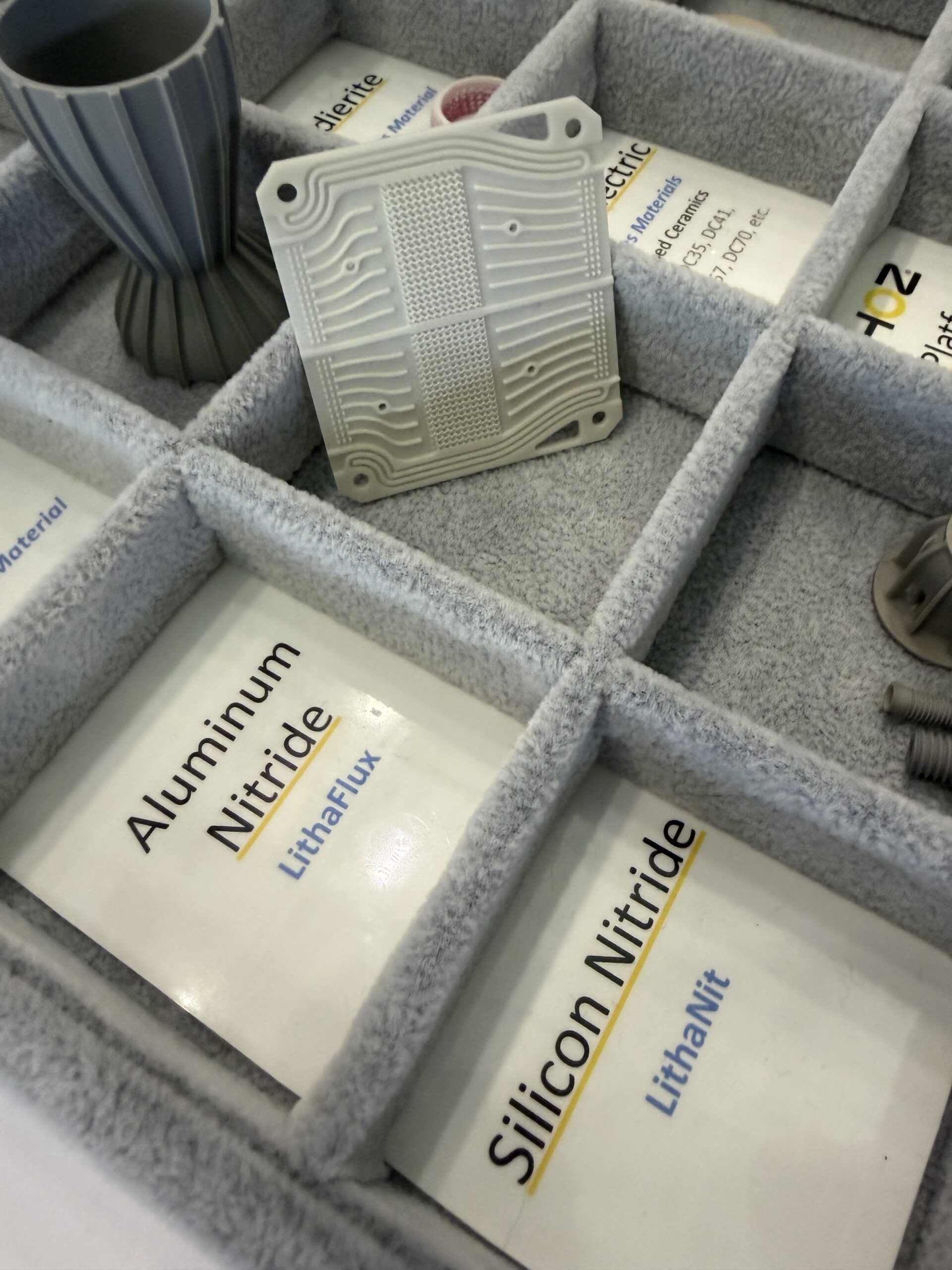
Aluminum nitride cooling plate demonstrator at the Lithoz RAPID+TCT 2026 booth.
Obviously, BMF and Lithoz offer very different 3D printing technologies, but the attention to detail for applications in industries that require precision is a big similarity.
Images courtesy of Sarah Saunders unless otherwise noted.