
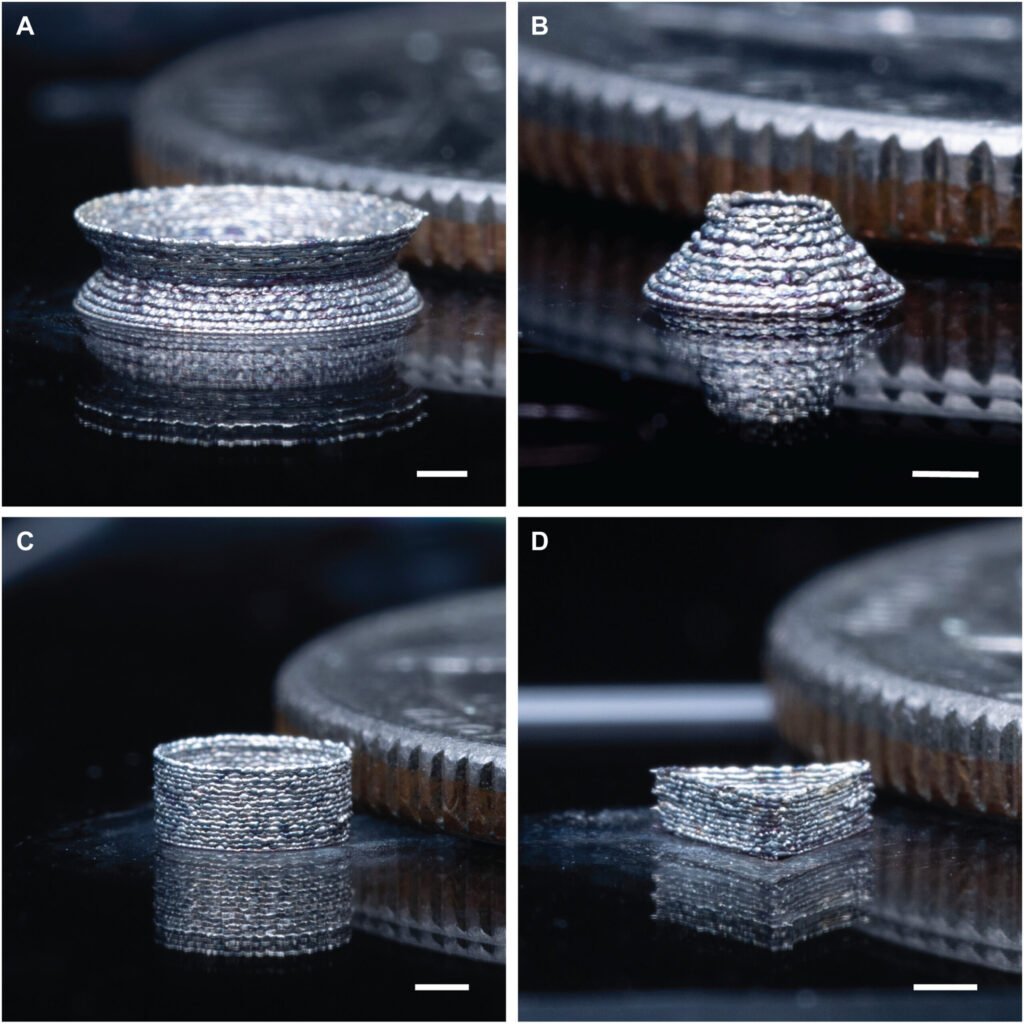
Rice University researchers have found a way to 3D print using focused microwaves. Published in Science Advances, Professor Yong Lin Kong and his team believe the technology could be used to 3D print electronics through heating inks without damaging substrates. By focusing the heating area precisely, only the electronic ink can be heated at one particular location.
Until now, this has been one of the biggest challenges in 3D printing electronics: the heat needed to make the ink functional often damages the material underneath it.
Professor Kong said,
“The ability to selectively heat the printed materials enables us to spatially program the ink’s functional properties, even when surrounded by temperature-sensitive material. This allows us to integrate freeform electronics onto a broad range of substrates, including biopolymers and living biological tissue, all within a desktop-size printer without the needs of complex facilities or labor-intensive manual processes.”
They call their process near-field microwave 3D printing (NFP). The process builds on the Meta-NFS device developed in conjunction with National University of Singapore researcher John Ho. This is a metamaterial device that creates directed near-field microwave energy. The system can focus that energy into a heating zone as small as the width of a human hair, allowing very precise control during printing.
Coupled with the microextrusion of nanoinks, local microstructure can be controlled, leading to programmable properties in circuits. Ceramics, thermosets, metals, or other doped inks can therefore be made either on the surface or selectively hardened within other structures. Particular sections can be annealed, and different materials can be joined selectively. Layers could also be joined more thoroughly. This also means different materials and functions can be built directly into the same structure during printing, rather than assembled later.
The team hopes that a desktop unit will now be able to make entire circuits at scale. Unlike traditional electronics manufacturing, which often relies on centralized facilities and complex assembly, this approach could simplify how electronic devices are made.
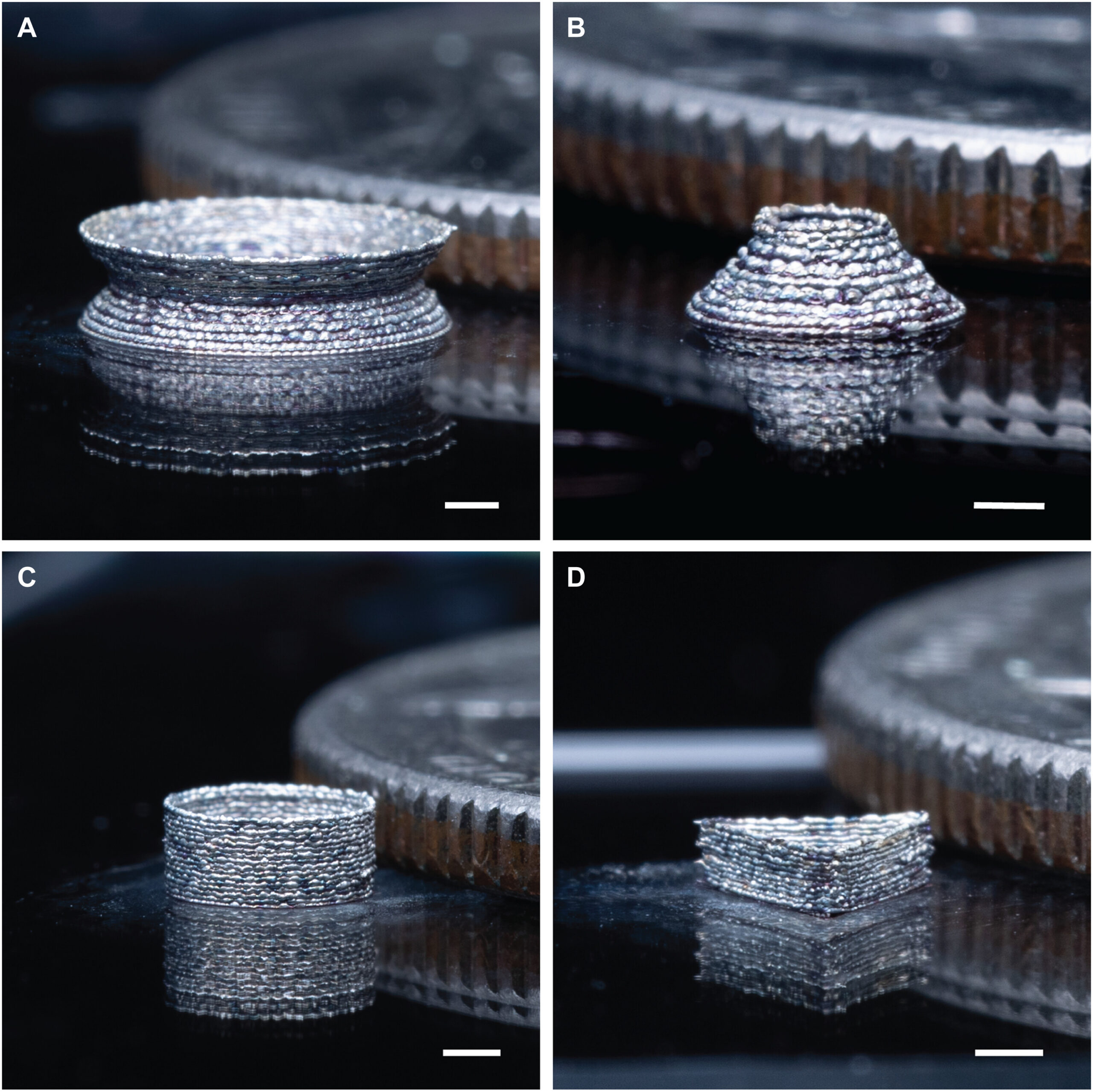
Photograph of 3D architectures printed by the layer-by-layer deposition approach using Meta-NFS. Image courtesy of Rice University.
As a test, strain sensors made from ultrahigh-molecular-weight polyethylene were printed to form a circuit that can be used in the body. They’re also working on sensors that can be eaten, soft robots, and complex devices. Meta-NFS 3D printing is now a core foundation for Kong’s group in developing fundamentally new classes of electronic devices for a broad range of applications that did not exist before. For instance, the group is developing ingestible electronic systems for personalized diagnostics and treatment, designing bionic devices that interface with biological organs, and creating next-generation 3D printed soft robots and drones with highly integrated electronic functionality.
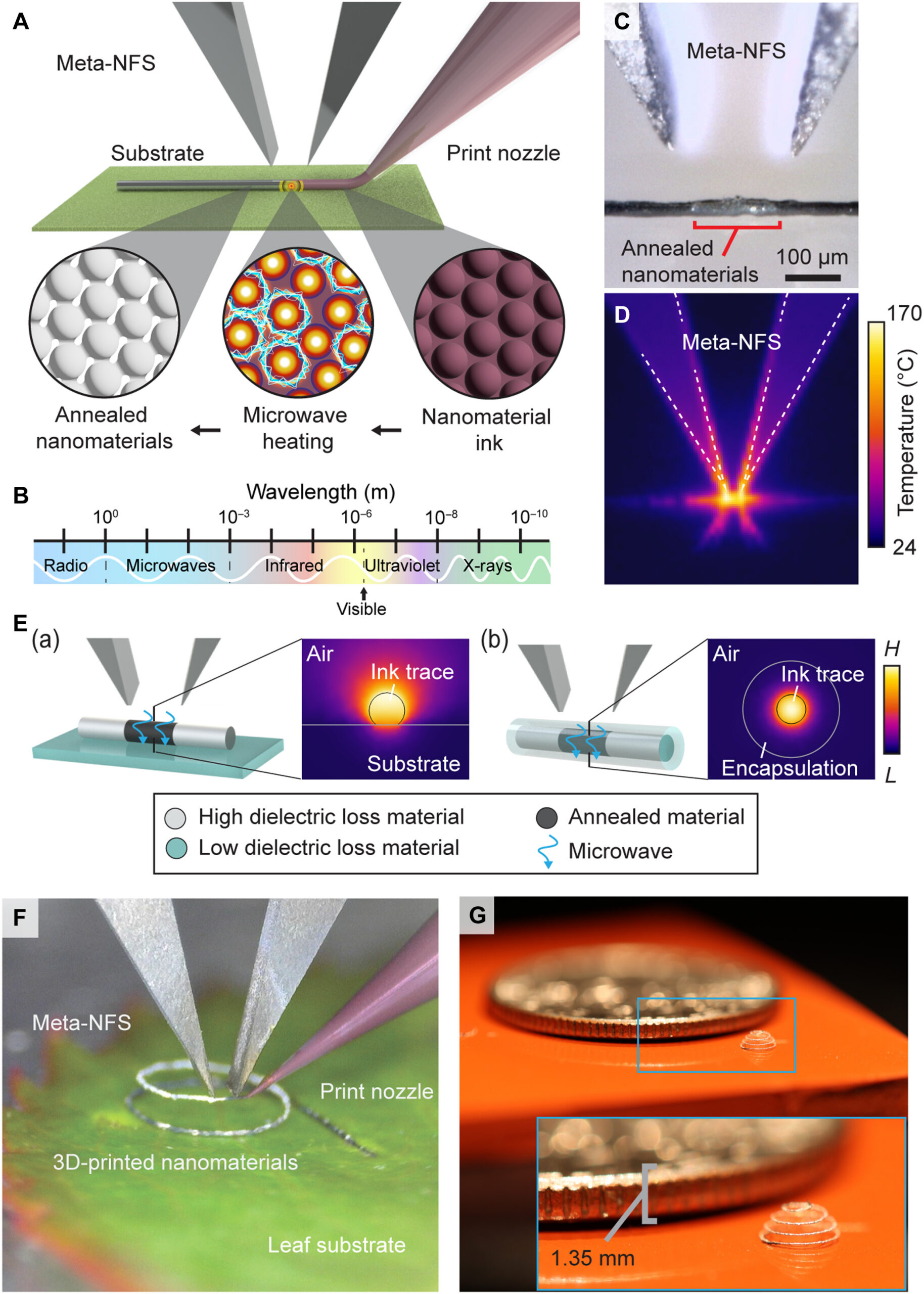
Highly selective and rapid volumetric heating of 3D printed materials with a Meta-NFS. Image courtesy of Rice University.
Kong says that,
“Meta-NFS 3D printing enables us to develop new classes of hybrid electronic devices that could not have been built — or even envisioned — with previous manufacturing approaches, providing us with a new capability to address unmet societal needs.”
As this allows for volumetric heating and the volumetric construction of new structures, made of annealed inks, this gives us a truly new capability. This could be a very advantageous process for enclosed 3D printing of sensors and complex devices. The body 3D printing sensor market could be considerable. This could also be used to make compact wearables for skin use. Glucose and health monitoring alone are a significant market there. Perhaps this could be used to make circuits at scale at much lower cost than alternatives. Our houses, lamp posts, and bridges are almost all dumb; resilient, enclosed circuits could make them monitor themselves or people in general. This is therefore a notable step forward in 3D printing that could lead to the democratization of enclosed-sensor 3D printing.