

There’s a lot happening in the world of 3D printing guns. There is the ever-present danger of some people trying to print guns at home. Suppressors are one of the largest 3D Printing applications, while on the Ukrainian battlefield, modifications are improving weapons. Firms are also using additive to make gun accessories such as cable covers, mounts, and the like. Whereas now most of the major gun manufacturers are making or selling 3D printed suppressors, they have been rather aloof toward 3D printing. This also aligns with recent Additive Manufacturing Research findings, which point to suppressors as one of the most commercially significant applications for metal AM, with demand driven by regulatory changes and broader adoption. The lion’s share of 3D printing innovation has instead come from small startups. This is something we see in cycling as well. In consumer-facing industries that traditionally handle most of their own subtractive manufacturing, we typically see greater hesitation to adopt 3D printing than elsewhere.
This may be about to change. In golf, we can see how, years ago, every major golf firm toyed with ultra-high-end 3D printed clubs. These supercars (or superclubs) were meant to slather the brand with an engineering halo. It then took years for one of them, Cobra, to take this further and make more accessible clubs. As a path to adoption, I like it a lot. Rather than fighting in the trenches for years inside firms to secure adoption and overcome institutional resistance, we test it out in a limited production run, in a manageable, outsourced capacity. No one loses their job, and we all get pats on the back.
It seems Benelli is on the same path, which could indicate that many major gun manufacturers may follow suit. Benelli is an Italian gun manufacturer that is particularly strong in shotguns. Benelli is part of Beretta Holding, a $1.4 billion firm that owns the storied Finnish gun manufacturer Sako and the optics firm Steiner.

Beretta Lupo Alpha LE rifle featuring a lightweight, lattice-style stock design and 3D printed parts.
Last year, the company released a Lupo Alpha rifle with 3D printed components. Now, an updated Lupo Alpha Limited Edition is said to be an ultralight, limited-edition rifle chambered in .308 Winchester, retailing for €10,000. A previous 3D printed version sold 1,000 units. At that point, the gun is squarely aimed at collectors. Most collectors collect elaborately embellished, traditionally made shotguns, including the ones from Beretta-owned Holland & Holland. These rarefied weapons are steeped in tradition and presented as heirlooms. But there is a new tech-savvy collector who wants something else.
In this case, it’s super-light 3D printed furniture. The gun’s chassis is 3D printed. Removing weight while maintaining rigidity is the main driver here. The stock has also been designed using FEA and other digital tools to be optimized for specific stresses that the rifle will go through. The rifle barrel has been made with Electrochemical Machining. This is something we’re hearing more about, and rifle makers are pointing to this manufacturing method as a way to make better barrels as opposed to hammer forging and other traditional methods.
In this case, the firm goes further and says it has its own electrochemical rifling process as well as BE.S.T. (Benelli Surface Treatment). BE.S.T. is an in-house Benelli-developed surface treatment that combines Physical Vapor Deposition (PVD) and Plasma Enhanced Chemical Vapor Deposition (PECVD) to make a super-hard, corrosion and abrasion-resistant coating for triggers, barrels, and more components. Barrels are also placed in a vacuum furnace and cryogenically treated. This kind of tech sell is especially useful for Benelli, which has only been making rifles for a few years and primarily makes shotguns. Being the new kid on the block, embracing technology and newness really is a way to position yourself as the challenger brand that rewrites the rules. That can be very effective marketing in a sector dominated by stalwarts; you substitute “tried and trusted” for boring and old.
Roberto Massarotto, Marketing, Communications, and Product Director of Benelli, said that,
“Additive manufacturing is something very important for us, we have some machines in the company, and we’re the only company that are able to produce in a massive quantity, these kinds of components, usually most companies use 3D printing for prototypes, we’re using it for production, its a different approach, 100%. This kind of shape, is impossible to get with any other kind of machining.”
It’s interesting to see Benelli move ahead with polymer 3D printed stocks and chassis components. The firm got an Additive Manufacturing department in 2023, then consisting of Ultimaker and Stratasys machines. We’re unsure which technology or printers the company is currently using for production. Something like 3NTR would make a lot of sense. The fellow Italian firm is a few hours away by car and makes solid Material Extrusion machines. Some high-performance PPA GF type materials could really work as rifle barrels. With the right finishing process, this could work and would lead to a wider material range.
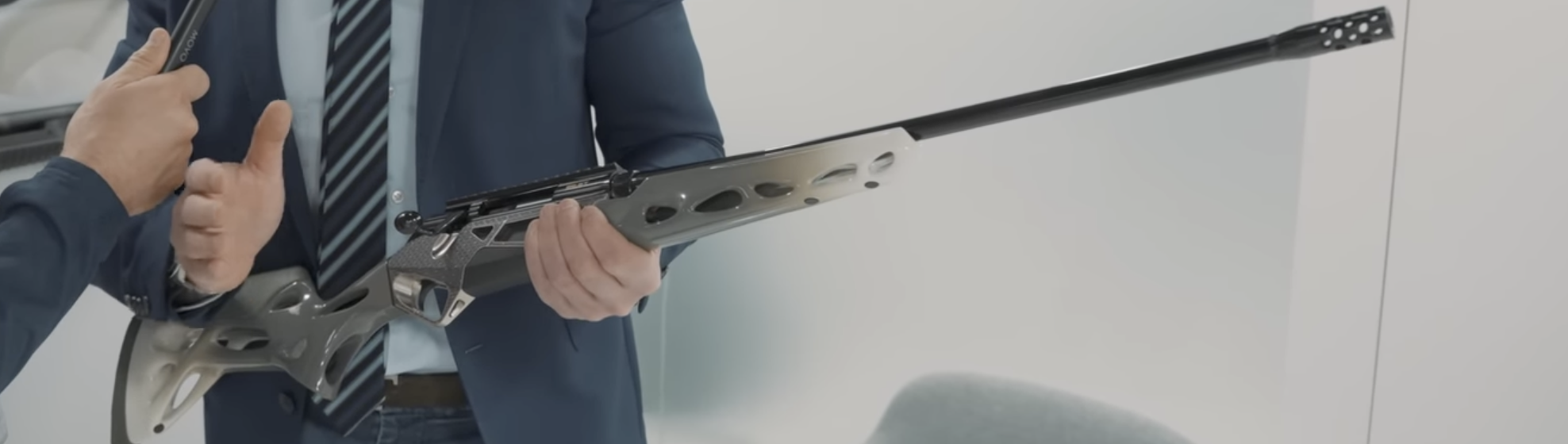
Handling of the Beretta Lupo Alpha LE rifle featuring 3D printed parts.
On the other hand, parent Beretta uses Powder Bed Fusion, running metal and polymer machines from EOS at its site. Beretta uses PA GF powders. Vat Polymerization has traditionally been used a lot in prototypes for stocks and the likes, but I’m guessing that we’re not there yet, performance-wise. The initial 3D printed version of the Lupo Alpha (the image at the top of the post) rifle looks like it is Powder Bed Fusion GF, but this one of the Lupo Alpha Limited Edition looks distinctly like vapor-smoothed Material Extrusion.
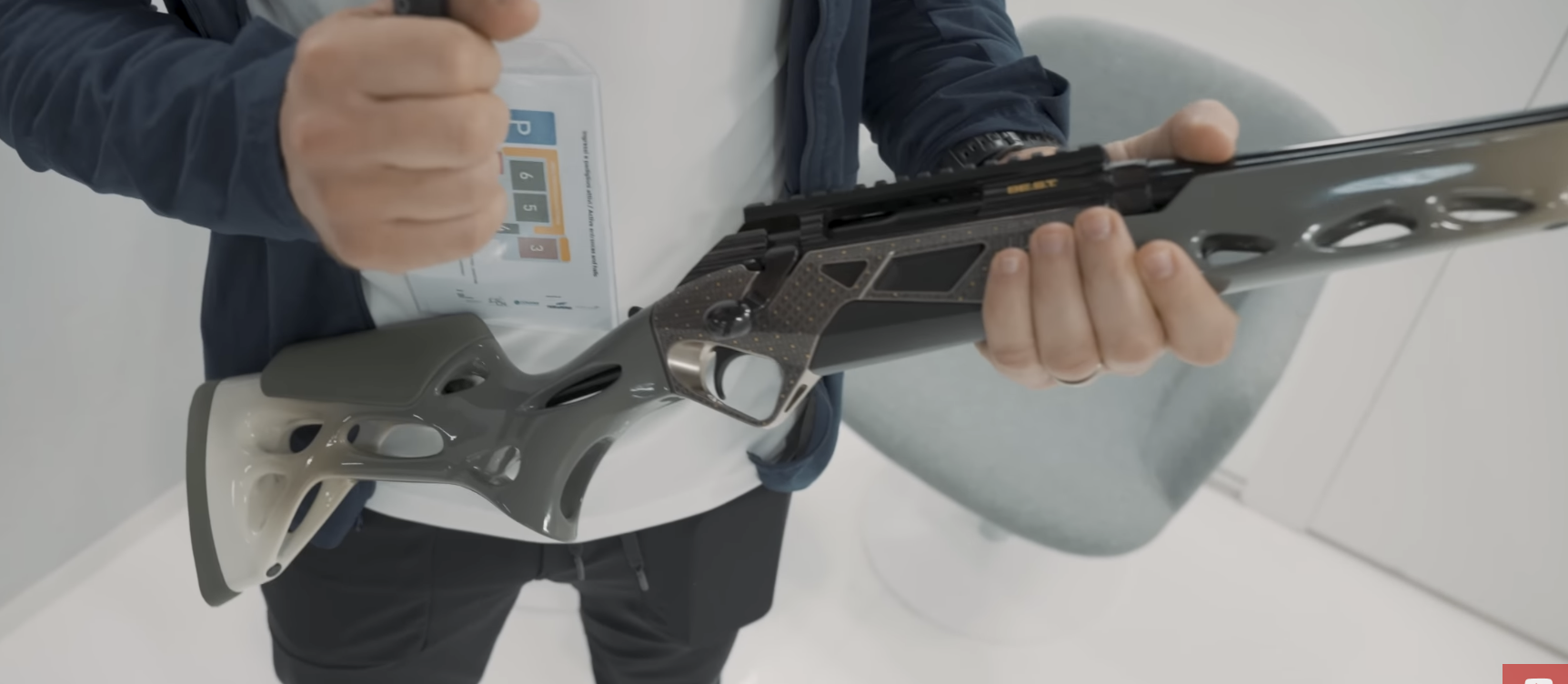
Up close of the Beretta Lupo Alpha LE rifle with 3D printed parts.
Given that the firm first sold a run of 1,000 3D printed guns and now sells 100, we can see that these small, profitable series are going ahead apace. But will this lead to 3D printed stocks & chassis becoming more common? Eventually, it might. I personally believe more in 3D printed custom cheek pieces and buttstocks. You could get a real improvement here in comfort and precision if you customized these to anatomy and behavior. If we look at Magpul’s success, an independent 3D printed stock or other component provider could also do well. We would expect more companies to look at polymer 3D printed accessories and stock them in the future.
Images courtesy of Beretta