
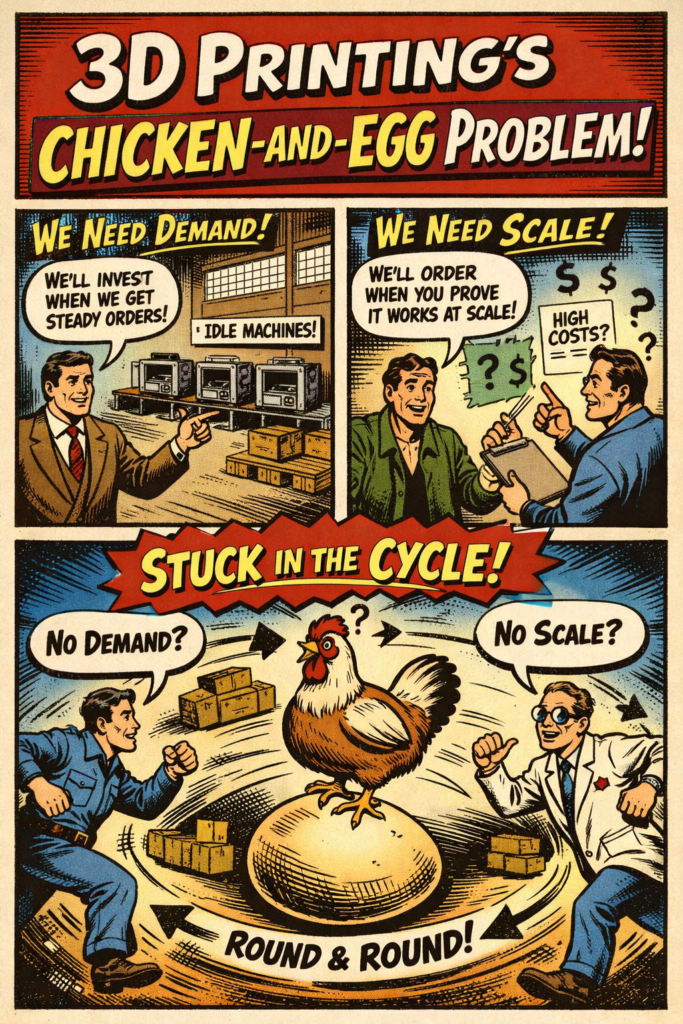
There’s a simple problem at the center of the 3D printing industry, and it hasn’t really gone away.
Companies say they will invest in additive manufacturing when there is steady demand. Customers say they will commit when it’s proven at scale. And so both sides wait.
This is 3D printing’s version of the classic chicken-and-egg problem. And perhaps, it helps explain why, after years of innovation, the technology still isn’t widely used at a scale the way it was originally expected to.
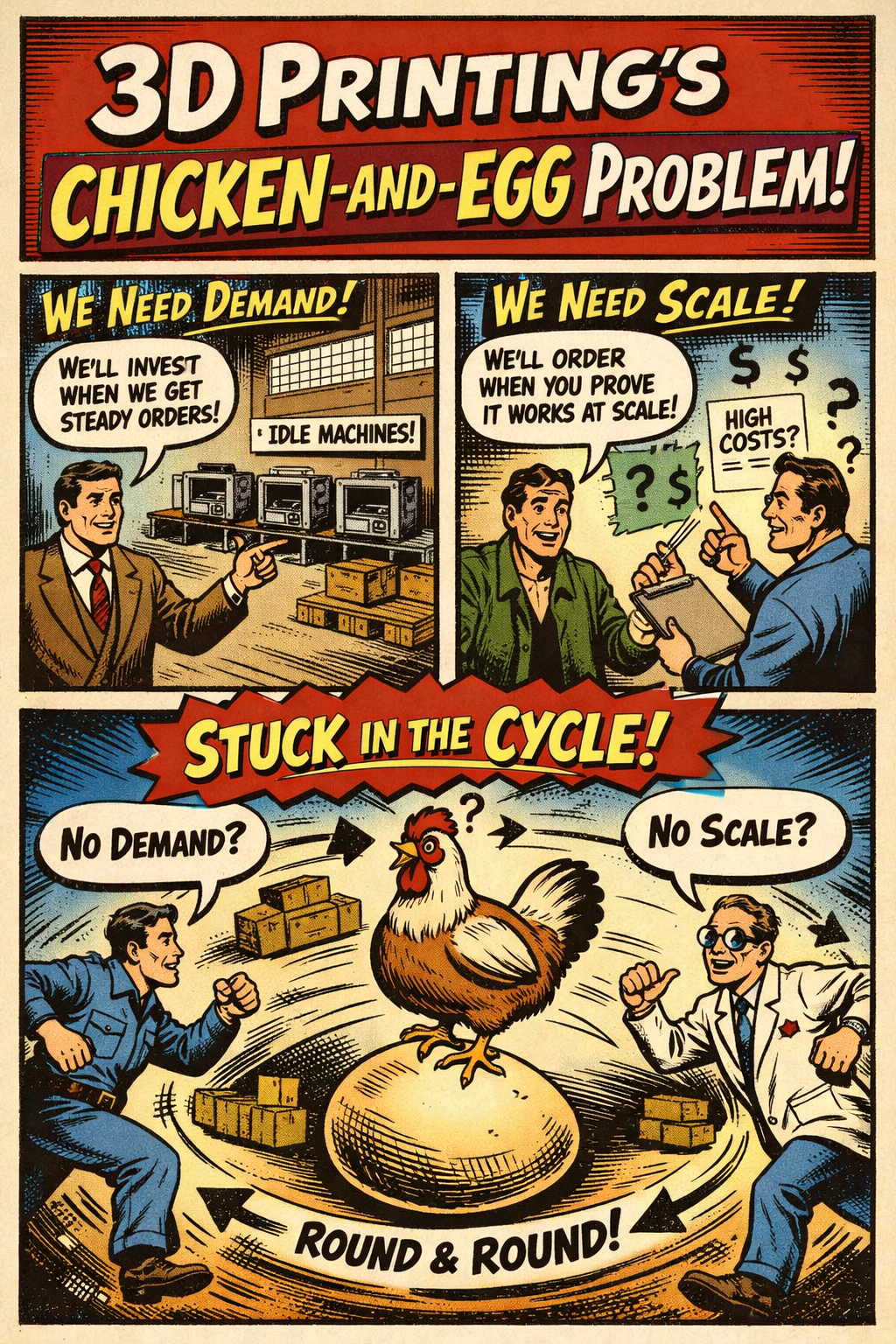
Visualization courtesy of 3DPrint.com.
Waiting for Proof
For many manufacturers, it’s not about whether 3D printing works. It clearly does. The challenge is making it reliable, cost-effective, and consistent at scale.
If a company is going to switch part of its production to additive manufacturing, it needs to know that parts will meet the same standards every time, production can run without disruption, and costs will stay predictable.
That kind of confidence usually comes from seeing the technology already being used at scale. But that’s exactly the problem.
Waiting for Demand
On the other side, 3D printing companies often need committed customers before they can scale up.
Running machines at full capacity, investing in more equipment, and building out production workflows all depend on having enough demand to justify it.
Without that demand, it’s hard to lower costs, improve efficiency, and prove long-term reliability. So suppliers wait as well.
Where This Shows Up
You can see this dynamic across the industry.
In aerospace, for example, companies like Boeing and Airbus have adopted 3D printing, but mostly for specific parts rather than full production lines. The technology works, but scaling it across entire systems takes time, certification, and long-term proof.
In defense, there is a strong interest in using 3D printing for spare parts and field production. But large-scale deployment still depends on qualification, repeatability, and trust in the process.
Even in consumer products, where 3D printing offers clear advantages in customization, companies are often cautious. They may test the technology in limited runs before committing to larger volumes.
But at the same time, there are signs that this is starting to change.
Some of the largest manufacturers are beginning to move beyond isolated use cases. BMW, for instance, is integrating 3D printed parts across multiple vehicle brands, and not just for prototyping, but also for actual production components. Apple is also reportedly exploring 3D printing for aluminum components in future devices, which would mark a significant step toward scaling the technology for high-volume consumer products.
These are still early moves, but they point in the same direction. As more companies begin to use 3D printing in real production environments, even in limited ways, it starts to build the confidence needed to expand further.
In other words, the balance may slowly be shifting in favor of adoption.
But the underlying pattern is still there: no scale without demand, and no demand without scale.

BMW 3D printed robot gripper. Image courtesy of BMW.
The Cost Loop
Cost plays a big role in this cycle.
3D printing becomes more competitive as production increases. More volume means better machine utilization, lower cost per part, and more refined workflows. But to reach that point, companies need enough demand in the first place. This creates a loop that is hard to break.
There are signs that this is starting to shift. In some areas, demand is becoming strong enough to push past the hesitation. For example, large-format parts in both metals and polymers are gaining traction, reshoring efforts are driving interest in more flexible manufacturing, and industries like defense and energy are looking for faster, more adaptable production methods.
At the same time, the technology itself is improving. Machines are becoming more reliable, materials are expanding, and post-processing is getting more automated. All of this helps reduce risk. And reducing risk is what breaks the cycle.
Onward
The industry is finding ways around the chicken-and-egg problem. In some cases, it starts with a single application. A company identifies one part where 3D printing clearly makes sense, proves it out, and then expands from there.
In other cases, it comes from external pressure. Supply chain disruptions, geopolitical shifts, or the need for faster production can push companies to adopt additive manufacturing sooner than they otherwise would.
What’s becoming clearer now is that this shift may already be underway.
Recent data from Additive Manufacturing Research (AMR), also covered by analyst Scott Dunham in his latest webinar, looks at where real growth is actually happening in 3D printing. Instead of treating the industry as one single trend, it breaks the market down by segment, showing which areas, such as specific applications or technologies, are gaining traction. If you want to see how that shift is playing out in detail, the full webinar is still available to watch and offers a clear, data-driven look at where the industry is gaining traction.
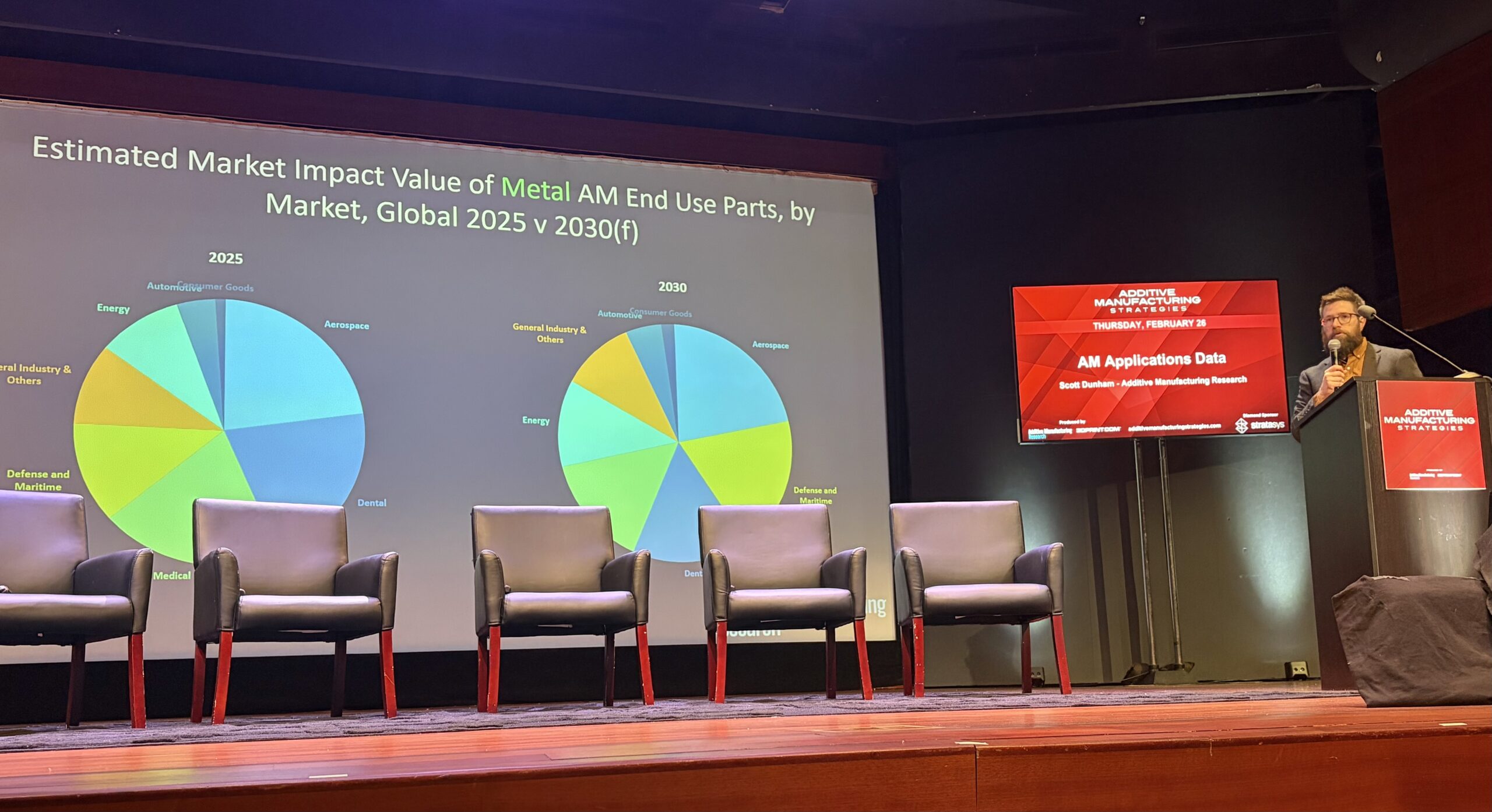
Scott Dunham during the AMS 2026 AM Applications Data presentation. Image courtesy of 3DPrint.com.
That matters because it starts to break the cycle. When certain parts of the industry begin to grow, companies gain more confidence to invest in production. As production increases, costs can come down, and the process becomes more reliable, making it easier for new customers to adopt the technology.
Once a few strong use cases are proven and the data starts to support them, the rest tends to follow.
A Familiar Problem
In many ways, this is not unique to 3D printing. Most new manufacturing technologies go through a similar phase. But in additive manufacturing, the cycle has lasted longer than many expected.
The technology is ready in many ways. The machines work. The materials are there. The applications exist. What’s still catching up is the confidence to scale. And until that gap closes, the industry will keep running into the same question: What comes first, demand or scale?