
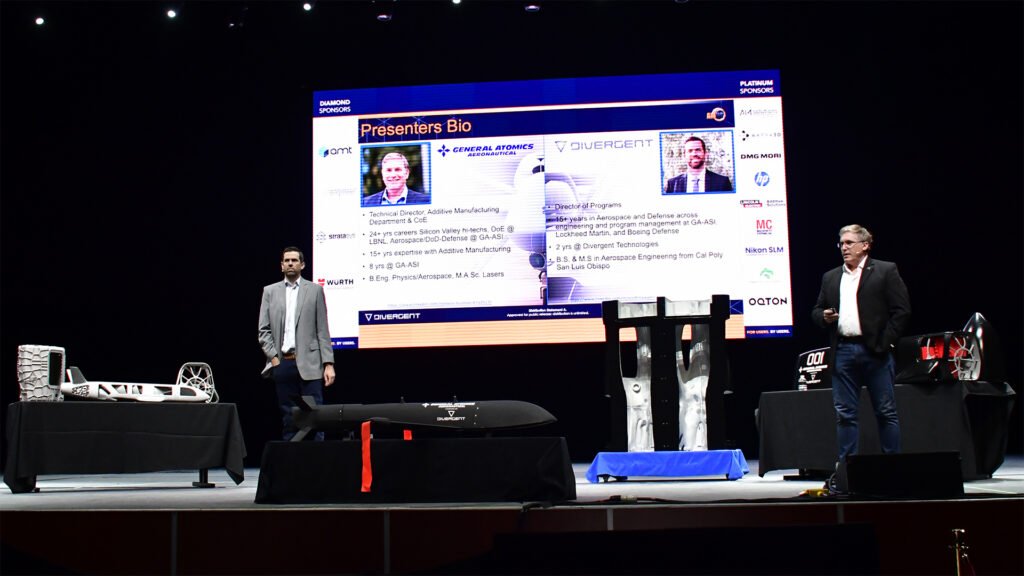
As I mentioned in my AMUG 2026 overview, I had a lot of delays traveling to Reno, Nevada to attend the conference. So unfortunately, I missed “From Hypercars to Defense Drones: How Two Major Industry Innovators Started their Partnership Journey at AMUG,” the Tuesday morning keynote by Steve Fournier, Senior Manager – Additive Manufacturing at General Atomics Aeronautical Systems (GA-ASI), and Scott Sawyer, Director of Programs – Aerospace and Defense, at Divergent.
Luckily, later that day, I had the chance to speak with both Fournier and Sawyer, and asked them to fill me in on what I’d missed during their joint presentation. It’s a story that proves just how important it is to make industry connections with people in different fields and disciplines than your own, and share your experiences with each other.

Steve Fournier, General Atomics Aeronautical Systems (GA-ASI), and Scott Sawyer, Divergent, onstage at AMUG 2026.
At AMUG 2022, Kevin Czinger, the founder and Executive Chairman of Divergent, presented a keynote. One of the people in the audience that day was Fournier. Divergent was primarily focused on automotive applications at the time, and GA-ASI works in aerospace and defense. But after the presentation, the two companies met up for a conversation.
“We met and basically we asked a simple question, which is, how can your technology stack be applied to a different industry, such as aerospace and defense, unmanned systems specifically?” Fournier told me. “And that started a journey of four years, which impacted us as a drone manufacturer in the way we make drones. It also impacted Divergent in the way they look at different markets besides automotive.”
Sawyer concurred with Fournier’s assessment of that initial conversation with Czinger.

Scott Sawyer, Divergent
“After Steve and Kevin connected, Divergent got set out on the path, via efforts with GA-ASI at the time, of seeing how that technology can transition into aerospace and defense, specifically with unmanned aircraft systems working with GA-ASI, and understanding what carryover is there for the technology, what tech development needs to occur, and even what is the process day-to-day of engineering teams working together, sharing data, doing collaborative design and analysis.”
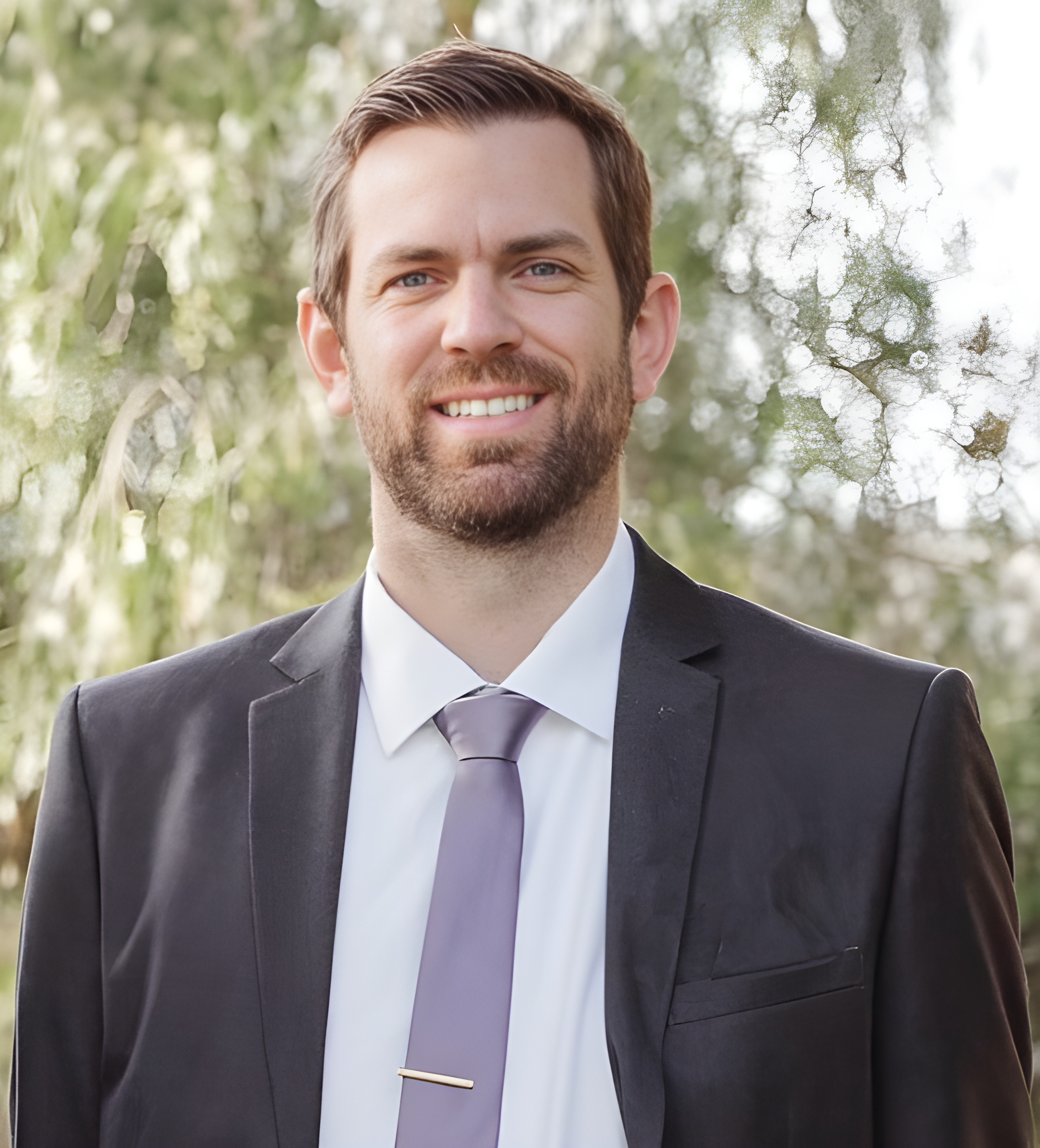
Interestingly, Sawyer actually used to work with GA-ASI before moving to Divergent, where he’s been employed for a little less than two years. He spent 15 years focused on aerospace and defense applications, but went to Divergent after he saw “the technology from the end user standpoint of working at GA-ASI and saw its applications.”
“Back in 2022, Divergent was very much commercially automotive, both from design and delivery of products to automotive OEMs, but then of course as well, designing and manufacturing Czinger vehicles,” Sawyer said.
Since that initial connection at AMUG, Divergent has significantly expanded its portfolio beyond automotive applications and into “the air domain,” as Sawyer said. The company now also works to produce unmanned aircraft systems (UAS), like the 3D printed drone it worked with GA-ASI to create; at AMUG 2023, Fournier actually took the stage with Divergent’s CTO to share about the design, 3D printing, and robotic assembly of the drone.
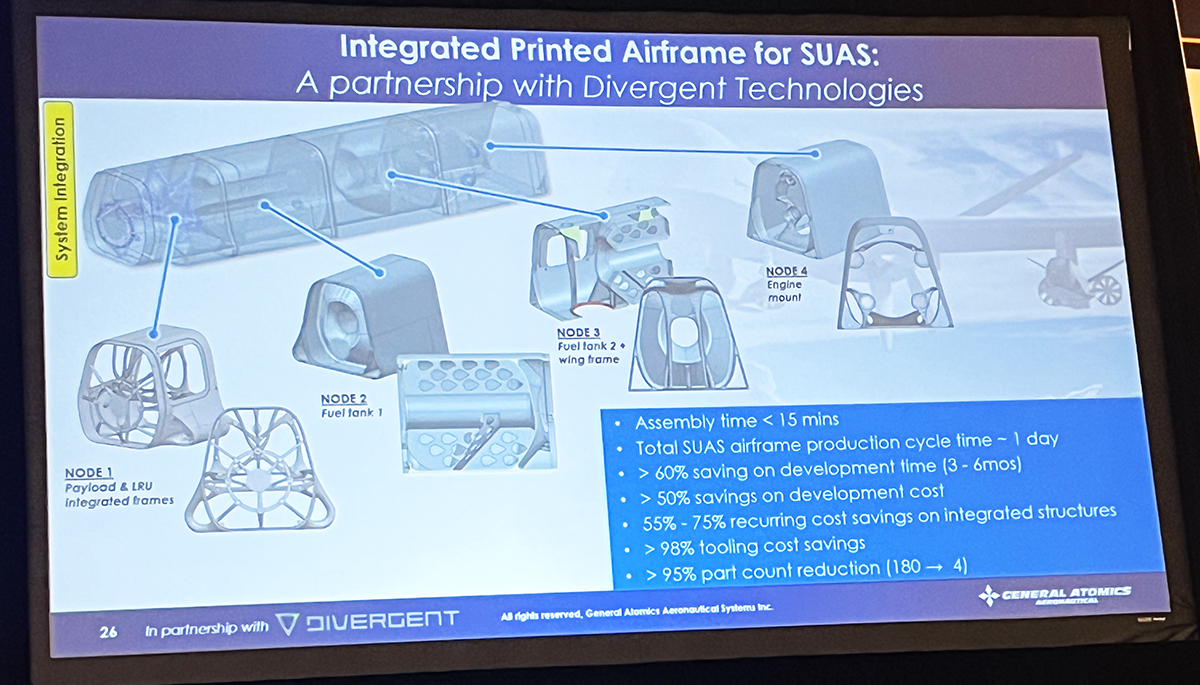
AMUG 2023 presentation by Divergent and GA-ASI. Image courtesy of 3DPrint.com
Sawyer also said that Divergent is continuing to grow its horizons and work on “subsurface applications,” like unmanned underwater vehicles, and is even working on space applications.
Bringing the conversation back to their joint presentation at AMUG 2026, Sawyer explained that what they shared with the audience was how “the initial efforts that Steve and Kevin spearheaded between the companies” helped define what entry into the AM space looks like.
“What are the hurdles that we’re gonna have to overcome, all the way down to the material qualification, environmental qualification, customer engagement. Where does this technology make sense? Where does it not make sense?”
In Sawyer’s words, Divergent used that initial collaboration with GA-ASI as “kind of a stepping stone” to expand more broadly into aerospace and defense markets as well.
Fournier said, “When I reflect back on how the GA-ASI and Divergent partnership emerged, I think one of the key messages that we tried to send out is that we live in bubbles of egocentric areas of interest, and events like AMUG are representative of this. The additive community is a bubble in itself. Sometimes, when we step back and peek at other such bubbles or industries, we realize that sometimes we have more things in common than we think, or that we can learn new things from others. This is the big lesson here. Even within the ‘additive bubble of AMUG,’ which has grown tremendously over its history, there are multiple ‘sub-bubbles.’”
Indeed, he also noted that there are multiple “sub-bubbles” in the AM industry, like oil and gas, medical, defense, aerospace, and space, and that we naturally converse within our own small bubbles, because that’s where we’re comfortable.
“We don’t necessarily spend enough time to value some other fields that may have a piece of information that could be applied and transfer to what your application space is.”
This is why AMUG is so different from other conferences, and so very important. I had heard about the event’s tradition of having people draw table numbers out of a bowl, and that’s where you had to sit for lunch, and I was honestly dreading it; as I told a colleague, I normally find a quiet corner table at industry events and just work while I eat alone. But I ended up really enjoying the opportunity to enjoy a full meal and conversations with people from different countries and parts of the industry, and hearing what they had to say.
AMUG 2026. Image courtesy of 3DPrint.com
As Fournier explained, even if there are two types of vehicles that are not at all the same on the outside, if you break them down to the subsystems, they could have more in common than we may think.
“You can make a correlation between product types,” he said. “And if you start doing that, you start finding much more commonalities that can be transferred. That’s conceptual.”
He noted that it is human nature to not want to change up how we do things, and said that breaking those barriers in the Divergent and GA-ASI collaboration “was kind of what we wanted to bring to the audience” at AMUG.
“How do we get through that, and what’s the success on the other side?” Fournier said. “It’s not like it’s been ten years, it’s four years, and look at all the things that happened since then.”
In terms of what Fournier said about the additive bubble, I referenced our recent AMS 2026 event, where Josef Prusa, CEO and Founder of Prusa Research, told attendees that the AM industry is “living in a huge bubble and we very rarely go outside that bubble and speak to the people and make them excited about 3D printing.” Many still think that 3D printing is only good for toys and prototyping. Fournier said that their presentation made it very obvious “that additive is here to stay, and it can be beneficial commercially.”
“When Apple comes up with a million Apple watch cases, that is commercial application at scale,” he said. “That is a topic we talked about. With the volume that we bring in terms of number of aircraft a year…it’s not a transitional technology anymore. It’s a production technology.”
He brought up DAPS technology—short for Divergent Adaptive Production System—and said this is where it “really shines, because you design for DAPS and then you produce with DAPS.”
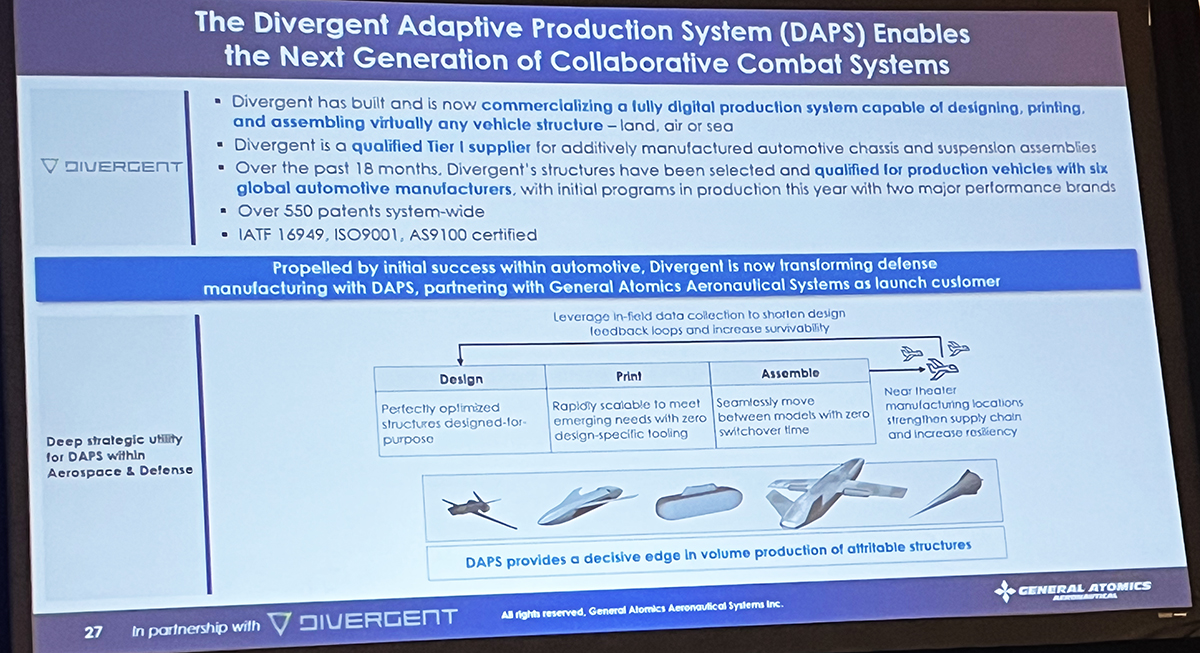
AMUG 2023 presentation by Divergent and GA-ASI. Image courtesy of 3DPrint.com
Sawyer jumped in here, explaining that while DAPS “is additive manufacturing-based, it’s also the design and robotic assembly of complex structural solutions.”
“So to Steve’s point, especially as we’ve grown in aerospace and defense…delivering a capability and prototype demonstration environment is great. It’s required for aerospace applications. But the end vision, you still need to be able to go manufacture at rate. Working with our customers and primes and government, it’s critical that we don’t lose sight of that.
“Let’s prototype, let’s learn, let’s iterate. But at the end of the day, let’s make sure that we can scale and deliver capabilities at rate today.”
We also talked a little bit about AMUG itself, as Sawyer and I were both first-timers.
“I go to a lot of conferences, but they’re all very commercially focused, right? Business strategy and business growth, details of the commercial application. And this has been cool,” Sawyer said. “The talk was cool because it’s more engineering-centric. What have you demonstrated, what capabilities? Seeing the openness of companies, at the engineering level and technical level, to share ideas and see how we can grow, it’s very different than other conferences.”
Fournier said that’s exactly why he thought their presentation would work well at AMUG.

Steve Fournier, GA-ASI
“It is specifically a user base,” he said. “At trade shows, you’ve got OEMs of materials, machine, software. They’re trying to map out the market and each other. They have showcases and they have talks, but the talks are supplemental. Then you have the other extreme, where you have a lot of scientific, academia, research type stuff, which is great. Then users are kind of in the middle. The machines, the material, the academia, the theory, the software, we’re applying that on a daily basis for applications.”
There’s a greater willingness to share with each other at AMUG, from your opinions on various OEMs to qualification challenges you’re having.
“All that together makes this event specifically interesting and especially relevant for this type of discussion,” Fournier said. “The point of our discussion was not to sell anything, but to really entice people to do similar types of endeavors, whether or not it’s with Divergent, or with another technology provider, or another user that wants to share and partner. There’s that process of looking over the fence, having a visionary moment, and having a strategy to go execute that vision towards onboarding it into your own operation. That’s really what we’ve done and I think that’s what Divergent is good at doing.”
Sawyer wholeheartedly agreed, noting that their intent was to offer their connection and resulting partnership as “an example to encourage others to hopefully find similar collaborations.”
“I think across the board, the more adoption you can get, no matter who that is pushed by, is extremely important.”
In closing, Fournier said that he believes additive will grow when the applications grow.
“Divergent wasn’t here to sell materials or machines, but applications, and specifically my application, which brings a benefit to my customers,” he said. “By making that application work, using additive, is the best demonstration that additive works. You can write papers, you can have a dissertation, a PowerPoint presentation on how you qualify and statistically prove that additive is working and is worth it. You can build a cost model, you can present at AMUG. But if you can show up with hardware that is in full production, there’s no better demonstration that additive works.”
Images courtesy of AMUG unless otherwise noted.