
Additive manufacturing (AM) has reached a turning point in education. The question is no longer whether students should be exposed to 3D printing, but whether that exposure actually prepares students for the realities of modern engineering and manufacturing.
AM programs are often built around equipment rather than outcomes. Schools invest in advanced printers, dedicate space in labs or makerspaces, and assume that access alone will translate into innovation. And while today’s manufacturers need problem solvers who understand design intent, material behavior, process tradeoffs, and how additive fits within a broader production ecosystem, they often find trainees who approach AM as standalone tool rather than an integrated discipline.
Without a structured instructional framework, students learn how to operate a machine but not how to apply AM as an engineering solution. Closing that gap creates as many opportunities as it solves problems.
This shift has been building for years. As AM matured from experimental technology to production-ready capability, expectations changed across industry. Employers began asking for credentials. Students started seeking proof that their skills were transferable beyond the classroom. Educators, meanwhile, were being asked to teach increasingly complex manufacturing concepts, often without the training or resources to do so confidently. That was the inflection point where AM education stopped being about exposure and started being about literacy.
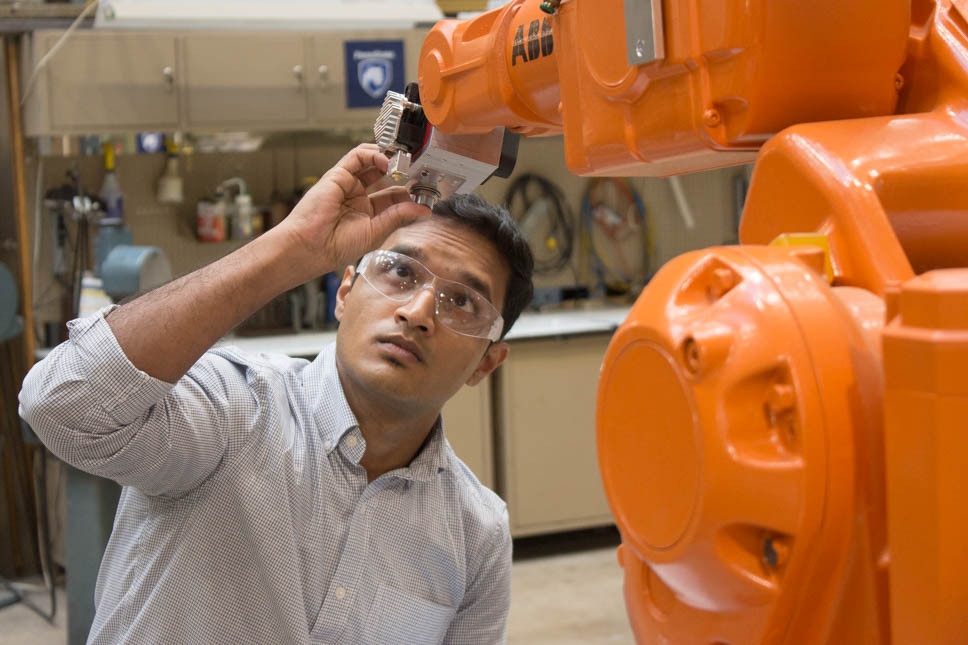
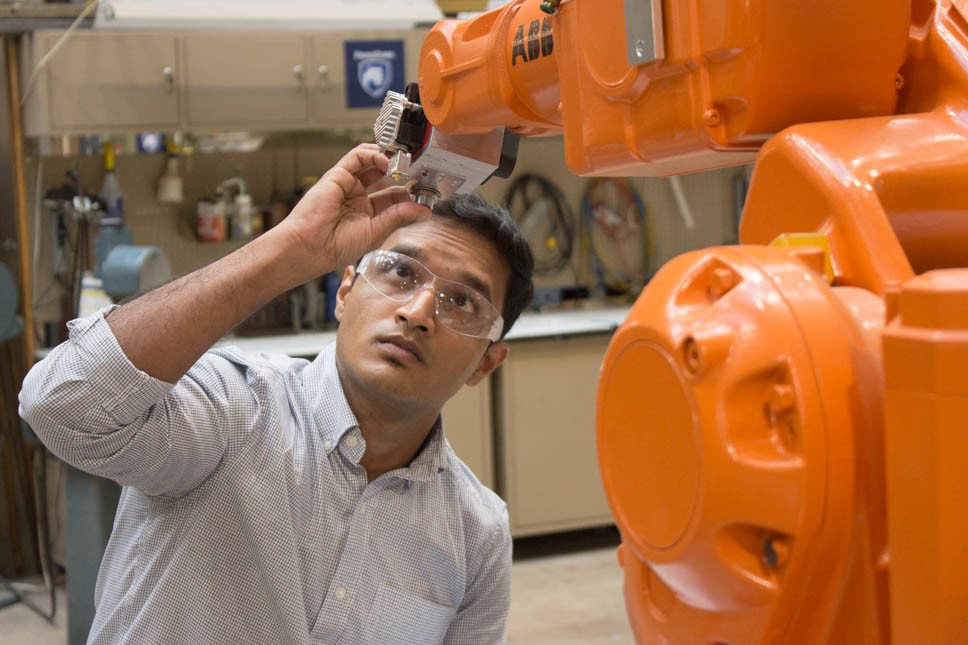
Rakshith Badarinath works in the Factory for Advanced Manufacturing Education (FAME) Lab, at Penn State. Image courtesy of Erin Cassidy Hendrick/Penn State.
The critical realization was this: meaningful AM education starts with educators.
Without guidance, instructors may limit its use to a single course, a single application, or a single material — despite the fact that AM touches design, healthcare, chemistry, aerospace, tooling, and advanced manufacturing workflows. To unlock that range, educators need context, confidence, and curriculum to go along with the hardware.
That understanding has shaped how education and workforce development are being approached across the additive manufacturing industry. Instead of focusing exclusively on student-facing training, there is increasing emphasis on educator enablement. Certification programs are designed to help instructors make informed decisions: when AM adds value, when traditional methods are better suited, which materials align with specific performance requirements, and how different technologies support different outcomes. When educators gain that fluency, AM stops being an isolated activity and becomes a deliberate part of instruction.
The impact is measurable. Programs built around structured training and certification tend to use their equipment more effectively, integrate additive across multiple disciplines, and graduate students with a clearer understanding of real-world applications. Perhaps just as importantly, those programs reduce friction as educators become more confident, students become more engaged, and the technology is used with purpose rather than experimentation.
This education-driven approach has begun to influence industry itself. Manufacturers across automotive, aerospace, and industrial sectors are increasingly adapting academic AM content for internal workforce development. In some cases, companies are less interested in formal credentials than in ensuring their teams understand where AM fits within product development and production. The overlap underscores a core tenet of today’s AM education approach: teaching judgment, not just technique.
That distinction becomes clear when students encounter industrial-grade materials and workflows. Exposure limited to entry-level polymers can create the impression that all 3D printing behaves the same way. Once students work with advanced materials, tolerances, and qualification requirements, their perspective changes. They begin to understand why material selection matters, how process parameters affect performance, and where AM delivers its greatest value. Those lessons follow them into industry, and shape how they approach engineering problems long after graduation.
The same principle applies beyond traditional manufacturing programs. In healthcare and life sciences, AM is enabling new approaches to education by making complex anatomy and pathology tangible. In technical and community colleges, students are gaining hands-on experience producing functional components for industry partners. These programs succeed not because they have printers, but because they align AM with real-world objectives.
At the same time, persistent misconceptions about manufacturing continue to limit participation. Manufacturing is still too often portrayed as low-skill or outdated, despite being one of the most technology-driven fields today. Modern manufacturing demands creativity, automation, software fluency, and systems thinking. Programs that integrate design, AM, and programming better prepare students for the roles they will fill.
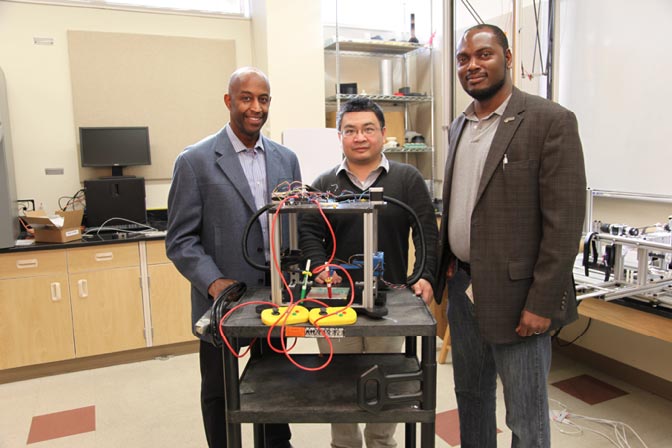
Professors Carl Moore, Hui Wang and Tarik Dickens are introducing new ideas and strategies to alter the way we manufacture composites via additive manufacturing. Image courtesy of FAMU-FSU College of Engineering.
Education cannot afford to lag industry. New materials, new processes, and new applications emerge every year. As AM evolves, curricula must be refreshed, instructors supported, and partnerships strengthened to ensure students are learning what employers truly need.
For schools that still treat AM as optional or extracurricular, the risk is clear. Students are increasingly selective about where they invest their time and tuition. They want skills that translate into opportunity. Programs that fail to embed AM into core learning will struggle to keep pace.
Ultimately, AM education is as much about mindset as it is machines. When students are taught how to evaluate problems, choose the right tools, and apply AM with intention, they gain confidence, adaptability, and the ability to turn ideas into impact. That is how we prepare the next generation of engineers — and why education must come first.

Jesse Roitenberg. Image courtesy of Stratasys.
About the Author:
Jesse Roitenberg is a former math and science teacher with more than 17 years of experience in the additive manufacturing industry. He holds a BA from the University of Minnesota and has worked across marketing, channel sales, and education, with a focus on workforce development and aligning additive manufacturing training with real-world industry needs. He is currently Director of Americas Education at Stratasys, where he has led education programs for more than a decade and works on the development of new materials, products, and training initiatives.