
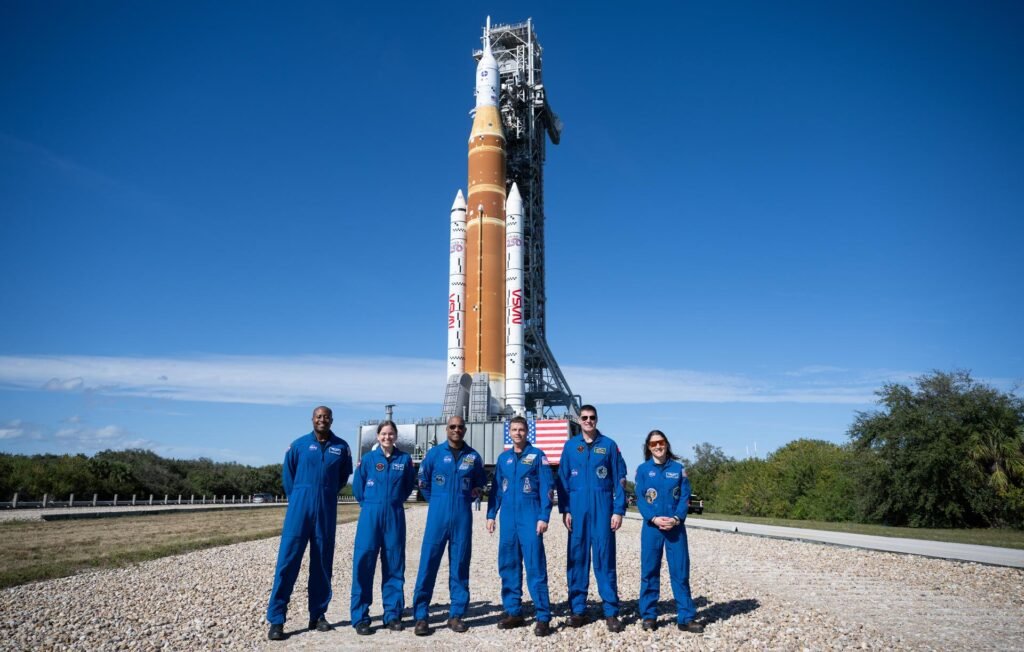
A new chapter in human spaceflight began today as NASA launched Artemis II from Kennedy Space Center, sending astronauts on a journey around the Moon for the first time in more than five decades.
The mission is a major milestone. It marks the first crewed flight of NASA’s Artemis program and a critical step toward returning humans to the lunar surface. But beyond the main story, Artemis II highlights how 3D printing is already part of how these missions are built. And in the years ahead, it may become essential to know how they are sustained.
Understanding Artemis II and 3D Printing’s Role in It
Artemis II is not a landing mission. Instead, it is a full systems test with astronauts on board. Much like Apollo 8, the crew will travel around the Moon and return to Earth, validating the spacecraft, life support systems, and overall mission architecture. The mission is expected to last about 10 days, with the crew returning to Earth and splashing down in the Pacific Ocean.
If Artemis II works as planned, it clears the path for future missions that seek to land astronauts on the Moon and begin building a long-term presence there. In fact, that long-term goal is what makes this mission different from Apollo. This is not just about going back. It is about staying.
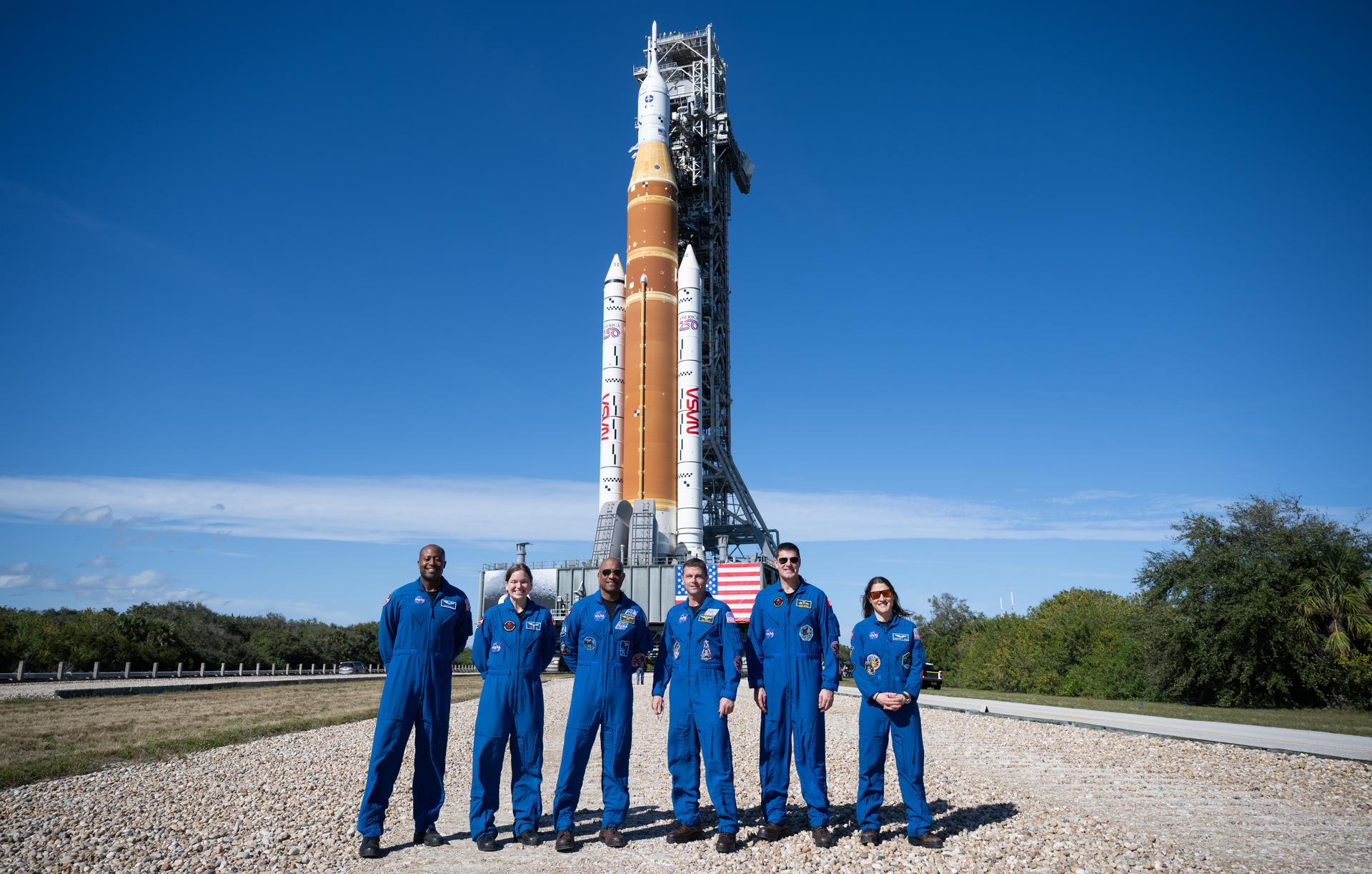
Artemis II backup crewmembers NASA astronaut Andre Douglas and CSA (Canadian Space Agency) astronaut Jenni Gibbons, and prime crewmembers NASA astronauts Victor Glover, Reid Wiseman, CSA (Canadian Space Agency) astronaut Jeremy Hansen, and NASA astronaut Christina Koch, pose for a picture with NASA’s Space Launch System (SLS) rocket and Orion spacecraft. Image courtesy of NASA.
Despite the scale of the Artemis program, additive manufacturing is not being used everywhere, and that’s expected. In aerospace, where certification, reliability, and long-term validation are critical, new technologies are adopted carefully. As a result, 3D printing is used in targeted ways, delivering clear advantages. Across NASA and its contractors, it has been applied in three main areas:
- Spacecraft Hardware (Orion)
The Orion spacecraft, which carries the crew, also includes 3D printed components. Lockheed Martin, Orion’s prime contractor, has used additive manufacturing to produce parts such as brackets, cable guides, environmental control system components, and housings throughout the spacecraft. Many of these parts have been produced using laser-based metal 3D printing processes, allowing them to be made as single pieces rather than assemblies.
These parts are important because they help reduce weight, simplify manufacturing, and improve reliability in areas where performance is critical.
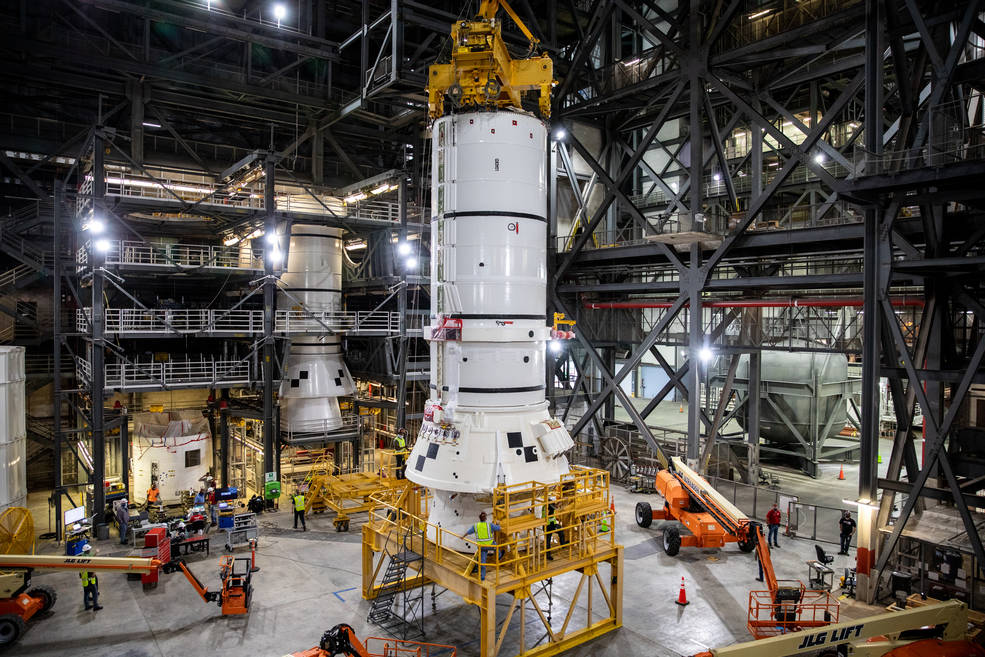
The solid rocket boosters are the first components of the SLS rocket to be stacked and will help support the remaining rocket pieces and the Orion spacecraft. Image courtesy of NASA/Kim Shiflett.
- Tooling, Testing, and Ground Systems
A significant portion of additive manufacturing use in the Artemis program happens behind the scenes. NASA centers, such as the Marshall Space Flight Center and Kennedy Space Center, and contractors rely on 3D printing for tooling, testing, and ground operations. This includes custom test fixtures and jigs used to validate engine and spacecraft components, as well as rapid prototypes, assembly aids, and other manufacturing tools that support production and integration. Many of these parts are produced using polymer-based processes such as fused deposition modeling (FDM), allowing teams to design, print, and test components quickly. While these parts do not fly, they play a critical role in the program, helping engineers iterate faster, reduce costs, and solve problems early in development.
- Rocket Engine Components (SLS)
Some of the most important applications of 3D printing in space are in rocket engines, even if they are not the most visible in this mission. The Space Launch System (SLS), NASA’s heavy-lift rocket, uses RS-25 engines originally developed for the Space Shuttle. The RS-25 engines, originally built for the Space Shuttle by Aerojet Rocketdyne (now part of L3Harris Technologies), were refurbished and upgraded by the company for Artemis missions.
Because these are heritage engines, most of the hardware flying on this mission was designed years ago. At the same time, NASA and its partners have been introducing 3D printed components into the RS-25 over the last few years, including parts of the pogo accumulator system, which helps reduce vibration, as well as certain valves and internal components. A larger share of additive manufacturing is expected in new versions of the engine planned for future Artemis missions.
This is where 3D printing could have one of its biggest impacts. Rocket engines are among the most complex systems in aerospace, operating under extreme conditions. Even small improvements matter. Additive manufacturing makes it possible to simplify designs, reduce the number of parts, and create internal channels that would be difficult or impossible to produce using traditional methods.

Aerojet Rocketdyne completes the initial RS-25 certification campaign of 12 hot-fire tests at NASA Stennis. Image courtesy of Aerojet Rocketdyne via Twitter.
What 3D Printing Is Not Doing (Yet)
Artemis II also shows where additive manufacturing fits today. It is not being used to print entire rockets or large-scale structures for flight. The core systems are still built using conventional methods that have been tested over decades.
Instead, 3D printing is used selectively. It is applied where it adds value, like in complex parts, lightweight structures, and rapid iteration, not as a full replacement for traditional manufacturing. This aligns with recent analysis from Additive Manufacturing Research (AMR), including work by Scott Dunham, which shows that industry growth is increasingly driven by specific applications rather than broad adoption across entire systems. That difference matters, especially since people often assume it’s used more broadly than it is.
From Launch to Long-Term Missions
The real impact of 3D printing in the Artemis program is not just about this launch. It’s about what comes next. Future missions aim to establish a sustained human presence on the Moon, and that changes the problem completely.
On Earth, manufacturing depends on supply chains, with materials and parts moving across global networks. On the Moon, that model does not work. Transport takes too long, payload capacity is limited, and every kilogram is expensive. In that environment, manufacturing has to move closer to where it’s needed.
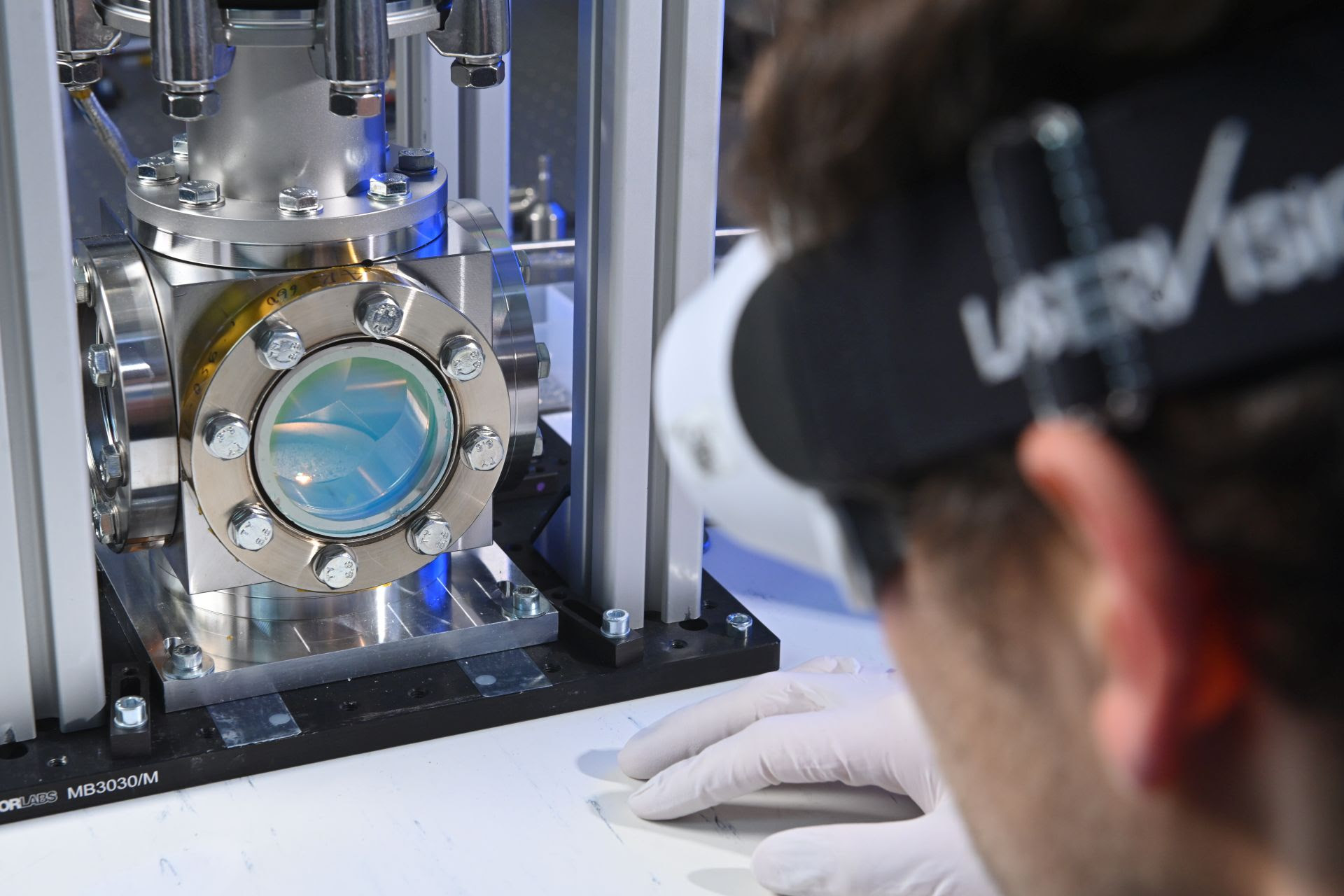
In the MOONRISE project, scientists are researching how to use lasers to 3D print structures from lunar regolith on the Moon. Image courtesy of LZH.
Basically, if you cannot move parts easily, you have to make them where you are. That is where 3D printing really starts to matter. Instead of shipping physical components, missions can carry digital files and produce parts on demand, whether it’s a tool, a replacement part, or something even more complex, like a medical application.
Looking ahead, this goes beyond small parts. NASA and research teams are exploring how to use lunar regolith, or Moon dust, as a 3D printing material. The goal is to use what is already there to build what crews will need. That could include landing pads, protective structures, habitats, and other infrastructure for long-term missions, reducing the need to transport materials from Earth.
If Artemis II is about proving the system, future missions are all about building with it. That means maintaining equipment, producing parts on site, and supporting human activity over time. 3D printing will play a key role, not everywhere, but where it makes sense, and that role will grow as missions move from short visits to staying on the Moon.
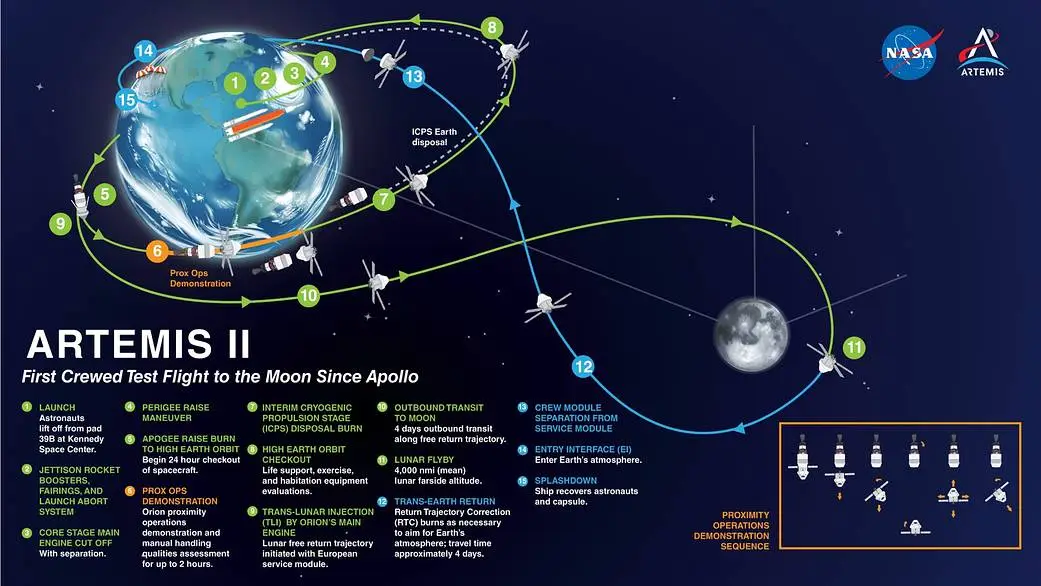
Trajectory for Artemis II, NASA’s first flight with crew aboard SLS, Orion to pave the way for long-term return to the Moon, missions to Mars. Image courtesy of NASA.
With Artemis II now underway, NASA has taken a major step toward returning humans to the Moon. The launch and mission coverage can be followed live through NASA’s official channels, including NASA TV and online streaming platforms.