
I’ve been tracking the US Navy’s additive manufacturing (AM) buildup as it relates to submarines for a while now, and even amidst the AM efforts that all the branches have embarked upon throughout this decade, the metal AM program for subs remains one of the most ambitious objectives on the US military’s industrial agenda. With the announcement from Maine’s Portsmouth Naval Shipyard (PNSY) that it successfully installed a metal 3D printed component on an in-service submarine on March 18, the Navy’s 3D printing capabilities look like they’re finally ready for broader implementation.
After inspecting and testing the component, a copper-nickel flange, maintenance fleet personnel at PNSY installed it on the Virginia-class USS Washington, following years of similar activity in private sector environments. The mission critical status of flanges, which are used to securely connect other components, like valves and pumps, to one another, demonstrates that the US Navy is becoming increasingly comfortable with the level of technical maturity it sees in its metal AM program.
Additionally, now that the precedent has been set, it should provide further stimulus to the branch’s willingness to target even more ambitious goals, such as leveraging AM to expand its use of distributed manufacturing. Last year, the Navy 3D printed a metal component on an aircraft carrier and then installed it on the USS Vermont. The success at PNSY will likely make that approach more commonplace.

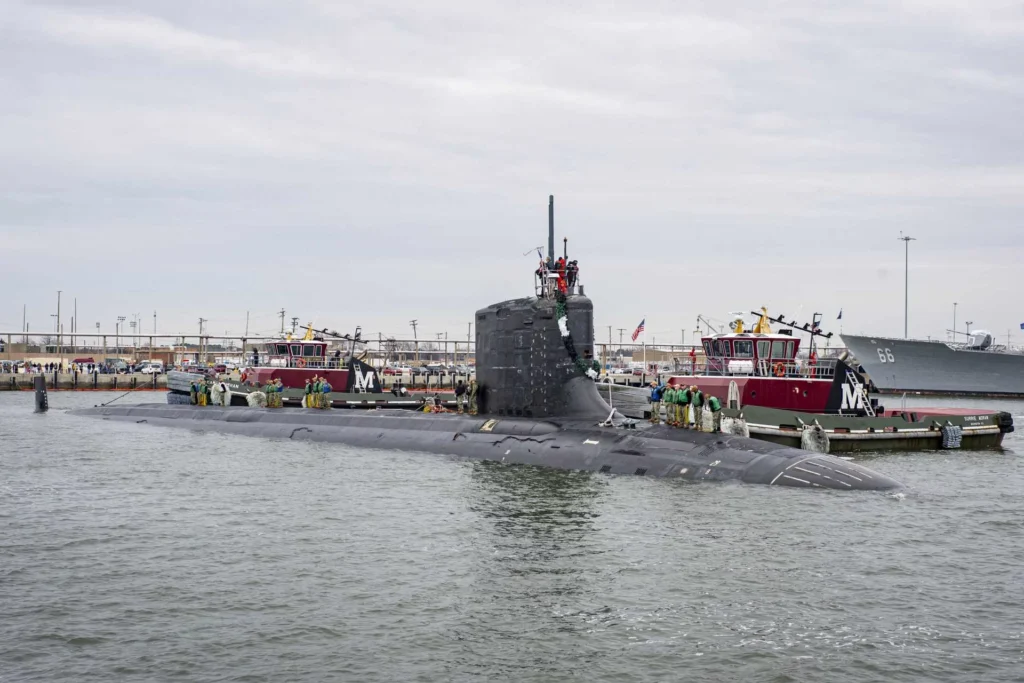
The installed component is a copper-nickel flange, a critical element typically used in critical piping systems and structural interfaces within submarines, where it must withstand high pressure, corrosion, and continuous operational stress. (Picture source: U.S. Navy)
With the war in Iran looking like it’s still in its earliest phases, US defense experts have started to sound the alarm concerning the rate at which the US military is depleting its hardware, most notably including high-cost missile systems. Against that background, there would seem to be a high likelihood that all the branches will try to find ways to accelerate the certification timelines for 3D printed parts.
In a press release about PNSY’s first installation of a metal 3D printed component on an in-service submarine, the shipyard commander, Cpt. Jesse Nice, said, “The unique nature of this momentous achievement is a testament to the strong teaming and innovation that PNSY is known for. For the first time, we forged a submarine component that met the fleet’s most rigorous technical specifications. This was the result of one team, with a single mission —getting the job done correctly and safely.”
Capt. Jason Deichler, commodore Submarine Squadron TWO, said, “Portsmouth Naval Shipyard is leading the organic industrial base in the production and installation of additively manufactured submarine components. This is truly a war fighting enabler and a key component to enhanced undersea readiness.”
I’ve long felt that the purpose of the Navy’s metal AM buildup for submarines wasn’t so much the submarines themselves, but rather the cultivation of the technical support abilities embodied by the buildup. While submarines aren’t quite obsolete yet, the very fact that it’s a realistic possibility, thanks to the rapid advancement of tracking capabilities, arguably makes the submarine program as it has traditionally existed an unjustifiable expense.
I don’t think that means that the US will stop using submarines, but I do think it raises legitimate questions about whether it makes any sense at all to try to keep making more advanced submarine classes. The Columbia program, for instance, was originally supposed to deliver its first sub by 2027, and that deadline has recently been pushed back to 2028 or even 2029. If the US is learning anything in Iran, aside from the fact that starting a war with Iran was probably a poor idea, it’s that it’s bad policy to commit to production timelines that have started to move a generation slower than the technologies that respond to our weapons systems.
Along those lines, the timeline for the class of submarines after the Columbia-class has already moved to the early 2040s, which to me, at least, strongly suggests it will never be built at all. Instead, I think the Pentagon will use all the data and know-how it has amassed thus far from the submarines program, and all the other manufacturing accelerators, to pivot to low-cost autonomous weapons systems.
In that case, the existing submarine fleet could still be used as motherships for subsurface drones, an idea that’s been floated for some time. AM would be all the more crucial in that context, as the supply chains for conventional subs would, over time, become comprised almost entirely of parts that are otherwise more or less out-of-production.
Images courtesy of US Navy