
Japanese firm Space Compass Corporation has agreed to buy a SWISSTo12 GEO optical data relay satellite. The compact Hummingsat will be used for Space Compass’ optical data relay service. Space Compass is an ambitious firm that’s a joint venture between IT giant NTT and pay-TV and satellite service firm SKY Perfect JSAT Corporation. JSAT was the first commercial company to operate a Japanese private communications satellite and operates a constellation of satellites for commercial purposes and Japanese military communications. JSAT, in turn, is owned by a veritable who’s who of the Japanese media and corporate worlds, including Itochu, Fuji Media Holdings, NTT Communications, the Sumitomo Corporation, Nippon TV, and TBS. Itochu and Sumitomo are two of Japan’s largest and most influential wholesale companies (sōgō shōsha) that are really overseas credit and investment firms, kind of a mix between a merchant bank, an investment bank, and an offline Amazon. The other firms are Japan’s largest TV companies.
What Japan wants to do with the satellite is really quite revolutionary. I don’t know why all Japanese corporate mission statement stuff sounds like it comes from eco-conscious nice wizards lording over the future of Earth, but Compass wants to “connect all human beings and data wherever needed in the expanding sphere of human activity by adopting the newest technology to connect Earth and space. This will contribute to creating a sustainable society by eliminating information disparities, thereby solving various social issues, such as natural disasters. It is important for Space Compass that no one is left behind and all people can pursue their peaceful and fulfilling lives.” If only the world would conform more to the dreams of Japanese corporations, imagine how happy we’d all be.
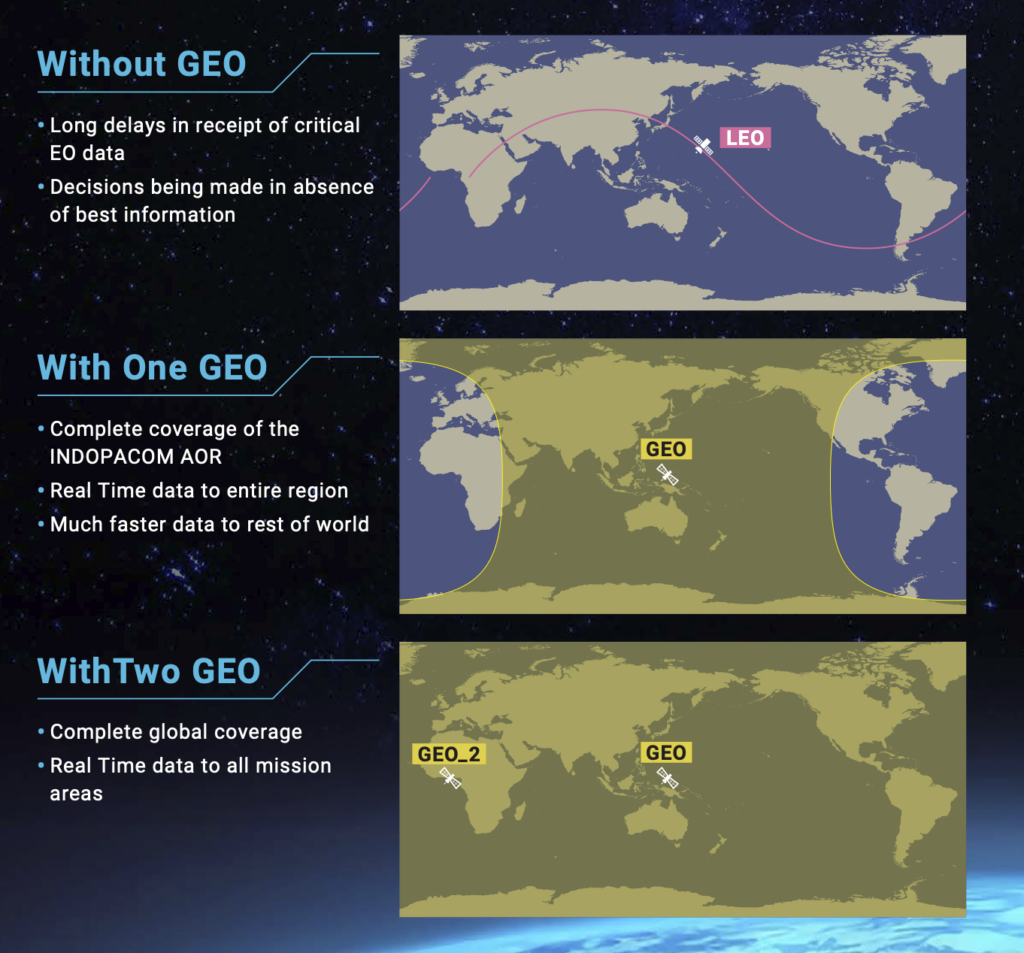
The first step to global fulfillment, apparently, is a GEO Satellite Optical Data Relay Service. This will accelerate the communication of Earth observation satellite data. This is currently not real-time; there is a delay. Information has to be periodically passed to properly placed ground stations when possible. Compass wants to make this information available instantaneously everywhere through its new satellites. This would, in effect, give militaries and companies a live Google Earth based on real-time imagery. A flood or earthquake’s effects could be seen immediately by planners, for example, or a battle could be seen as it unfolds, not in intermittent flashes. For the military, it would give them over-the-horizon control and navigation capabilities for missiles, drones, and military missions generally. One issue in Ukraine now is to, without interception and jamming, control and let navigate drones far away from bases. The Optical Data Relay Service would also solve this issue.
SWISSto12’s CEO Emile de Rijk said,
“We are delighted about this partnership with Space Compass and our shared vision to build multi-orbit, secure space infrastructure that supports some of the world’s most important space missions, such as earth observation. By hosting optical communications payloads for LEO-GEO data relay, HummingSat once again proves its versatility and its outsized impact in enabling purposeful innovation in space.”
While Space Compass Co‑CEO Hiromi Komatsu stated,
“The execution of this procurement contract represents a critical milestone toward the realization of our optical data relay service. By leveraging high speed, high-capacity optical data-relay architecture, we aim to enable faster and smarter decision making through real-time Earth observation insights. This first satellite will play a pivotal role in establishing a new space communications infrastructure.”

The US can probably do this everywhere, but precious few other countries can (I’m going to go out on a limb here and guess France can). With the US periodically cutting off intelligence sharing and satellite access to various allies, a commercial alternative seems like it could be lucrative and definitely could be a good idea for Japan. We would expect more initiatives like this as countries diversify away from the US in light of its late onset capriciousness. Real-time data like this could aid a lot of scientists and government departments while helping investors, analysts, and large companies mitigate risks and sudden onset events as well. Optical data transmission also opens up new types of businesses and communications modalities. You could do secure communications to units, start data services for traveling people, or track lots of containers, for example. Or it could just make search-and-rescue communications more precise and meaningful. You could track lost people, ships, or assets in real time, ping them, judge their movement more accurately, and perhaps even communicate with them.
This is indeed a great thing for SWISSTo12, which has positioned itself to build compact-capable satellites outside the US. We would expect more companies and countries to turn to SWISSTo12 to reduce their dependence on US infrastructure. This also explains our rather breathless, at times, perhaps coverage of SWISSTO12 and its progress. With a new office in Spain, expansion into satcom on hold, a 73 million investment, and expansion of its Swiss factory, the company is moving forward. There are a few companies in 3D printing that I’m more excited about. Geopolitically, SWISSTO12 GEO play is well-timed, while a general expansion of constellations, space businesses, and communications will also give it much more business. This firm has optimized 3D printed components and turned them into a business that is giving information assurance to nation-states and companies. More firms should dominate their applications and leverage that dominance to build influential, growing applications crucial to the world.