
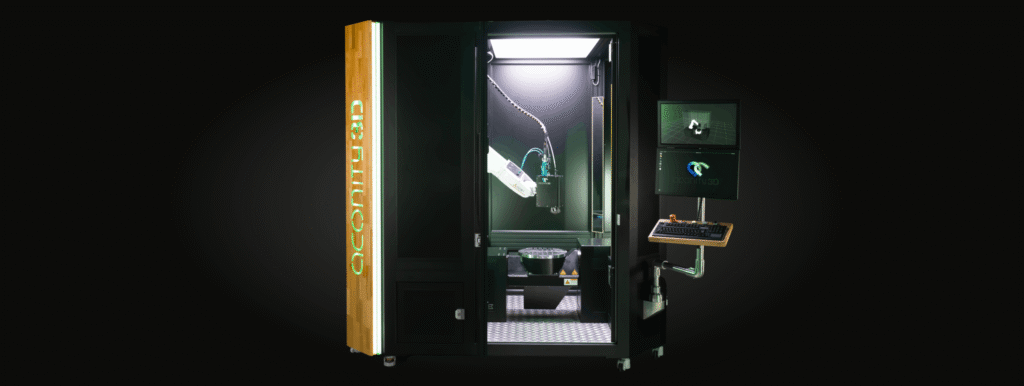
Aconity3D has a line of open systems in polymer LPBF, metal LPBF, and WireDED. A lot of universities and researchers use Aconity systems to develop new processes, test new exotic materials, do more with parameters, and develop entirely new 3D printing technologies. Its Midi system can heat up to 1000 °C while letting you play with every possible parameter. A microsystem has a 40 µm spot size and layer thicknesses under 10 µm and is meant for small structures and powders. The company has now added a new multi-material head to its DED system.
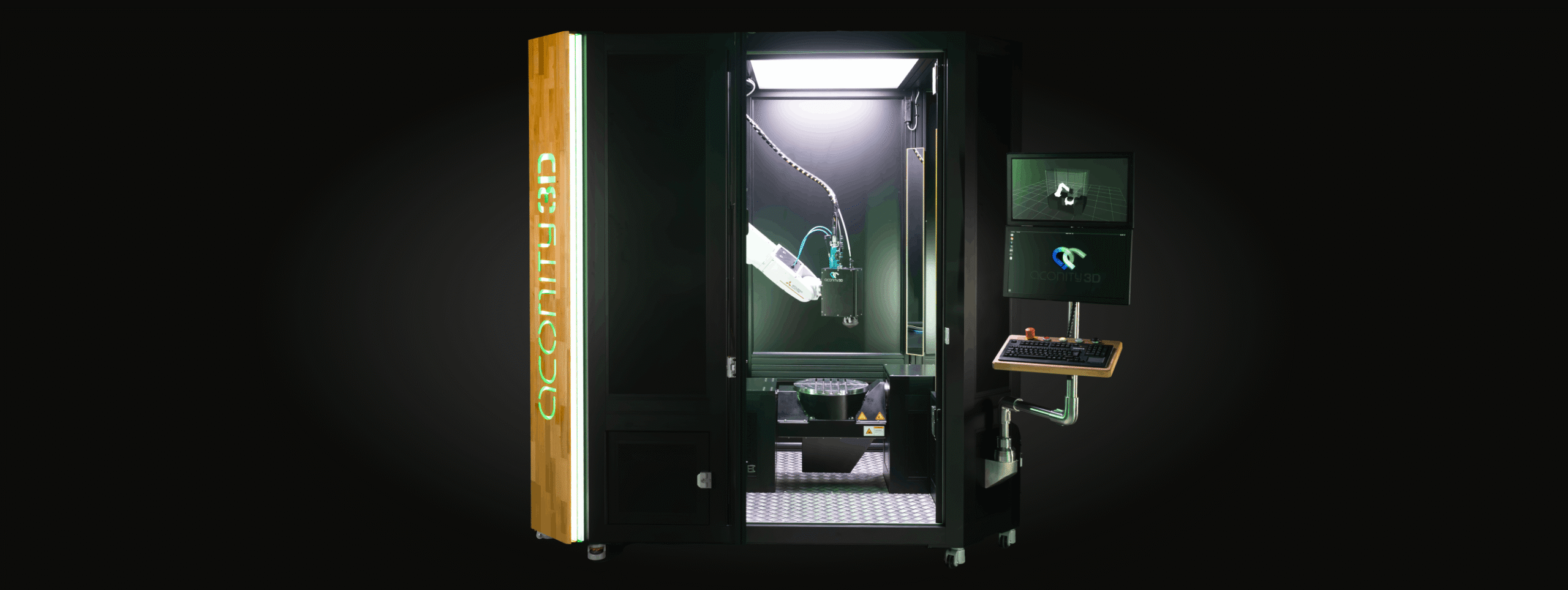
AconityWIRE 3D printer.
The AconityWIRE has a build volume of 400 by 780 mm. The system works with coaxially fed welding wire and has a 6-axis robot and a 2-axis turn-tilt table. The nozzle is shielded, and the system can be heated to 500 °C. Powered by a 1000 W or 1200 W fiber laser. It has been validated on Aluminum, Stainless Steel, Inconel, and Titanium wire. The machine is 3000 x 1500 x 2200 mm and weighs 2 tonnes.
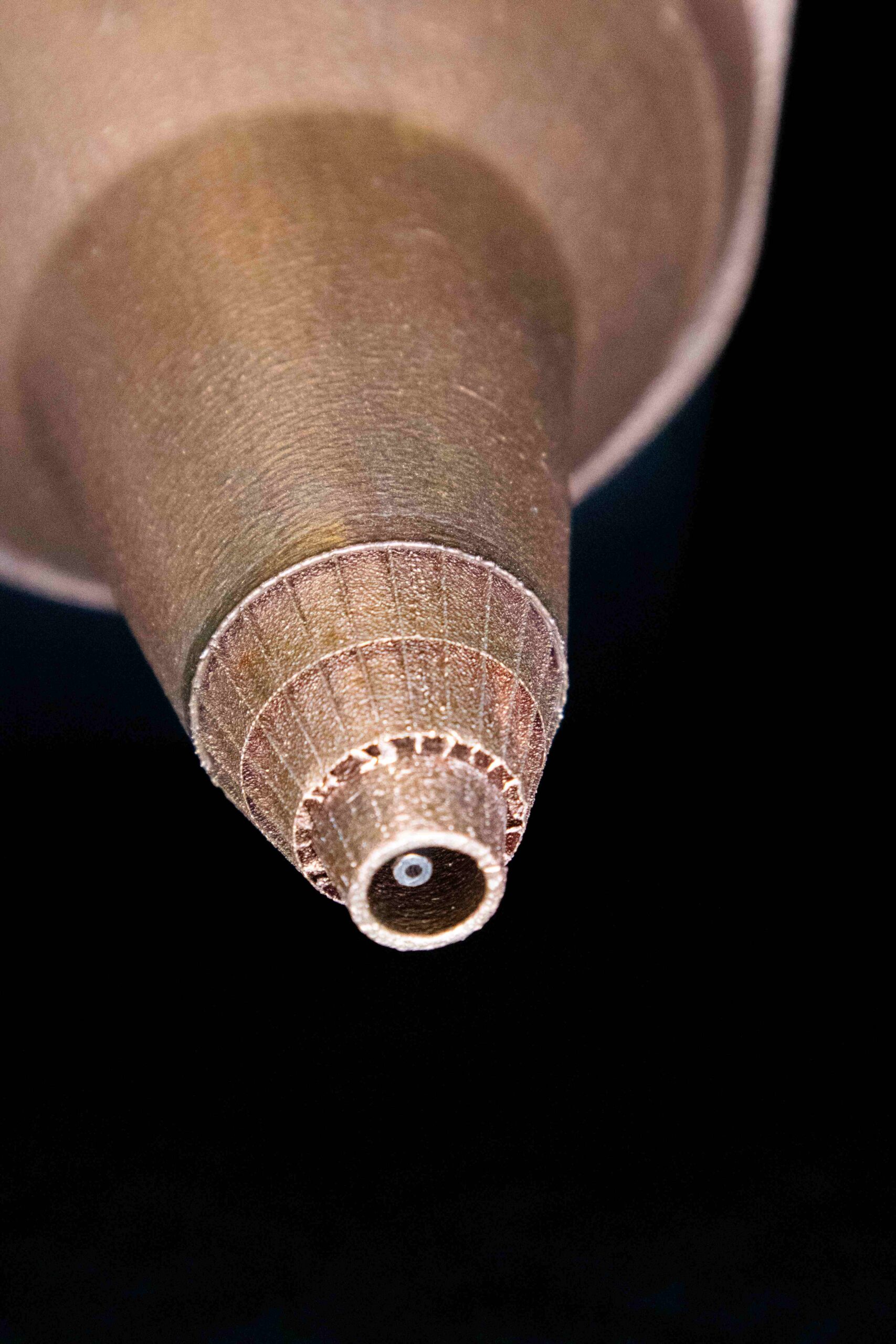
AconityWIRE Multi-Material Weld Head with Robot.
The new head can use up to 3 different materials in a single build. The company says that the system does not have to be significantly changed to implement different materials. Aconity also thinks that MRO, augmentation, and repair could be good use cases for the nozzle. The head can be used with the AconityWIRE, but it can also be added to another system. Rosenheim Technical University of Applied Sciences already has one and there it is being used to make multi-material parts.
WireDED is seeing renewed interest in manufacturing. Energy industries are looking at this process for repair and part production. In mining, oil, gas, and nuclear, we can see people looking to use WireDED for part production. With inexpensive wire, well-understood processes, and a large build volume, WireDED (and also blown-powder DED) provides a cost-effective solution for many larger parts. WireDED is safer to use than many processes as well, since it does not use any powders. That makes it a burgeoning area for expeditionary manufacturing and military use as well. Combined with wire mixing, the abilities of these systems are compounded. One could make armor or hardened surfaces for tools with such a process. Large molds with wear surfaces and conductive ones could be made as well. Perhaps gradient, or gradient-like parts, could be made as well. You could do cool things as well, such as combining very soft materials with hard ones. For automotive, this technology could be made to work for chassis components. We’re already seeing impact in aviation from DED, which is now used to produce commercial aircraft parts.
Often, significant machining is required to make parts smooth. But if we start thinking a little differently, DED will get much cheaper. As long as mating surfaces and functional areas are machined to spec and we check the part’s dimensional tolerances, there is no need to machine the whole thing. I know this sounds super obvious, but people still tend to make parts smooth as they come from other processes. For some things, this is needed. But for many parts, we do not need to machine the entire part. Raw printed WireDED parts are super cheap. If we can use them, then the economics are super good. With this mindset, much cheaper industrial parts are now possible. Cheap, forward-deployed repair and manufacturing of multi-material raw DED parts could be very impactful for militaries and in industry. Along with Meltio and Hybrid Manufacturing Technologies, there’s now another option for a head that can be integrated into your new machine or new research project. This will also help this segment mature and grow. WireDED has long been an underrepresented area in our industry; this may be about to change.
Images courtesy of Aconity3D GmbH