
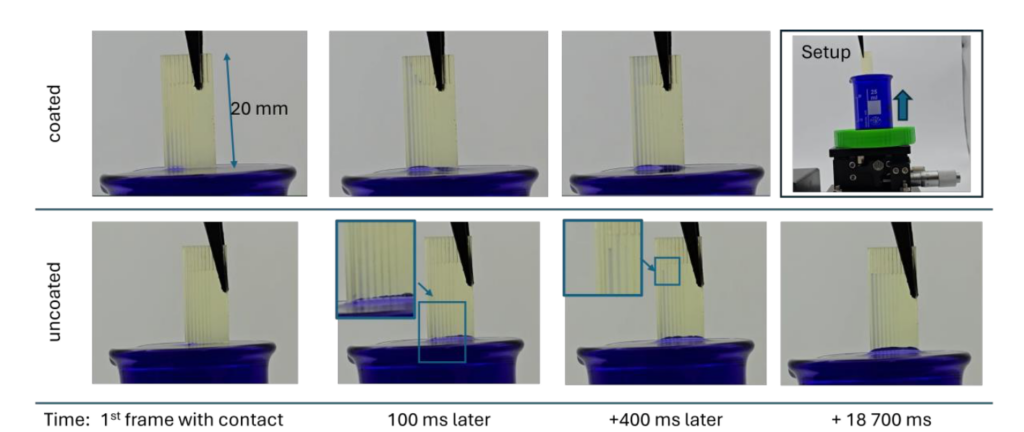
Horizon Microtechnologies uses Boston Micro Fabrication‘s (BMF) Projection Micro Stereolithography (PμSL) technology to make tiny, accurate parts. It then enhances these polymer prints with proprietary coatings and expertise in controlling the dipping process, enabling higher-performance 3D printed parts. By combining micro-scale 3D printing with advanced coatings, Horizon is targeting applications such as electronics packaging, space components, and antennas. Now it is delving deeper into another application: microfluidics.
The firm has come up with coatings that can make “leak-free devices with fully three-dimensional channel networks — without bonded layer interfaces and, in many cases, with much simpler (or no dedicated) capillary priming as well as electrical properties.”
If this holds up in testing, this means that the company could have found an easy, working, repeatable pathway to making microfluidic devices at scale. A lot of microfluidics combines multiple parts, processes, or manual assembly. Many require a whole series of processes, with discrete processes and lots of assembly. This makes a lot of microfluidic devices cost-prohibitive. The idea of microfluidics is that millions of tests, functional environments, or systems can be performed at low cost. In reality, there’s a lot of fiddling with different glues. So, for a certain class of devices, Horizon may be on to something here.
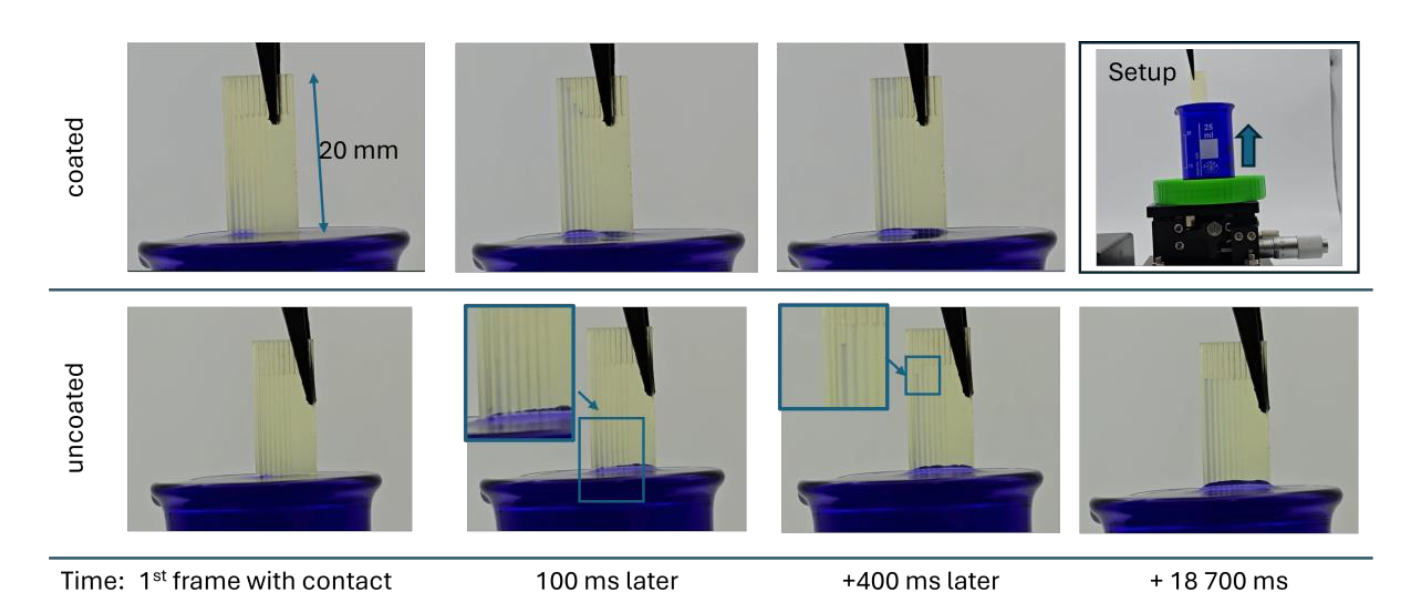
The company says its devices are made directly through printing and coating and can make channels, internal geometry, and micro needle structures, too. These micro needles can be “one millimetre high with multiple, differently sized side openings along the needles’ length.” The company aims to “achieve predictable liquid handling in lab-on-a-chip diagnostics, drug microdosing, and high-precision analysis” by optimizing wetting and flow. Furthermore, parts can be biocompatible, optically clear, and electrically conductive. Coatings can make parts hydrophilic and can also be used to protect parts. One channel could be coated with one material, while another channel could be coated with a conductive material; meanwhile, the outside of the part could be uncoated. Resins are tested to ISO 10993-1:2018.
The flow inside the part could also be better and better optimized for a specific use case. Combining all of these things means that a faster, perhaps cheaper process could make much more of the functionality needed for microfluidics within fewer steps. Combining 3D printing with design also means that more compact, technologically advanced devices could be made.
Horizon Microtechnologies CEO Andreas Frölich said,
“When you combine micro-AM with our coating toolbox, you get microfluidic platforms that are much closer to finished products than to simple test structures. We can deliver geometry, surface behaviour, electrical function, and optical access as one integrated solution, which simplifies development, improves reliability, and accelerates the path from concept to functional hardware.”
The company foresees it making a “microneedle array for microdosing and sampling, a compact diagnostic cartridge, or a microfluidic platform with integrated electrodes and optics, Horizon’s print–develop–coat process offers a practical route from CAD geometry to functionally coated, biocompatible, optically clear hardware ready for testing and scale-up.”
I’m a huge fan of Horizon. I love how they’re taking a two-step process and using it to create a plethora of devices.
Relatively low cost, accurate, tiny, and with lots of different properties, these parts could really win in many areas. Through its coatings, the company has made its offering versatile and fit for purpose. More 3D printing companies should look into coatings to extend the functionality and lifespan of 3D printed components. In Horizon’s case, their process could also be deployed at scale in different markets. Whether in antenna or microfluidics, Horizon could see high volume, sufficient margin, and success at scale.