
Investors have become increasingly anxious about the sustainability of NVIDIA‘s growth trajectory, which is a rather natural outcome when a stock goes up infinity percent or so over the course of a decade. Meanwhile, this healthy skepticism has left the company’s share price at levels that recently led Bloomberg to say it now “looks like a value stock,” and CEO Jensen Huang just declared that the chipmaker anticipates at least $1 trillion in revenue through the end of next year.
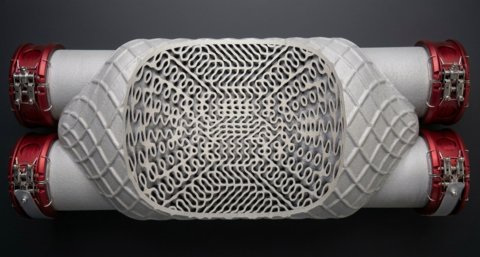
Of course, in order to remain optimistic about the AI boom’s longevity, it’s not enough to factor in NVIDIA’s own projections: what’s perhaps even more critical at this point is the revenue that NVIDIA’s customers are bringing in thanks to adoption of the company’s tech. Moreover, those customers can’t just be hyperscalers; NVIDIA has to prove that its chips are stimulating growth across the economy as a whole, for small businesses in addition to giants. Thus, Sintavia, the Florida-based, additive manufacturing (AM)-enabled contract manufacturer, is signaling quite a milestone with its announcement that it has used NVIDIA’s RTX Pro 6000 Blackwell Workstation Edition GPU to drastically reduce the design and validation timeline for an aerospace heat exchanger.
After designing the part at an accelerated pace, Sintavia ran “over 300 iterations” of a heat transfer simulation in just seven minutes with the Blackwell, a phase of the process which the company notes would’ve taken 11x longer with advanced CPUs. Sintavia used Siemens’ Simcenter STAR-CCM+ CFD software and nTop implicit modeling to design the part, which resulted in a combined 30 percent weight reduction and 20 percent increase in thermal efficiency.
All in all, Sintavia shortened a process that would typically take months into a production schedule of about two weeks.
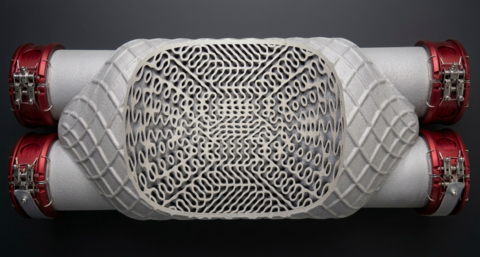
Scooped version of the representative heat exchanger.
Notably, beyond the performance achievement, Sintavia also scored a big PR win by landing a spot on NVIDIA’s website as a customer success story. This is warranted hype: Sintavia managed to weave together a number of relevant economic themes that are poised to continue gaining in relevance in the current geopolitical environment.
In an interview I did with Cisco’s VP of Product Management for IoT Industrial Networking, published earlier this week, I discussed why I think that infrastructure investments, including expanded edge computing capacity, are a necessary precursor to the AM’s next scaling phase. And in another post from this week, I wrote about how the US-Israel war in Iran is likely to lead to the disruption of supply chains far beyond oil & gas.
As evidenced by the company’s GPU competencies, Sintavia is clearly positioned to utilize edge computing to handle the greater networking capacity required for operational growth. As for the supply chain disruptions, while the company didn’t say what the heat exchanger was made from, there are plenty of metal supply chains dependent on the Strait of Hormuz, including aluminum, one of the most common metals used for heat exchangers. The Bahrainian aluminum giant Alba, which operates the world’s single largest aluminum smelting facility, has already cut production by 19 percent in response to the shutdown of shipping through Hormuz.
This obviously has a negative impact on suppliers of aluminum parts as a whole by raising prices, but the persistence of the disruptions could ultimately catalyze greater demand from manufacturers using AM, especially from the addressable market closest to the point of supply. You may pay more for the printed part, but if delivery within a reasonable timeframe is guaranteed, the higher cost might be justified. And lower shipping costs compared to parts from overseas could start to make a dent in the premium.
Finally, although Sintavia’s use-case is an aerospace heat exchanger, NVIDIA’s involvement naturally made me think of heat exchangers for data centers. Digital manufacturing is already an indispensable proof-of-concept for NVIDIA’s long-term business model, for the reasons mentioned at the beginning of this post. If NVIDIA starts eating its own dog food by using a combination of AI and AM to help build up the domestic data center hardware ecosystem, AM will become strategically critical infrastructure for the linchpin of the global market.
Images courtesy of Sintavia