

On its own, additive manufacturing (AM) may not need a new round of record-setting investment in order to move to new heights of scalability (whether or not any investors would even be willing to foot such a bill). But it is highly likely that, as part of a global transition towards anchoring the manufacturing sector in networks defined by industrial internet of things (IIoT) capabilities, the AM industry’s next phase of growth will depend on the effectiveness of investments in AI-ready factory infrastructure.
I recently wrote about this topic in a post about the 2026 State of Industrial AI report from global networking hardware giant Cisco, which found that the ROI for AI spend in manufacturing is heavily determined by a given enterprise’s cybersecurity and networking readiness prior to incorporating AI into its workflow. To sum up: if you want to truly benefit from AI adoption, then before you even start integrating new software platforms, you need to have a structured plan in place across all your operations that takes into account the additional bandwidth and hardware requirements necessary to give AI legs in your work environment.
While those findings are conducive to selling Cisco products, I think that they also happen to align with the economic reality of the moment, and they also align with what AM industry professionals have noted for years when combating 3D printing overhype. We’ve heard over and over again how “AM isn’t plug-and-play,” so when it’s sold like it is, customers are bound to be disappointed. Samuel Pasquier, the VP of Product Management for Cisco’s IoT Industrial Networking Portfolio, explained to me in a recent interview that AI isn’t exactly plug-and-play, either:
“Historically, manufacturers have treated the network like electricity: you plug it in, and it just works. This has led to networks being built in a very organic, unstructured way where security is an afterthought rather than a core component,” Pasquier began.
“But with modern use-cases, the demand for performance and bandwidth is far exceeding what these legacy architectures can handle. Simply ‘plugging in’ doesn’t work anymore; you have to design the network specifically for the performance and security the process requires.”

Essentially, evolving from using AM and other digitally-centered manufacturing technologies as peripheral add-ons to traditional core competencies, to treating them as instrument sections within an orchestra of production, manufacturers need to build on an edge computing foundation. Connecting an entire factory of not just machines, but countless sensors permeated throughout a factory, 24/7, to the cloud, is wholly unfeasible. For the processes entailed to operate smoothly at scale, businesses need to invest in server racks that function effectively as “date-centers-in-miniature” on-site.
One reason for this is to avoid latency:
“We often see companies deploy technology at a small scale — connecting one or two mobile robots in a single shop, for instance — and it works fine,” Pasquier told me. “But when you try to expand that to 100 robots across an entire factory, it becomes a completely different story.
“That is when the network becomes a bottleneck. To gain the full value of technology like AI, you have to rethink the architecture to move beyond isolated stations and look at the entire system.”
In an AM context, this is especially important when 3D printers are integral components within a smart manufacturing ecosystem, rather than simple production tools. Traceability of parts is a key value proposition for AM due to various factors that are becoming increasingly relevant in an era defined equally by geopolitical tensions and the need to decarbonize. Comprehensive part traceability demands traceability of processes, which implies a data tsunami that could drown an unprepared enterprise.
While all of this may make AI for manufacturing sound like it comes attached with a runaway list of constantly arising hidden expenditures, it’s more like a front-loaded investment with the potential to lower long-run costs as the adopting enterprise gradually accumulates efficiency gains. In that way, again, it’s not so different from AM. Another similarity is that both can serve as industrial insurance policies. That selling point may not carry the same flash of social networking apps built for AI agents or the novelty of giving the musically ungifted the ability to make music, but there is serious potential for risk-prevention and, in turn, long-term cost savings:
As Pasquier put it, “When you rely on paper documentation, you invite human error. By moving to a fully connected digital world, you remove that manual portion of the process. While you may have to deal with software bugs, you eliminate the mistakes that humans naturally make. If a computer system is programmed correctly, it simply gets the job done consistently.”
More than money, when it comes to mission critical parts, that has the potential to save lives. Once more, though, you can’t simply “layer on” the capability for this level of documentation on top of a system built on a structure of paper. You need to redesign your enterprise architecture on an edge computing footing.
Screenshot
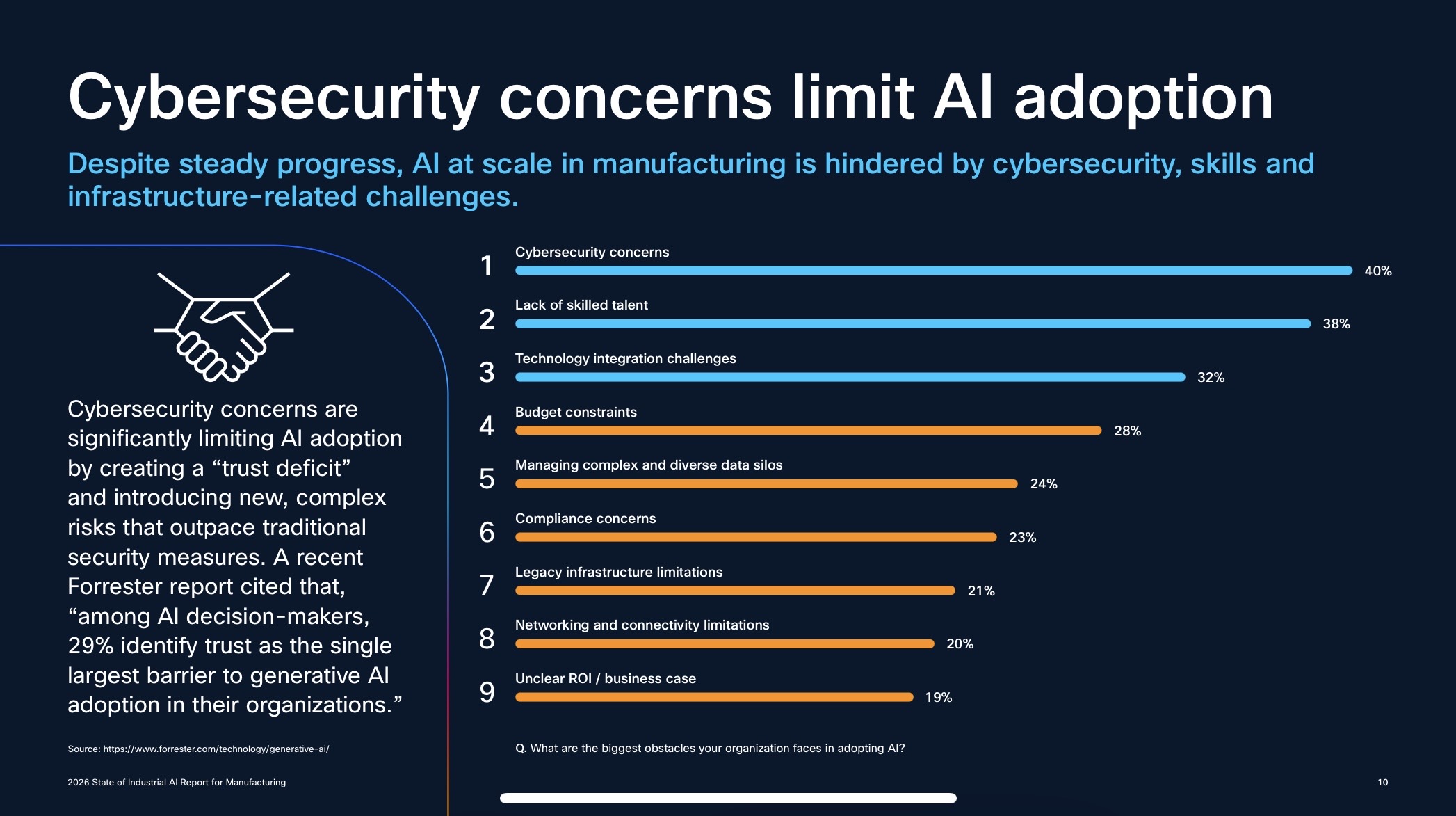
The other major angle to edge computing is cybersecurity. To the extent that the AM industry has concerned itself with cybersecurity at all, the focus has largely been on protecting part recipes. When you’re connecting an entire factory, however, there are added, even more urgent, concerns, namely that cloud outages could lead to operational downtime, or — worst of all — that cloud vulnerabilities could result in remote hijacking of your infrastructure:
“In the industrial world, the primary concern isn’t just losing data, or time,” Pasquier told me, “it’s losing control of the process. If a plant goes down, it is incredibly costly, but if someone takes control of the physical infrastructure, it impacts the safety of the workforce. That is the ultimate ‘red flag’ that needs to be prevented in advance. Security in this context is really about protecting the physical integrity of the overall manufacturing process.”
The Cisco report, and my conversation with Samuel Pasquier, reaffirmed for me that for manufacturers, investing in AI has long-ceased to be a question of “if”, and is now more defined by questions of “how” and “when.” How are the most technologically-adept in the world of hardware acclimating to this new universe of software, and when will the broader manufacturing sector follow the early adopters’ lead?
I think the networking infrastructure context does much to answer the first question. The second question will take longer to answer, because it depends upon a consistent track record in which the use-cases with the clearest path to ROI rise to the fore. But Pasquier already sees lowering the cost of product evaluation as a major driver, which is a positive sign for AM’s potential as an AI beneficiary.
“One of the most immediate returns on investment for AI in manufacturing is in quality control. Take cement manufacturing: traditionally, they have to cure a sample cube for 30 days before they can test its strength. With AI monitoring the humidity and temperature of the ingredients in real-time, they can optimize the kiln’s energy consumption and predict the quality of the batch 30 days in advance. They no longer have to wait a month to know if the product is up-to-standard. And that same logic applies to things like weld penetration, or paint quality, say, in any high-end manufacturing environment.”
Finally, while AI may mean more automation, manufacturing stakeholders also need to keep in mind that in any change management scenario—especially one that centers around substituting a new technology for human agency—implementation can only be as effective as the quality of the human talent responsible for managing the change:
“AI is not going away,” Pasquier concluded. “The writing is on the wall; its presence in the factory is only going to increase. The real question now is how fast a company can move. Success depends on having the right people to deploy these use-cases and the right infrastructure to support them securely.”
Images courtesy of Cisco