
The war in Iran is only about two weeks old, but countless lessons — and warnings — have already emerged for militaries across the planet and the economy in general. One lesson for the Pentagon is that it should probably double- and triple-down on accelerating the adoption of more flexible acquisition processes across its supply chains.
Barely days after the war began, commenters began noting how quickly the US was drawing down its munitions stockpiles, and reports confirm that the nation used a mind-boggling $5.6 billion worth of munitions in just the first 48 hours of strikes. This is unsustainable, but the Pentagon does have some options to turn to when it comes to replenishing its supplies, and one of those options is Ursa Major.
Less than a year ago, the US Air Force Research Laboratory (AFRL) awarded Ursa Major $28.6 million to continue work on the development of the Draper liquid engine, which underwent its first successful hotfire test in early 2024. The contract was for work through early 2027, including a flight demonstration.
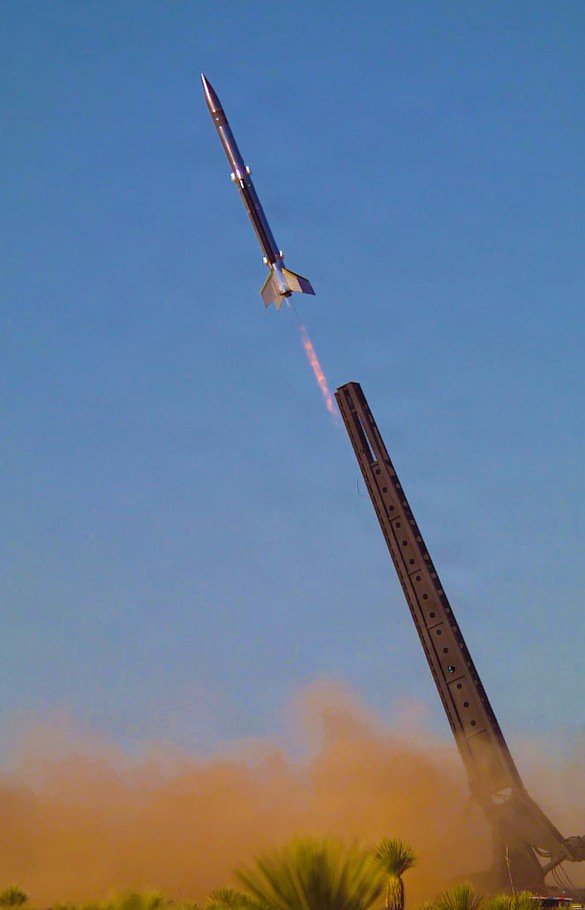
To reiterate, it is well under a year since Ursa Major received that follow-on contract, and the Air Force is already announcing that Ursa Major has successfully completed a test flight with the Draper. Part of a program called the Affordable Rapid Missile Demonstrator (ARMD), the Draper hit supersonic speeds during the exercise, a pivotal milestone toward hypersonic capabilities.
That should be the next phase of the ARMD program, as Ursa Major’s plans for the Draper center around the engine’s role in powering the mid-range, hypersonic HAVOC missile system the company announced in February. In parallel with the Draper, Ursa Major is working on a number of other modular engine systems that heavily leverage additive manufacturing (AM), in partnership with all the major branches of the US military, as well as with the private sector.
In a press release about Ursa Major’s successful test flight of the Draper engine in partnership with the AFRL, AFRL Commander and Air Force Technology Executive Officer Brig. Gen. Jason Bartolomei said, “This project proves that we can transform and leverage our acquisition models to rapidly deliver critical technology advancements to deter and win in a future conflict. We are not just building a single missile; we are forging a new path toward a cost-effective, mass-producible deterrent for the nation.”
Chris Spagnoletti, CEO of Ursa Major, said, “This flight proves that you can get a vehicle with a safe, storable and throttleable liquid engine in the air quickly and affordably. We went from contract to flight-ready of an all up round and propulsion system in just eight months.”

The Affordable Rapid Missile Demonstrator, powered by the Draper liquid rocket engine, seen launching during its recent flight. The flight was a key milestone in increasing the technology readiness level of the Draper liquid rocket engine. Image courtesy of US Army/Ryan Harty.
Almost exactly two years ago, I wrote a post about how the Pentagon’s investment in Ursa Major epitomized the demand signals that should be tracked in order to analyze which companies are most likely to succeed at this point in the history of the AM industry. While rocket motors obviously have an importance all their own, Ursa Major’s growth trajectory is about far more than the specific product that the company manufactures.
As is being repeatedly shown via the dynamics at play in Iran, Ukraine, and all the other flashpoints involved in the troubling number of active conflicts all over the globe, war now moves far too rapidly for the Pentagon’s post-WWII acquisition cycles to keep up. Even if the US could continue the habit of buying conventionally produced weapons to replace what has already been depleted thus far in Iran, and have them delivered within a meaningfully quick timeframe — and everything that is known about the state of the US defense sector in 2026 argues against that — it would still be a grave error. Success in contemporary warfare means leaning towards iteration cycles that are as rapid and as low-cost as possible, so you’re always positioned to adapt with the utmost seamlessness to battle conditions as they emerge.
The logic of war has been inverted so that stockpiles are no longer the deterrent: the deterrent is the infrastructure that can produce the most immediately relevant hardware at any given time. As I described in that 2024 post, this means that, in the arms race between the US and China, for instance, the “arms” in question are no longer the missiles themselves, but the machines that print them.
That is particularly essential to keep in mind given the current primacy of economic warfare in strategic competition. The differentiating factor of a tool like a large-format metal 3D printer is its dual-use capability, not its status as a “rocketmaker.” The ultimate deterrent isn’t projecting the fact that you’re sitting on a giant arsenal: it’s the ability to illustrate in real-time that you can effectively alternate between producing munitions systems on one day and critical energy hardware, medical devices, EVs, etc., the next.