
The longer that the US-Israel war on Iran continues, the more that the discourse surrounding the war will start to absorb strategic tensions between the West and China surrounding Taiwan, and indeed, this started almost as soon as the first airstrikes began a little over a week ago. Xi and Trump are still scheduled to meet at the end of the month, and Trump has reportedly delayed an arms package shipment to Taiwan announced last December, a move that’s seen as a way to cool things down a bit going into the summit.
While Taiwan is a nation of over 20 million human beings, in a world where resource wars are treated as a reasonable negotiating tactic, Taiwan = chips. Aside from its status as a bargaining chip between global superpowers, and inextricably related to that status, the most well-known fact about the East Asian island is that it produces an unsustainably high percentage of the world’s semiconductor devices, including well over 60 percent of chips in general, and about 90 percent of the most powerful chips.
Now, it is morally repugnant to see war and perceive a “business opportunity.” At the same time, since there are more or less no remaining segments of the global economy that can function without semiconductors, figuring out workarounds to any potential disruption to the Taiwan chip bottleneck is less an opportunity and more a necessity for economic survival. It’s not too much to say that contingency plans for the semiconductor supply chain are a requirement to limit the potential for human suffering.
China has already started to figure out its own contingency plans, thanks to years of economic warfare imposed by the US. American restrictions on Chinese purchases of semiconductor capital equipment (semicap) from Western OEMs, most notably ASML, as well as limitations on higher-end devices from NVIDIA, forced the Chinese government to find an alternate path towards the same performance capabilities. As I’ve noted in recent posts, one on a deal between Advanced Production of Electronic Systems (APES) and Great Lakes Semiconductor, another on the Polish company XTPL’s new strategic partnership with Manz Asia, additive manufacturing (AM) is integral to what we can consider to be an insurrection against the status quo of the semicap industry.
The key point I made in framing the significance of both deals is that chip design that moved beyond 2D to 2.5, and 3D was “the silent economic revolution of the 2010s.” Shifting the design of integrated circuits (ICs) from logic that only worked in a side-by-side arrangement to a logic that fully incorporates the z-axis has enabled a complete reimagining of how semiconductor devices can be created. In addition to the System-on-a-Chip (SoP) model, semiconductor OEMs are now also starting to see how far they can go with chiplets: the System-in-a-Package (SiP) model defined by stacking a number of less sophisticated dies. Increasingly, AM is the tool that the new wave of semicap OEMs are leveraging to deliver the advanced package necessary to produce chiplets.
Because of how secretive the semiconductor industry is, for every company that we know about that’s using AM for advanced packaging — like the aerosol jet AM tech produced by Optomec — or any other technique that enables semiconductor OEMs to avoid relying exclusively on standard manufacturing processes, there are probably a dozen companies getting off the ground that we know little to nothing about. Atomic Semi, for instance, describes itself simply as “building a small, fast semiconductor fab.” OpenAI reportedly invested $15 million in the San Francisco startup in 2023, valuing it at $100 million.

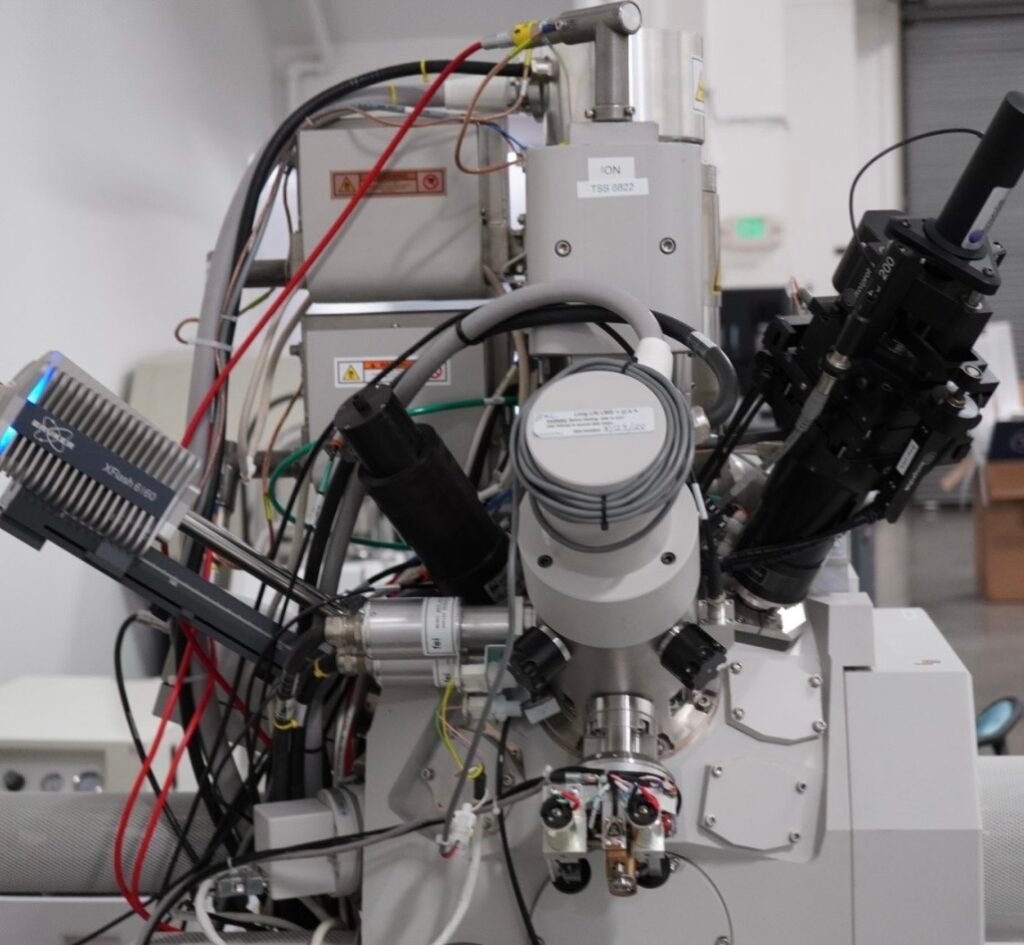
Atomic Semi’s experimental lab setup for developing next-generation chip fabrication tools. Image courtesy of Atomic Semi.
Atomic Semi’s co-founder, Sam Zeloof, has a popular YouTube channel where he documents his adventures making chips in his garage, and in November 2022, tweeted, “I’m building a semiconductor fab fab.” On the company’s website, Atomic Semi notes that, “We believe our team and fab can build anything. We’ve set up 3D printers, a wide array of microscopes, e-beam writers, and general fabrication equipment.” It’s not entirely clear what role 3D printers play in Atomic Semi’s workflow, but an article in the South China Morning Post (SCMP) from February 2026 perhaps provides some hints.
The article, reporting on the return to China of Xu Zhenpeng, an engineer who worked at Atomic Semi, briefly describes some of what Xu was up to at the startup, alongside a highlight reel of Xu’s 3D printing career. Xu returned to China to serve as an assistant professor at Shanghai Jiao Tong University:
“Before returning to China, Xu led a team at California-based manufacturing start-up Atomic Semi, where he developed 3D printing techniques aimed at making chip production faster and cheaper than conventional methods that rely on bulky, multimillion-dollar machines,” writes the SCMP.
“Xu earned his PhD from University of California, Los Angeles in 2023 and is regarded as a rising talent in large-area, micron-precision 3D printing, a technology increasingly applied in electronics manufacturing.
According to his faculty profile at Shanghai Jiao Tong University, Xu was a key contributor during his doctoral studies to U.S. Department of Energy and National Science Foundation projects focused on ultra-lightweight materials and advanced multi-material 3D printing.“
“Large-area, micron-precision 3D printing” does in fact appear to be one of the technologies that chiplet manufacturers are taking seriously, and the DeSimone Lab at Stanford has developed a form of the process called roll-to-roll continuous liquid interface production (r2rCLIP), built on the tech that powers Carbon’s 3D printers. In any case, I think we can assume that Professor Xu will found some startups of his own in China.

Inside Atomic Semi’s lab, where engineers are developing tools to manufacture semiconductor chips. Image courtesy of Atomic Semi.
To summarize what’s happening: the US prevented China from easy access to mass quantities of the most powerful semiconductor devices, and even more importantly, from the capital equipment needed to make those devices; China leveraged the chiplet solution as a Plan B; the US is now scrambling to develop its own version of a backup plan.
Meanwhile, a potential conflict involving Taiwan is far from the only reason why having a contingency plan matters. ASML’s rollout of its latest generation of production equipment, High-NA EUV, has been met with more reluctance by the market than it would presumably have liked, as fabs rightly question whether it makes sense to go all in on a machine with a $350 million price tag. While skeptics are ultimately likely to come around, the response almost certainly gives ASML pause about continuing to hinge its business model on machines that double in price every generation from hereon out.
If the OpenAI investment in Atomic Semi is any indicator, flexibility in production processes for both chipmakers and semicap suppliers is likely to be a dominant theme in the next phase of the history of chips. Remaining lean and agile is the utmost virtue under these circumstances.
Thus, AM should have roles to play in the emerging semicap order far beyond enabling new chiplet designs. Equipment suppliers will need to respond to changing market conditions at a moment’s notice and adjust production targets and timelines accordingly. AM is ideally suited to just that task. It will be fascinating to see how the world’s most innovative product developers use it to reinvent themselves.
Featured image courtesy of Stanford University and DeSimone Research Group: The r2rCLIP setup in the DeSimone lab runs from right to left. The printing occurs at the area below the red piece.’