
3D Systems (NYSE: DDD) closed out 2025 with stronger performance in the final quarter, helped by growing demand for 3D printing in healthcare, dental, and aerospace applications. The company said new printer sales and higher materials use helped raise results late in the year, while cost-cutting programs reduced expenses and improved its financial position. At the same time, the bigger picture for the full year was tough with revenue still lower than the year before despite growth in some key markets. The company now expects to build on its momentum in 2026 as more industries adopt additive manufacturing (AM).
The company reported fourth-quarter revenue of $106.3 million. That was a 16% increase compared with the previous quarter, a stronger result than the company had expected. Management said the increase was mainly driven by higher sales of printer systems and increased materials consumption as more installed machines began operating.
However, compared with the same quarter a year earlier, revenue declined by 4%. Part of that drop is related to the company’s sale of its Geomagic software business in April 2025. Because Geomagic contributed revenue in the prior year but is no longer included in the company’s results, the numbers are not directly comparable. After adjusting for Geomagic, 3D Systems said revenue actually increased by about 3% year over year.

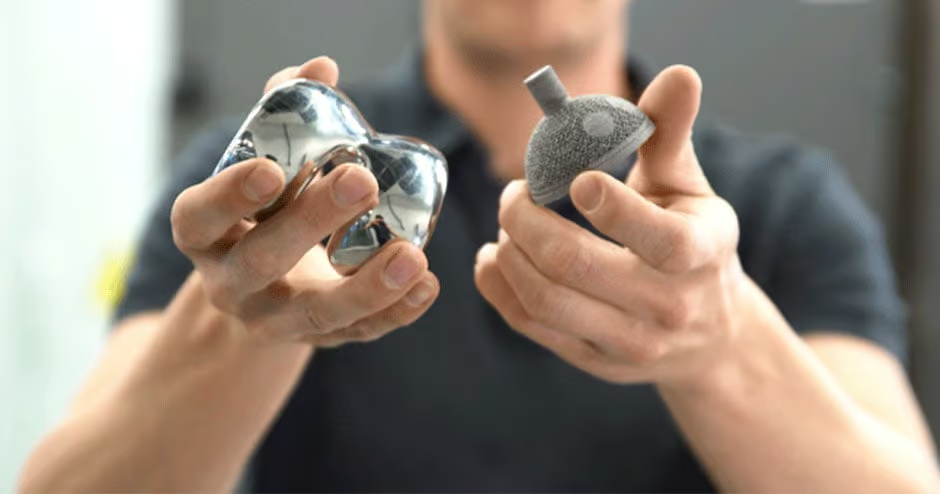
3D Systems creates implantable medical devices. Image courtesy of 3D Systems.
Much of the company’s growth came from its healthcare business. Revenue in the Healthcare Solutions segment rose to $50.5 million in the fourth quarter, increasing 25% from the same period in 2024. Much of that growth came from the company’s personalized health services business, which includes patient-specific medical devices and surgical planning services.
CEO Jeffrey Graves said, “Within med tech, our personalized health services business delivered strong double-digit year-over-year growth in the fourth quarter and for the full 2025 fiscal year, and has become the largest segment within our healthcare business. This growth is being fueled by our expansion into the trauma market, enabled by shorter cycle times for surgical planning and execution. In addition, our point-of-care centers, now expanding to even more leading research hospitals, are at the cutting edge of complex orthopedic procedures, in many cases related to oncology treatment. Our ability to offer solutions printed in titanium or medical-grade PEEK is of significant value to surgeons as they work to treat patients and restore their quality of life.”
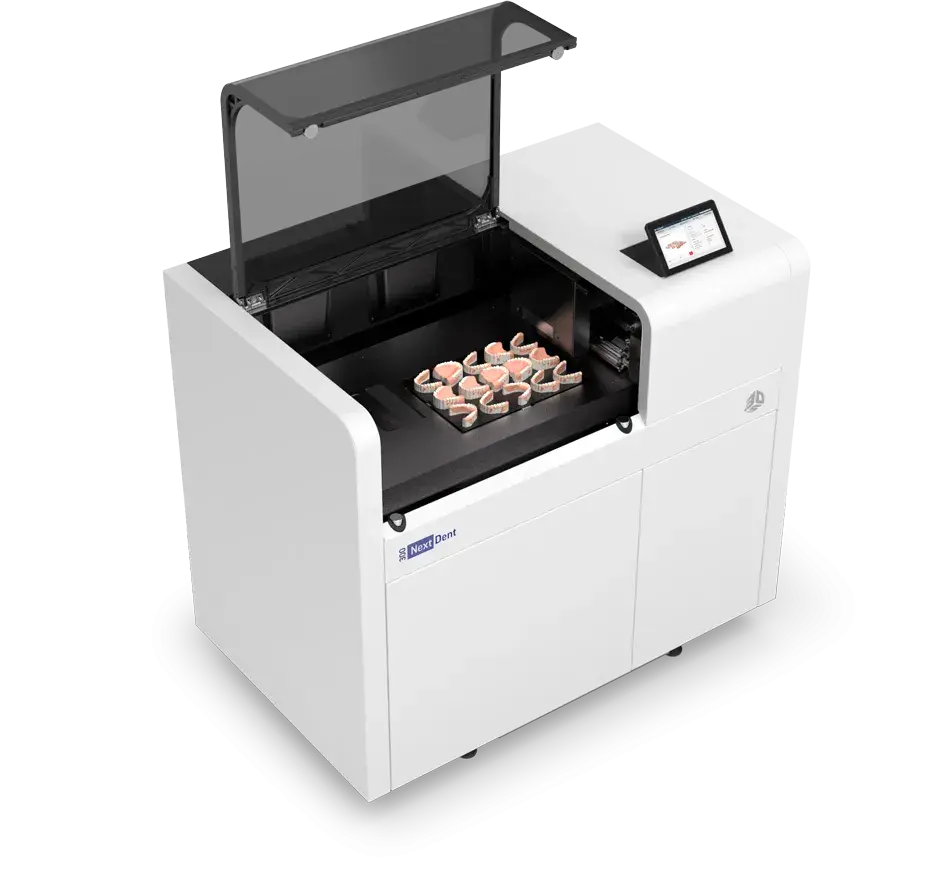
NextDent Jetted Denture Solution. Image courtesy of 3D Systems.
Dental applications were another area of growth. The company said its dental business increased at a strong double-digit rate compared with the previous quarter. This growth was helped by a recovery in the aligner market and the launch of new denture manufacturing technology, including its NextDent Jetted Denture Solution, which produces full dentures in a single print.
Industrial markets showed a more mixed performance. Industrial Solutions revenue declined 21% year over year in the fourth quarter to $55.8 million. When excluding the Geomagic divestiture, the decline was closer to 11%.
Despite that decline, the company highlighted aerospace and defense as a major opportunity. Revenue in this sector grew 16% for the full year, slightly exceeding the company’s internal target of 15% growth.
Graves said aerospace and defense customers are increasingly using AM as a production method rather than just for prototyping. The company expects revenue from this sector to grow roughly 20% in 2026.
The company also said that strong printer sales during the quarter slightly reduced profit margins. This is common in the 3D printing industry because printer systems usually generate lower margins than materials and services. However, once printers are installed at customer sites, they often lead to ongoing sales of materials, spare parts, and service contracts, creating recurring revenue over time.
Gross profit margin for the fourth quarter was 30.8%, slightly below the 31% reported in the same period last year.
Moreover, 3D Systems continued to focus heavily on reducing costs during the year. The company said its restructuring and efficiency programs produced about $55 million in annualized savings in 2025.
These efforts helped improve profitability compared with earlier periods. Net loss for the fourth quarter was $19.5 million, an improvement of $14.2 million compared with the previous year. Adjusted EBITDA also improved significantly, reaching a loss of $5.3 million, compared with a much larger loss a year earlier.
The company also improved its balance sheet by restructuring its debt and eliminating most of the 2026 debt. At the end of the year, it held $97.1 million in cash, compared with about $171 million at the end of 2024.
“We remain intensely focused on reducing overall spending, while prioritizing strategic investments that drive growth in our priority markets,” noted Phyllis Nordstrom, Interim Chief Financial Officer of 3D Systems.

Lightweight brackets for satellites made with 3D Systems’ Direct Metal Printing (DMP) technology. Image courtesy of 3D Systems.
For the full year, revenue totaled $386.9 million. That was a 12% decline from 2024, although part of the decrease was related to the Geomagic divestiture. After adjusting for that sale, revenue declined about 7% year over year.
More specifically, Healthcare Solutions’ revenue for the year reached $179.6 million, while Industrial Solutions generated $207.3 million.
Net income for the full year was $29.9 million. The improvement was largely due to gains from the sale of businesses, including the Geomagic divestiture, along with lower operating expenses and fewer asset impairment charges compared with the previous year. Adjusted EBITDA for the full year remained negative at $45.4 million, though that still represented a significant improvement from the previous year.
Looking ahead, the company expects first-quarter 2026 revenue to be between $91 million and $94 million. Adjusted EBITDA for the quarter is expected to range between a loss of $3 million and $5 million.
Even though revenue was mixed, the company says the long-term outlook is still positive. Growth in healthcare, dental applications, and aerospace manufacturing continues to drive the adoption of AM technologies. And Graves said these industries are increasingly turning to 3D printing as a core manufacturing tool rather than an experimental technology.
“Three markets were particularly noteworthy: med tech, dental, and aerospace and defense, which are rapidly adopting 3D printing as a core manufacturing method. These three markets have been a particular focus for our new product development over the last several years, and we believe they offer sustained growth opportunities over the next decade,” he said.
For 3D Systems, the strategy moving forward is to expand its presence in these high-value industries while continuing to control costs and improve profitability.