
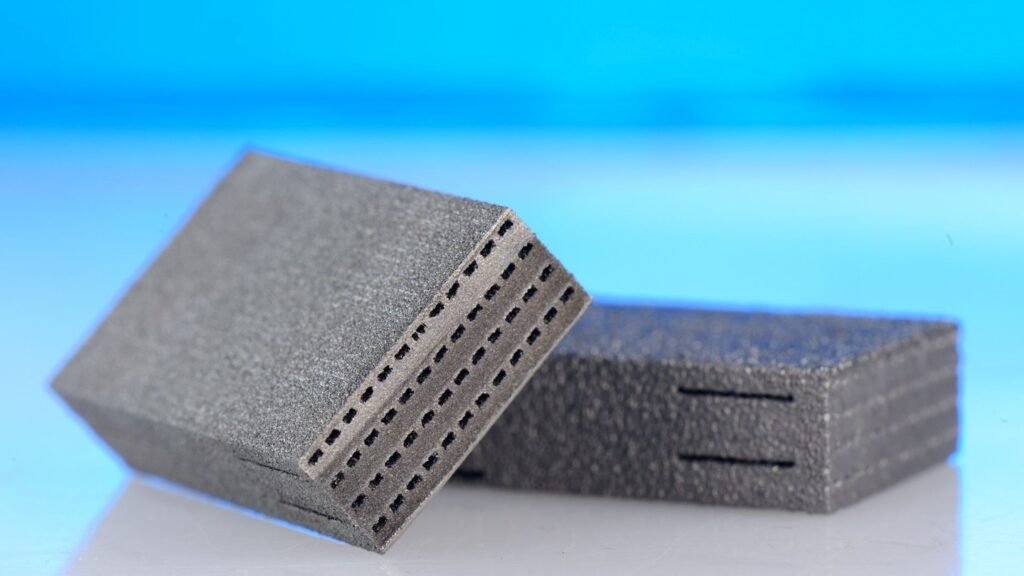
The Aachen-based Fraunhofer Institute for Laser Technology (Fraunhofer ILT) is to research titanium aluminide hydrogen reactors and heat exchangers. The hope is that lightweight, better-performing 3D printed components will make the production of hydrogen for transport more efficient. Specifically, this project wants to allow for onboard hydrogen creation. Power-hungry vehicles like mining excavators, combines, or aircraft could possibly be candidates for this.
I personally am a hydrogen sceptic thinking. That this will be akin to standardizing your energy system on a single battery technology seems rather costly now and in the future. At the same time, things that move with lots of hydrogen on board seem like they could be a boon for terrorists. For additive, hydrogen storage, dissemination, and creation are also big opportunities, however. Hydrogen tanks could be made using DED or large-format composites, while many filtration, reaction, and heat-exchange components could be printed.
This project is called InnoWaerm and consists of 1.5 million euros from the German Federal Ministry of Research, Technology and Space (BMFTR) and will take 2 years. Fraunhofer ILT will work together with the Fraunhofer Institute for Microengineering and Microsystems (Fraunhofer IMM). The Mainz-based institute has extensive experience in developing small hydrogen reactors.
Parliamentary State Secretary at the BMFTR, Matthias Hauer, stated that,
“With the High-Tech Agenda Germany, we are setting clear research and economic policy impulses for Germany as a location for innovation. The goal is to systematically transfer scientific excellence into marketable technologies and societal applications.The BMFTR’s VIP+ validation funding program creates a reliable bridge between research and value creation – open to all topics and exploitation paths. The VIP+ funded project InnoWaerm demonstrates this impressively and will make an important contribution to competitive and sustainable mobility of the future with its innovative manufacturing process. I wish the project team the greatest possible success.”
Meanwhile, Fraunhofer ILT’s Andreas Vogelpoth stated that,
“With InnoWaerm, we are developing a solution to make hydrogen compact, lightweight, and robust for mobile heavy-duty applications. With our technology, we are creating the foundation for climate-neutral drives for aircraft and large agricultural machinery, where batteries reach their limits.”
The project will look at making heat exchangers and onboard microreactors that turn methanol or ammonia into hydrogen. Roving ammonia-hydrogen bombs on board immense mining vehicles, I can’t think of anything else I could spend my money on. What could go wrong?
The material used will be titanium aluminide, a brittle intermetallic that has been used in turbo machinery and other high-temperature applications.

InnoWaerm combines novel materials with application-oriented research, using titanium aluminide reactors that are designed to generate hydrogen directly on board aircraft by converting liquid carrier substances. Image courtesy of Fraunhofer ILT.
Vogelpoth explains that,
“Titanium aluminide belongs to the intermetallic phases. It combines properties of metallic and ceramic materials. The unusual alloy is extremely lightweight, heat-resistant, but also brittle and difficult to process. That’s why it was hardly usable for complex components until now. With our new preheating technique in the laser melting process, we can now change that. This makes it possible to produce microstructured reactors that are light enough for use in mobile applications, from aircraft to agricultural machinery. What we want to show: It works. It’s feasible. And it’s worthwhile.”
I thought that titanium alloys specifically had issues when they came into contact with high-temperature steam from ammonia? Perhaps the material could protect itself with an oxide coating, but I was under the impression that it would degrade. I like the work here because these kinds of high-temperature heat exchangers could be used in applications such as ammonia production, which could then be used to produce fertilizers or other chemicals.