
As additive manufacturing moved beyond prototyping, its first sustained production relevance emerged in applications where performance considerations outweighed cost efficiency and throughput. The driving factor in these cases was not the novelty of the technology, but the ability to realize geometries and functions that were difficult or impractical to achieve with conventional manufacturing methods.
This dynamic was most visible in sectors where part value was high and design constraints were tight. In aerospace, weight reduction, part consolidation, and internal features delivered measurable performance benefits. In medical and dental applications, patient-specific geometry and controlled porosity addressed functional and clinical requirements that conventional processes could not easily accommodate. In tooling, conformal cooling enabled more uniform thermal control and shorter cycle times, improving downstream manufacturing performance rather than the tooling itself.
The central challenge in these applications was not whether additive manufacturing could produce the required geometry, but whether it could do so with sufficient consistency and confidence. Performance gains were often offset by increased demands on process control, material traceability, and post-processing. In many cases, additive manufacturing shifted complexity rather than removing it.
The industrial response was to narrow the scope and stabilize variables. Additive manufacturing was introduced for clearly defined part families, often with frozen designs, fixed parameter sets, and tightly controlled material supply. Production volumes remained limited, but predictability improved. Where additive manufacturing was successful, it functioned as a specialized production route within a broader manufacturing system rather than as a general purpose alternative.
This pattern reinforces a broader observation. Production adoption has been driven by application specific performance requirements rather than by general improvements in machine capability. Where performance advantages were marginal or could be achieved by optimizing conventional processes, adoption tended to stall. Where performance gains were structural, additive manufacturing persisted despite higher complexity and cost.
Additive manufacturing in regulated production environments
As additive manufacturing entered production contexts with higher safety and liability exposure, it increasingly encountered regulated industrial environments. This shift was most visible in aerospace, medical devices, and parts of the energy sector, where manufacturing processes are subject to formal qualification, documentation, and change control requirements.
The force driving this integration was not regulatory pressure itself, but the growing relevance of additive manufacturing in applications in which regulation is intrinsic to market access. Once AM was used for load-bearing aircraft components, implantable medical devices, or other safety-critical systems, it became subject to the same governance expectations as any established manufacturing process in those domains.
The primary challenge that emerged was not technical feasibility, but procedural compatibility. Additive manufacturing processes are sensitive to changes in material batches, machine condition, software versions, and parameter sets. In regulated environments, such changes are significant. They often trigger requalification, additional testing, and formal approval cycles. This reduces flexibility and slows iteration, even when technical improvements are available.
The industrial response has been a tendency toward constraint and standardization. Additive manufacturing implementations in regulated sectors are typically narrow in scope, with well-defined part definitions, locked process windows, and conservative change management practices. Process improvements are introduced cautiously and infrequently, with stability and traceability taking precedence over rapid optimization.
This has had a structural effect on how additive manufacturing is used industrially. In regulated contexts, AM systems are treated less as flexible manufacturing platforms and more as fixed production processes. While this limits adaptability, it enables compliance and long-term reliability, which are prerequisites for sustained use in these sectors.
The result is a form of adoption that is durable but deliberately slow-moving. Additive manufacturing continues to expand in regulated industries, but primarily through incremental qualification of specific applications rather than through broad substitution of existing production processes.

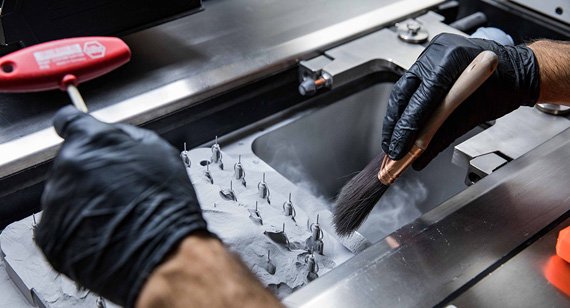
Metal 3D printing. Image courtesy of Protolabs.
Market cycles, hype, and capital shaping adoption
In parallel with technical and industrial development, additive manufacturing has been shaped by successive market cycles in which expectations, capital availability, and strategic narratives have acted as external forces. These cycles have not been unique to additive manufacturing, but their effects have been particularly visible in a technology that combines high capital intensity, long qualification timelines, and broad claims of applicability.
A first phase of market expansion emerged alongside the professionalization of rapid prototyping. In this period, additive manufacturing was framed primarily as an engineering productivity tool. Investment followed demonstrated value in design iteration, reduced development time, and improved communication across product teams. Growth remained closely aligned with observable industrial use, and expectations were relatively contained.
A second phase coincided with the broader maker movement and a rapid reduction in hardware cost. Desktop systems, open software ecosystems, and accessible materials expanded awareness and participation well beyond traditional industrial environments. This phase functioned primarily as a diffusion force rather than an industrialization one. While it did not translate directly into large-scale production adoption, it broadened the perceived scope of additive manufacturing and reinforced the idea of AM as a general-purpose fabrication technology.
A third phase, beginning in the mid 2010s, was driven less by technical inflection points and more by financial and strategic dynamics. Additive manufacturing became associated with narratives of industrial disruption, supply chain transformation, and manufacturing reshoring. Expectations around market size and adoption speed increased rapidly, and capital flowed accordingly. Companies expanded headcount, capacity, and acquisition activity in anticipation of near term scale that, in many cases, was not yet supported by industrial demand, qualification readiness, or organizational maturity.
These responses were not irrational. They reflected prevailing signals from capital markets, policy discussions, and comparative technology narratives at the time. Over time, however, the mismatch between investment timelines and the slower realities of industrial adoption became visible. Valuations adjusted, consolidation increased, and several organizations were forced to retrench, reduce capacity, or narrow their scope. The resulting correction has contributed to the more restrained market conditions observed today.
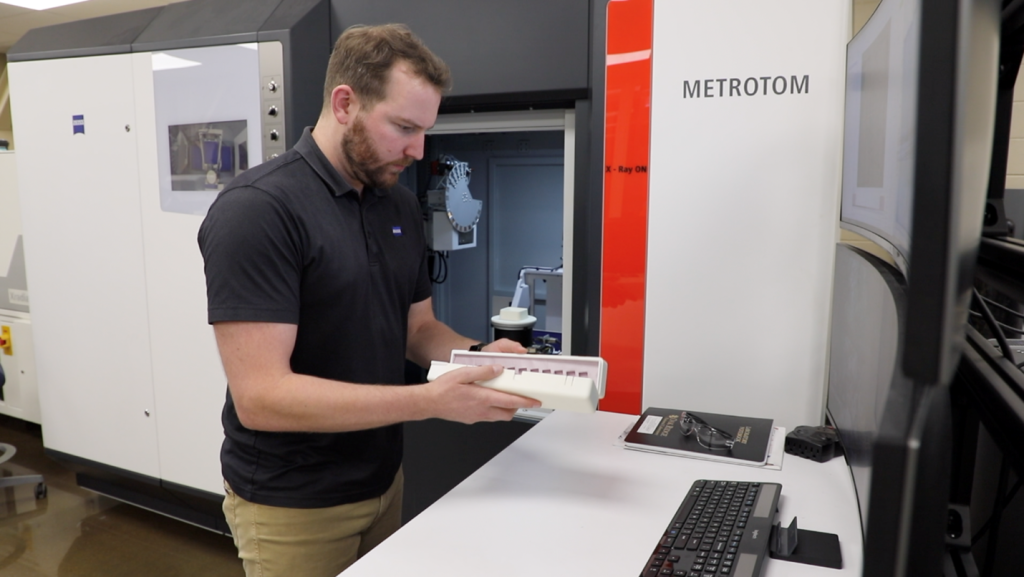
Paul Brackman loads 3D printed metal samples into a tower for examination using an X-ray CT scan at ORNL. Image courtesy of Brittany Cramer/ORNL, DOE.
These market cycles did not fundamentally alter the underlying industrial logic of additive manufacturing. They amplified attention, accelerated some forms of experimentation, and increased infrastructure investment, but they did not remove the structural constraints associated with qualification, process stability, economics, or organizational integration. Capital reshaped behavior around AM rather than changing what the technology could reliably deliver.
More recently, attention has begun to shift toward business models that align more closely with additive manufacturing’s demonstrated strengths. Clear aligner production, digital inventories for spare parts, and controlled forms of mass customization illustrate approaches in which AM is embedded within tightly defined value chains rather than positioned as a universal manufacturing alternative. These developments remain limited in scope, but they point toward adoption driven as much by system design and commercial structure as by process capability.
Viewed in this light, market cycles and hype are best understood as contextual forces that shape the pace, emphasis, and investment behavior rather than as indicators of technical success or failure. The current market environment reflects a realignment between expectation and industrial reality. As in earlier phases, durable progress is likely to emerge where capital deployment, organizational capability, and application-specific value remain closely coupled.
Part 2 has examined how performance demands, regulatory frameworks, and capital cycles shaped additive manufacturing’s industrial trajectory. The final installment turns to system-level integration, supply chain strategy, persistent structural constraints, and what the current state of additive manufacturing reveals about its future development.

Ulf Lindhe. Image courtesy of The Org.
About the Author:
Ulf Lindhe is a veteran executive in the additive manufacturing industry with decades of experience spanning technology development, industrial strategy, and global market expansion. He has held senior leadership roles within the metal additive manufacturing sector, contributing to the commercialization and international growth of advanced AM systems. Over the course of his career, Lindhe has worked closely with aerospace, medical, and high-performance engineering companies, helping bridge the gap between technological capability and practical industrial deployment.