
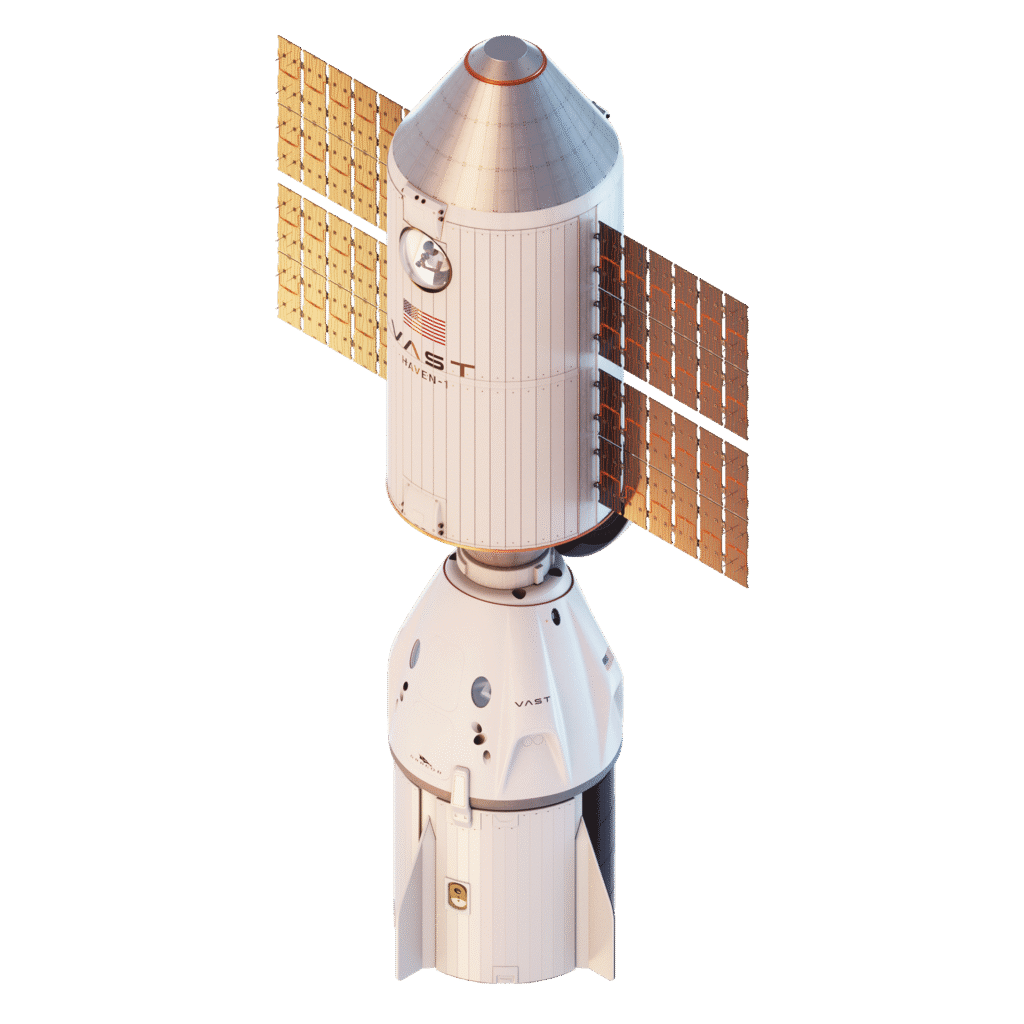
ISS was built over decades by a consortium of nations but Vast would like to replace it by itself. Founded by Jed McCaleb the company has been built on top of his cryptocurrency fortune acquired as a cofounder of Stellar. Jed also created Mt. Gox, the first functioning Bitcoin exchange and was a cofounder of Ripple. His pioneering efforts in crypto lead to an estimated $3.9 billion fortune. Mtgox was initially meant to be an exchange for Magic the Gathering cards but luckily Jed developed an interest in crypto and begun developing Ripple and the exchange leading to him being able to build his own space station. One space station was by the Soviet Union, another the US and then 15 nations worked together on a third one and the fourth one is by Jed.
Vast started pioneering anti gravity space stations in 2022. Headquarters in el Segundo and Long Beach its already physically close to Nikon´s operations there. And it’s a part of a cluster of leading space, aerospace, defense and new space firms in the Long Beach area using Additive Manufacturing extensively. Vast bought Launcher in 2023. Launcher was an early adopter of Velo3D, and soon after launched Orbiter a satellite launch transfer vehicle. Launcher later purchased AMCM systems to make ever larger rocket engines and other space components. When it was acquired in 2023 Launcher added to Vast´s team and capabilities speeding up the development of an intended 100 meter long space station housing 40 people.

Vast´s mission is staggeringly complex and ambitious and it’s now enlisting Nikon in it. Nikon has previously worked with Japan Aerospace Exploration Agency (JAXA) Space Strategy Fund program and its SLM 3D printers power a lot of space and space propulsion startups. Nikon has also partnered with ArianeGroup & RocketLab to bolster its space credentials and prowess. Both these firms are interested in what is beyond the NXG, which Nikon mysteriously alludes to when they say they will, ¨reserve multiple units of Nikon’s upcoming ultra-large format metal AM platforms.¨ These platforms in part will probably by underpinned by Adira´s Fraunhofer ILT commercialization of Tiled Laser Melting (TLM). In TLM a moving build chamber (or indeed build chambers) moves over the part to build it in sections. This to me is the only logical way of building extremely large multiple meter long parts using LPBF without using up ludicrous amounts of argon and electricity.
Hamid Zarringhalam, Director, President and CEO of Nikon Ventures Corporation and Nikon Advanced Manufacturing stated
“Like Nikon, Vast is a technology-driven company, and we definitely see commonalities in our vision as well as exciting synergistic opportunities. Nikon is tremendously proud of our half-century of contributions to space science and exploration, and through this investment in Vast, as well as other programs across our Nikon imaging and AM businesses, we look forward to enabling transformative capabilities in space.”
Vast CEO Max Haot said
“Nikon’s legacy in precision imaging, advanced manufacturing, and space science is unmatched, and their long-term commitment to enabling breakthrough capabilities strongly resonates with our mission. We’re excited to work with Nikon to unlock the next era of commercial space that advances exploration and technological breakthroughs that benefit the world.”
Money Pit
In the 1986 comedy Money Pit, a couple buys an old house at a bargain price aiming to build a future together. The house collapses and everything that can go wrong goes wrong. This is my main worry with Vast as an enterprise. The supreme optimism and technical complexity of the task at hand is almost unbelievable. It’s a very complex machine that has to be very redundant and survivable for an extremely long time. But, whereas you can make trains very heavy and robust on land, in space every kilo counts. And whereas on the ground you can do extensive maintenance on planes in space this is expensive of nigh impossible. You can´t easily check for corrosion or a crack in space and you can´t easily repair something either. So the ¨build it tough¨ or ¨build it redundant¨ both along with continuous maintenance approaches that current stage technology relies on will simply not work if a space station needs to be well working, safe and profitable. The running costs of ISS for a decade are over $100 billion, while construction is estimated to have cost from $75 to $150 billion. At the same time it’s unclear what the right business model is and experimentation with that will be expensive. In space manufacturing, space tourism, launching people further into space & supporting other in space businesses in mining and the like are all promising candidates.

But, which one works to what extent will take time. Experimentation meanwhile will not be fluid, software like. It will take time and money, even with modularity, to change a space hotel into a space mining hub. Vast must find up front commitments from a stream of customers for a particular set up and then meet their demand. Given the example of SpaceX this may seem easy but this was the right firm, with the world’s attention squarely on it, offering cheaper launch conform its own standards. An ensuing hype filled its pipeline. This is simpler, much cheaper and more easy to predict than a station. And unlike space launch or the Google search engine it’s unclear if Vast will be a good business with a lot of customers. And unlike those two it’s unclear if the underlying economics will add up. Making a rocket cheaper is much simpler than making a human bastion in space. If one rocket crashes we accept this emotionally, in the news because it has happened before. It’s unclear what will happen if a space station is lost. The economics of having one money earning asset that needs to be utilized are also often fraught. Marriott makes sense, but the first hotel was a much more difficult business to make efficient.
Unicorn Hunting
In selling its SLM NXG units Nikon is effectively Unicorn hunting. It is seeking the companies out there that have tens of millions to invest in 3D printing production capacity. Defense primes in missiles and aerospace are going to line up. And very ambitious New Space companies are going to line up. And the satellite people are still mostly ignoring us, but will line up. But, the number of these companies is limited. What’s more many will either standardize on one vendor or dole an 80%, 20% split between two vendors to save on money while keeping redundancy and supplier diversity. So if there are 1000 metal production sites worldwide, how many can afford an NXG? Out of a 100 big defense contractors how many are interested in expensive things that go fast? We’re reaching the limits of this group now.
The NXG is, I still believe, a large parts machine not a large production machine. Cost and redundancy wise a fleet of smaller machines will give you more flexibility and less risk at less expense. So only those richest firms that need the largest parts can buy an NXG. In this sense locking in partnerships with Rocket Lab, Ariane & Vast as well as defense primes is the perfect move. These companies are unlikely to ever walk away from Nikon. SpaceX also owns previous Velo3D IP and could make its own metal 3D printers. This could further cause firms to band together with a vendor to collectively power an alternative cost effectively.
Switchover
Assuming that Nikon is working on Tiled Laser Melting (TLM) it may make companies hesitant to right now buy NXG´s. At the same time people will be wary of a new technology and need a lot of convincing to adopt the new technology. If it works however Nikon SLM will make a technological leap over Chinese and Western competitors. The next year will be a difficult balancing act but if it can sufficiently underpin operations with current stage revenues and grow the TLM client base it will leap ahead. It will effectively be two technological leaps ahead of competitors. TLM (or indeed Nikon´s mysterious even nexter generation) will have to work and the investment will be enormous. But, if it is successful then LPBF will be Nikon´s game to lose.
Focus
The NFocus Fund, is managed by Geodesic Capital along with Nikon Ventures Corporation (NVC) and has in it $51.5 million. The fund is meant to energize Silicon Valley startup can do for Nikon. In the scheme of things this is peanuts. This is approximately what Vast will spend on order out sandwiches in achieving its spade station dreams. This is therefore an excellent investment. Nikon will have to be careful that competitors don´t think it too close to Vast. Barring this the investment will let Nikon learn an awful lot about making space stations, engines and structures in space. It will also place them centrally as a part of the New Space community and race. They’ll be an investor amidst investors and a happy crowd of Long Beach vastronauts. Limitless money from crypto, government subsidies, government contracts and the US central bank have lead to a glut of cash being pushed through the spigot that is Long Beach. Long Beach is the heart of New Space, the heart of a lot of aerospace and the home of metal 3D printing. By placing itself squarely at the center of this event and community Nikon is making a good move here. See this as a rebate or point of sale promotion. Of course a camera and photonics company is going to do a good job of focusing in on the opportunity. This is very good news for Nikon and shows that the company is marching ahead.