
Australian metal additive manufacturing firm AML3D (ASX: AL3) has reported approximately A$16.5 million ($11.7 million) in orders in hand in its half-year results for the period ending December 31, 2025, positioning the company for what it says could be a record second half of its fiscal year 2026.
While only A$3.25 million ($2.3 million) of those orders were recognized as revenue during the period, the company said the decline (roughly 30% compared to the prior corresponding period) was due to delays in raw materials and extensions in project timelines. AML3D said those delays pushed part of the expected revenue into the second half of FY26, rather than canceling it. So, what they are saying is that the orders are there, but the revenue is just coming later.

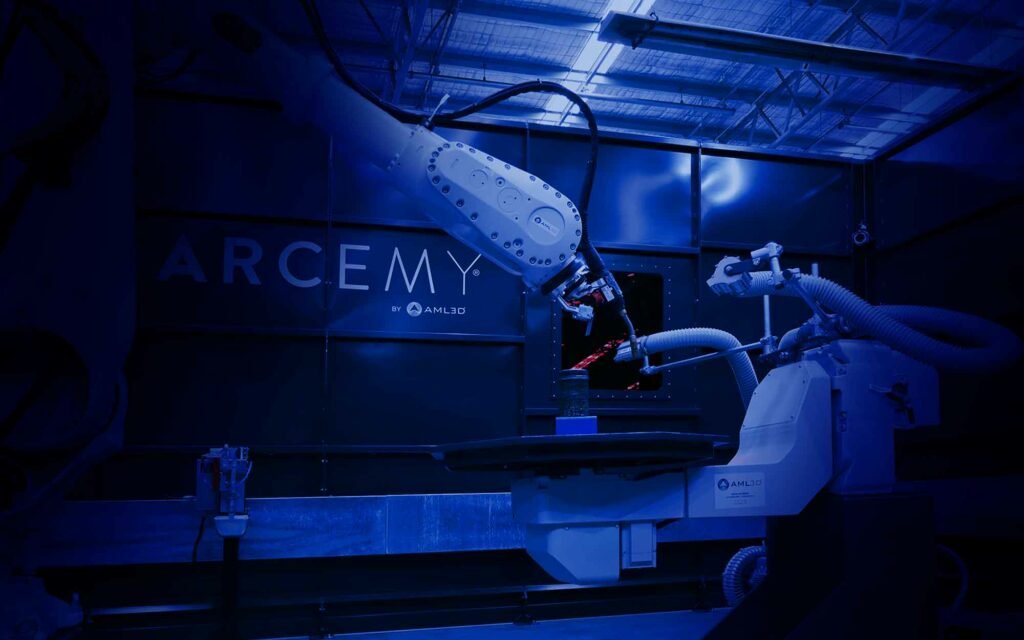
AML3D Arcemy 3D printing. Image courtesy of AML3D.
Most of AML3D’s business comes from the United States, with about 87% of first-half revenue generated from U.S. customers. This reflects AML3D’s growing work in defense and shipbuilding, including projects with the U.S. Navy and large U.S. shipbuilders.
The company has already announced contracts tied to submarine and naval components, where large-scale metal 3D printing helps reduce part counts, improve repair times, and support more reliable supply chains.
With defense spending rising and naval upgrades underway in key markets, AML3D says it’s aiming to supply large metal components for essential defense projects.
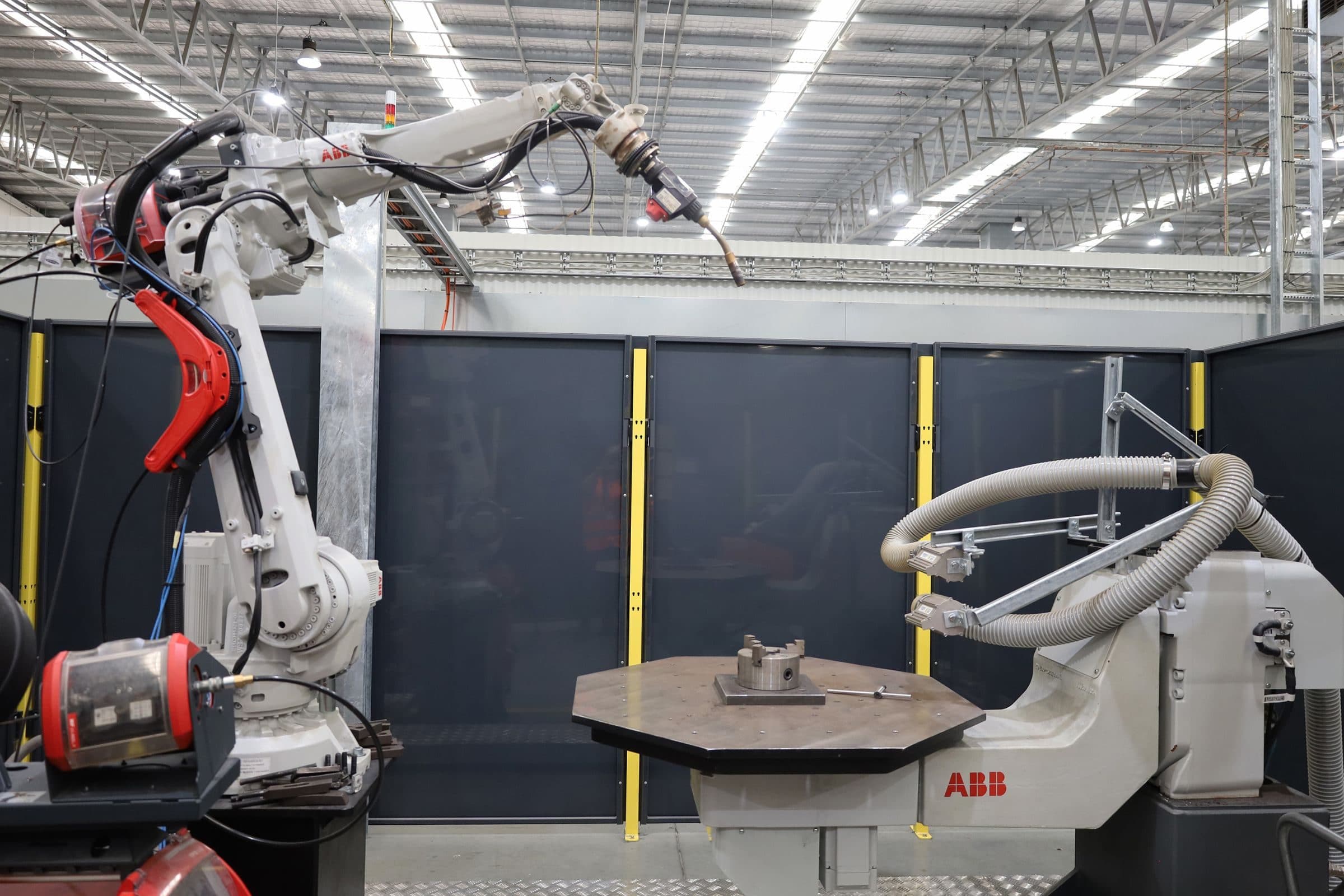
AML3D WAM technology. Image courtesy of AML3D.
At the center of AML3D is its proprietary Wire Arc Additive Manufacturing (WAAM) technology, branded as WAM®.
Unlike powder-based metal processes such as powder bed fusion, WAAM uses welding wire as feedstock, building large metal structures layer by layer using an electric arc. The approach is particularly well-suited for producing large-format structural components, often in stainless steel, nickel alloys, and other high-performance materials.
For applications such as naval shipbuilding, utilities infrastructure, and defense components, the ability to produce large, near-net-shape metal parts with reduced material waste can be a significant advantage.
WAAM also avoids some of the powder handling complexities and cost structures associated with traditional metal AM systems, making it attractive for industrial environments where scale and durability matter more than fine-detail resolution.
AML3D has been improving its machines and digital controls, with a focus on consistency and meeting strict standards, both essential when working with defense customers.

AML3D creates parts for Boeing using its Arcemy WAM printer. Image courtesy of AML3D.
Although AML3D’s revenue was down 30%, we now know that the orders were not canceled, and that the revenue is just coming later. Material delays and schedule changes moved some revenue into the second half of FY26, but the A$16.5 million order book remains unchanged. With those orders secured, AML3D enters the second half of the year in a strong position.
The company stated it has entered its next phase of growth, supported by new contracts in the U.S. utilities sector and the UK defense market, alongside its established U.S. Navy work. This shows the company is expanding beyond the U.S. while still focusing on defense and infrastructure.

Nickel Aluminum Bronze part 3D printed using AML3D’s wire additive manufacturing process for BAE Systems. Image courtesy of AML3D
AML3D is increasingly focused on international growth. Along with the U.S. expansion, the company is also looking to grow in Europe, especially in defense markets.
Many governments now want to make more critical parts at home instead of depending on long overseas supply chains. Large-scale metal 3D printing systems like AML3D’s WAM technology can help make that possible. The company’s technology fits well with this move toward more local production.
AML3D is entering the second half of 2026 in a strong position. With solid orders in place and revenue expected later this year, the company is moving into larger-scale industrial production. The wider metal 3D printing market remains competitive, especially in aerospace and other high-precision areas where powder-based systems dominate. AML3D is focused on something different: large structural parts, where its wire-based process can be more cost-effective and better suited for bigger components.