
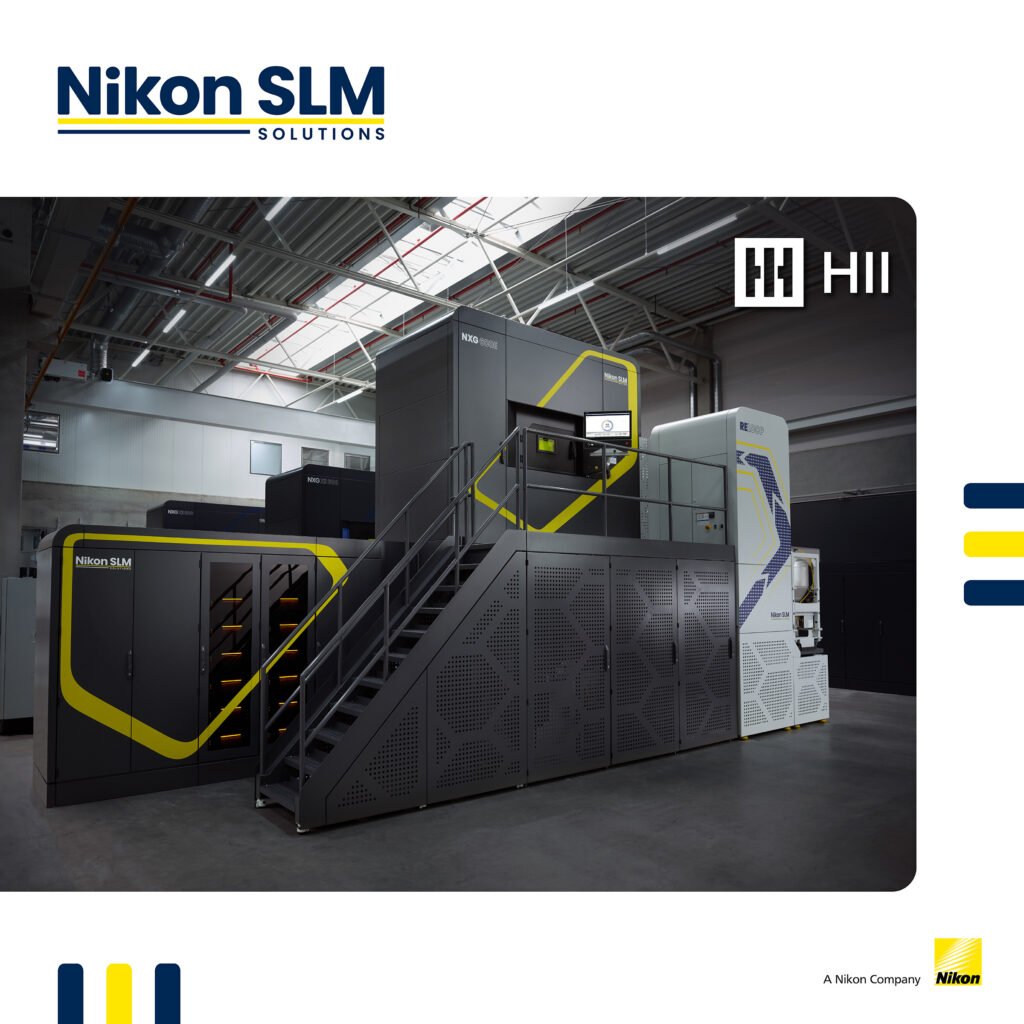
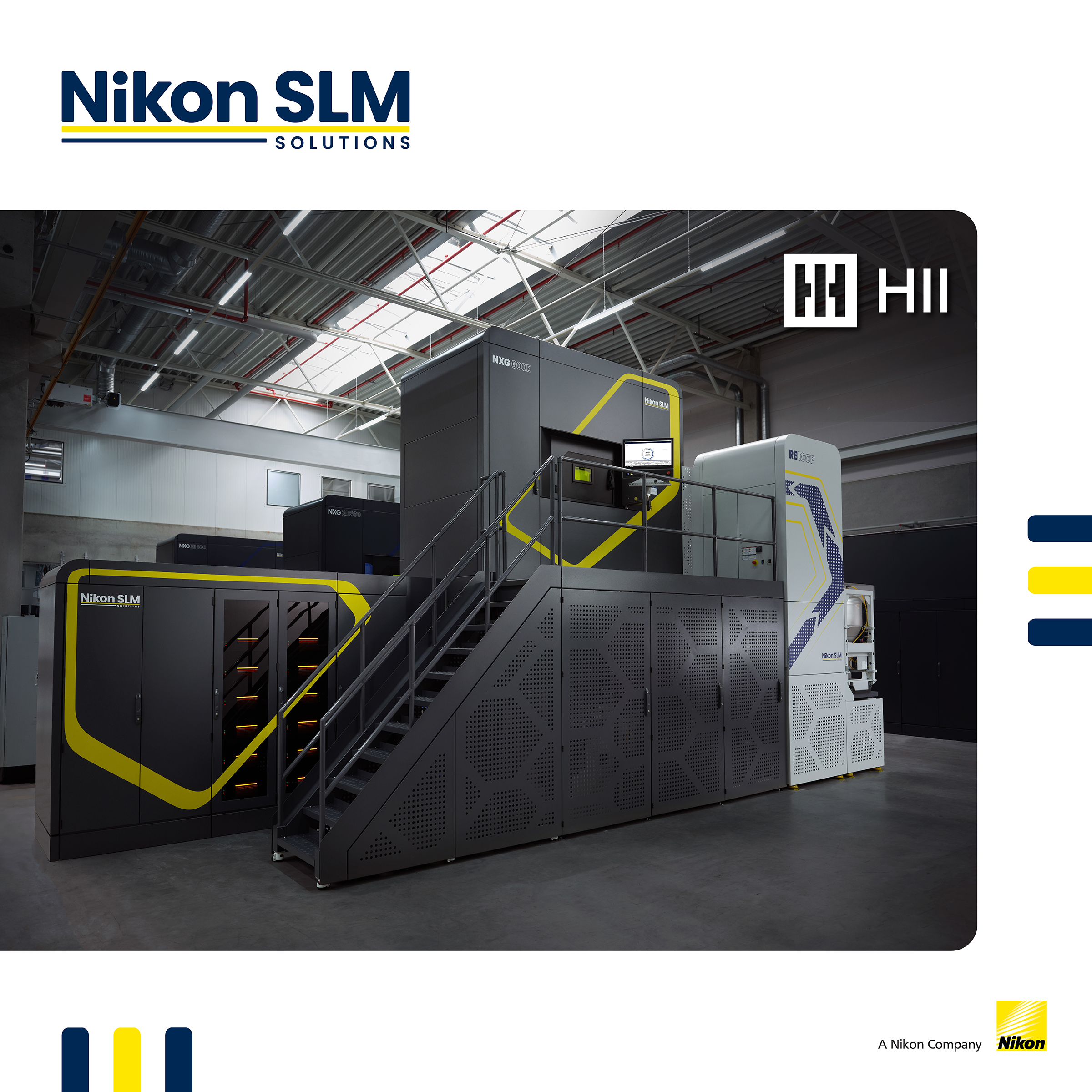
Nikon SLM Solutions has sold a second NXG 600E to HII’s Newport News Shipbuilding unit. This machine will be used to print in NiAlBr, Nickel Aluminum Bronze. The printer will be used for MRO and new construction, and Nikon SLM will help with characterizing the material and process stability.
Nikon Advanced Manufacturing CEO Hamid Zarringhalam said,
“This second NXG 600E order reflects HII’s leadership and long-term commitment to advancing the maritime industrial base through additive manufacturing. Expanding critical materials capabilities such as Nickel Aluminum Bronze is a foundational part of Nikon Advanced Manufacturing’s holistic approach, combining scalable platforms, material and process development, and U.S.-based production and support. Together with HII, we are enabling additive manufacturing to move from isolated applications to a repeatable, industrial capability that supports U.S. Navy shipbuilding at scale.”
This is another step forward for HII. Due to the large part size required by the maritime industrial base, and its relatively late transition from 2D to 3D CAD, it has been slow going for decades in that area. Thanks, however, is due to the work of the Maritime Industrial Base team, which has promoted and pioneered the introduction of additive for naval parts.
The US is increasingly active in trotting out its carrier groups worldwide. Undoubtedly formidable, these formations eat money and require billions in maintenance. You’re essentially taking a Princess of the Sea with a runway, 60 planes, and 5,000 people to war. A modern US aircraft carrier has around 500 toilets, perhaps more than some of the places it could be attacking. In a limited few week engagement against the Houthis that saw no meaningful degradation of their capabilities, the US Navy spent $1.6 billion in operational costs and a further $2.4 billion in munitions, which is about a fifth of Yemeni GDP.
The scope therefore for Additive in repairing ships effectively and quickly is clear. Acceleration of new ship construction is also sorely needed. But, in addition to helping legacy projects, we need to make sure that Additive is on the frontlines of the next. Every other nation on earth knows that it can not possibly best the US in copying its carrier group and ballistic sub capability. These nations look to long distance ballistic missiles, hypersonics, UASs, and UAVs instead.
For these craft, many countries can now cost effectively build up defenses against the US Navy. These defenses are pennies to the dollar when compared to the US maintaining its current operational readiness level. Now, the US will be able to wipe out the critical infrastructure of 90% of countries 100% of the time in a matter of hours. But, a few billion will increase the standoff distance to a level where a carrier group alone will be hard pressed to make a significant impact. Ballistic missile subs will be harder to find and counter. Each of the 14 US Ohio class nuclear missile submarines can have 20 nuclear missiles on board, while four Ohio guided missile subs have 154 Tomahawks each. The US can reach out and touch someone, but not infinitely, through conventional munitions. It’s estimated that currently of the 18 ships, two are being refueled, 11 are at sea, so a maximum of eight could be available operationally to patrol. These are dotted around the various oceans, so not all are available. Sense dictates also that you’d keep at least two well out of the way of any conflict zone to keep the nuclear threat credible. Additionally, the US has 34 Los Angeles class vessels that can carry 12 Tomahawks each.
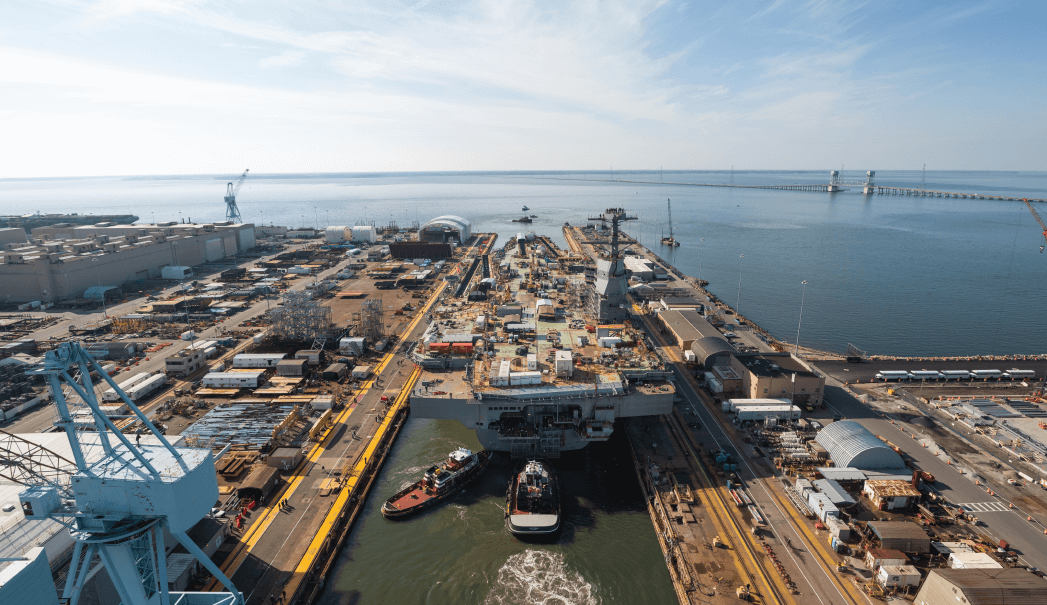
Tugboats move the aircraft carrier John F. Kennedy from Newport News Shipbuilding’s Dock Dry 12 to Pier 3 on Monday, where the ship will undergo final completion and outfitting. Photo courtesy of Huntington Ingalls Industries.
Three questions: the first Ohio is set to retire in 2027, while the Los Angeles class will be retired as well over the coming few years. This crunch time seems rather inopportune, to say the least?
The second is that realistically, the US could have a capability to fire around 400 Tomahawks clandestinely from its submarine fleet. The carrier group could ostensibly reload Tomahawks at sea and keep on firing them until the US runs out of them. But, if a long range missile can keep the carrier group over the horizon or beyond the extended range of Tomahawks (up to 2,500 kilometers), the capacity is limited. Now, 2,500 kilometers is the distance between New York and Denver. So I’m not saying that this will be easy, but it is doable for most advanced economies. So, given that around 20 countries worldwide spend over 10 billion a year on defense, how many of these countries will be working on an anti ship ballistic missile with a range of over 2,500 kilometers? For reference, a Ukrainian startup has created a Flamingo cruise missile which costs $500,000 and can go over 3,000 kilometers. In development for three years, the country now aims to make 100 a month. One Flamingo may not deter a carrier group, but a flock might. And Ukraine is of course uniquely motivated, but other countries can and will follow.
Keeping this in mind, ask yourself, if you were the leader of China, how much money would you spend on the DF 21D, DF 26B, and other anti ship ballistic missile programs? These hypersonic missiles have ranges of around 4,000 kilometers and reportedly are hypersonic glide vehicles, not the falling brick type hypersonics others have. So as the Premier, how much would you spend on the capability to most probably be able to deter the US from attacking you? You know that you could never fight off nuclear weapons from subs. You know that they could conceivably hit you with 400 conventional Tomahawks without you doing anything against it. That’s half the total used in Operation Iraqi Freedom, by the way.
So this NXG, it’s cheap. Because the cost of failure for the US will be enormous. It is also important. But, we must also invest in hypersonics, and UAS and UAV systems, because that will be the only option should the US fail. So what are my answers to these questions? The fleet retirement seems to warrant caution. Despite its might, the US is decidedly on the back foot in maintaining a credible nuclear and conventional threat for the next decade.
How many countries will be working on an anti ship ballistic missile with a range of over 2,500 kilometers capable of sinking a carrier? I’d guess China, Iran, Saudi Arabia, Israel, North Korea, France, Germany, Pakistan, UAE, Russia, and Turkey. South Korea and Japan could totally do it also, but their enemies are not that far away. Australia, Brazil, Italy, Canada, and Spain may be able to, but would probably club together with others or prefer to worry about other stuff.
As for the third question, if I was the Premier of China, I’d spend around 0.5% of my GDP on anti carrier hypersonic missile systems. That should be around $100 billion. This compares relatively favorably to the China Pakistan Economic Corridor project, which is building 3,000 kilometers of roads in Pakistan and costs $62 billion. Anyone ambitious and daring enough to spend $62 billion in Pakistan on roads would probably find it prudent to spend a bit more making sure that they can never face a credible threat from the US. China has spent $10 billion on a canal and another $18 billion on a bridge. I couldn’t imagine spending less than $30 billion on hypersonics if I were the Premier of China. So sure, we can 3D print submarines, but at 1850 ccm/h, it will take me 1,770 years to 3D print an Ohio class submarine. As well as 3D printing submarines, we should be focusing on 3D printing what kills them and what will replace them. These things will be much smaller. And if I were China or any of the other countries mentioned, that is exactly what I would use 3D printing for.