
The material extrusion market has seen titanic shifts over the past few years. A new bevvy of low-cost 3D printers have turned to software and sensors to make reliable high-speed systems that are selling in the millions of units. $200 units that print reliably and $800 systems that work very well indeed at high yields and accuracy have radically altered the market. The desktop Material Extrusion segment is also signing up tens of thousands of new enterprise customers and ushering in a new era for expanding low-cost print farms.
“The key change we will observe in the area of end-use part production is a gradual shift away from powder-based technologies (SLS and MJF) toward large print farms built around desktop-grade FFF or SLA systems. The advantages of powder-based systems include high productivity, no need for support structures, full utilization of the build chamber, and high geometric freedom. At the same time, they have come with clear limitations: high machine costs, a limited range of materials (mainly polyamides), and relatively high powder price In 2022, with the introduction of fast, reliable, and affordable desktop-class Material Extrusion systems, a new trend emerged: the creation of large print farms comprising dozens or even thousands of such machines. Thanks to advances in speed, quality, and repeatability of FFF printers, the gap in production capabilities compared to SLS/MJF systems has started to narrow. Economics has become the decisive argument. For many entrepreneurs – especially new market entrants – investing in a farm of hundreds of FFF printers at a cost lower than that of a single industrial SLS machine is far more attractive. Of course, FFF print farms come with their own challenges: they require significant floor space, as well as careful management of logistics, infrastructure, and personnel. SLS and MJF technologies remain indispensable where specific certifications (such as aerospace or automotive) or particular material properties are required. However, for a substantial portion of the rapid manufacturing market, the cost efficiency and accessibility of desktop-based FFF farms are becoming the decisive factor, increasingly challenging the long-standing dominance of powder-based methods.”
“I believe that in 2026 Material Extrusion is going to gain further momentum as a mass manufacturing production technology for mechanical components. Material Extrusion has an edge in economic viability, speed, flexibility, and robustness over other additive manufacturing technologies. It holds up in mechanical performance, surface quality, and dimensional accuracy.”
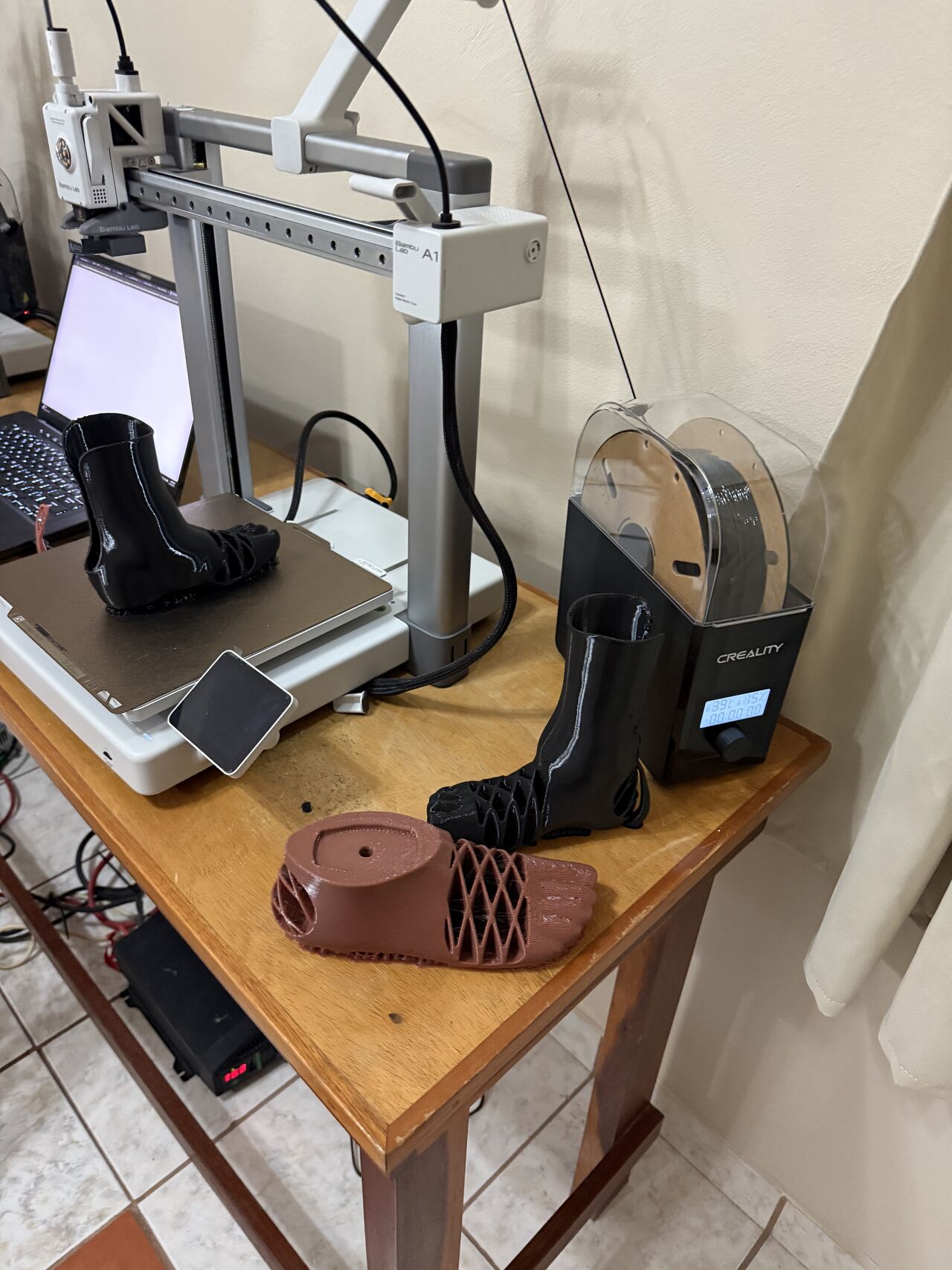
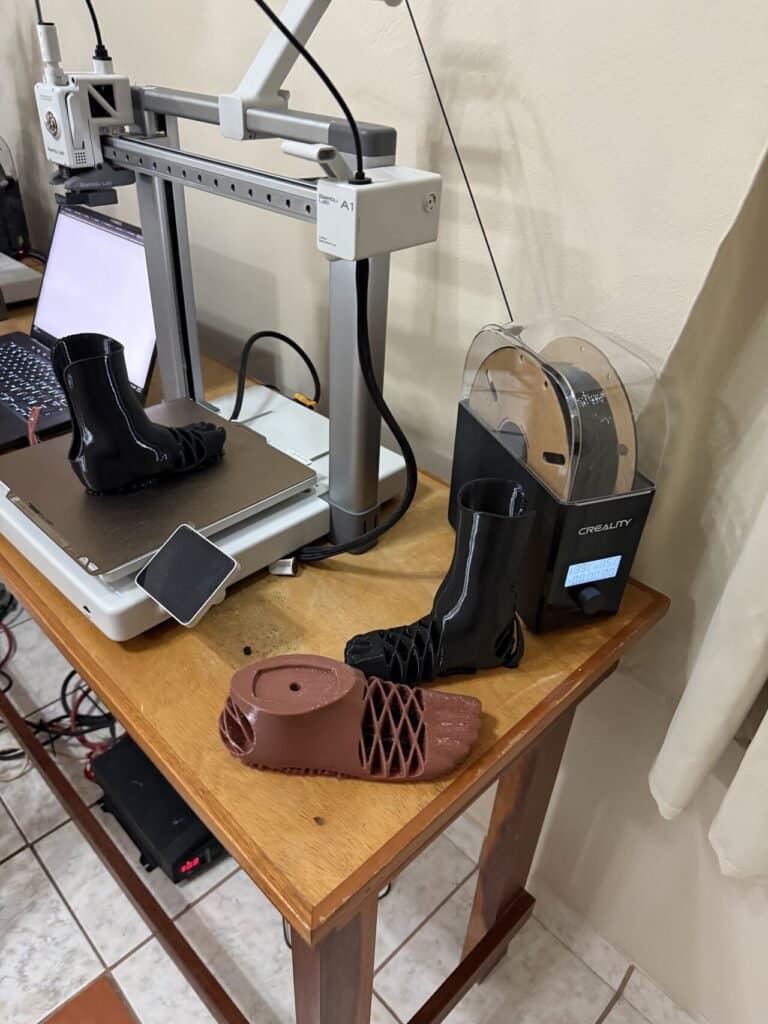
Brent Wright is using Bambu A1 3D printers in Guatemala to make prosthetic feet for his LifeEnabled foundation. A $50 donation will see a patient get a prosthetic foot. Image courtesy of Brent Wright.
“Material extrusion has been exciting to watch, specifically for the orthotic and prosthetic industry. The extruder has improved at pushing TPU, and the materials have improved as well. We have moved many of our interfaces from LPBF to material extrusion. The other thing that’s been very neat to see is the tool path motion move into a more complex way to extrude material. You have non-planar motion on three-axis machines, along with adding complexity to four and five-axis and full-blown robots, and then finally, some belt 45-degree printers really become mainstream. Another thing that I’m really excited to see is our Advanced 3D Vortex DS1, which is a cantilever polar printer that allows for non-planar toolpathing while being extremely efficient by minimizing movement. This leads to less resonance and artifacts in large prints and allows for faster speeds which, for the O & P industry allows more throughput and opens up the possibilities of same day fittings. I am extremely bullish on material extrusion and will continue to add more machines to the stable.”
Brent’s focus on non-planar, belt, and multi-axis robots is something more people should consider. Yes, the new and improved gantry box is sweeping the world with millions of units sold. But for many applications, a robot or a three-axis belt machine may be far better, offering stronger parts and higher throughput. The current form factor is not the be-all and end-all of the material extrusion industry. Over at high performance materials creator Tectonic3D, CEO Kenneth Kempinski thinks that,
¨Overall we see an accelerating trend towards highly filled polymers that can replace metals in demanding environments, reducing cost, lead times and complexity. In parallel, the European defense market is driving a strong requirement for locally sourced and manufactured materials and filaments. Also, there is a clear demand for high‑speed materials with thoroughly vetted performance — not merely in appearance but in retained mechanical strength. Additionally we’re seeing a shift to larger spools to enable bigger prints and higher part counts per spool, reducing spool changes and supporting more efficient production. And finally, we are seeing a marked increase in the development of materials with stringent specifications for demanding sectors such as industrial and oil & gas, driving ever more specialized solutions for these applications.¨
“Over the next 12 months, industrial polymer additive manufacturing is expected to experience a significant increase in the adoption of large-format additive manufacturing (LFAM) technologies. This growth will be driven by the need to produce tooling with greater speed and cost efficiency compared to conventional CNC fabrication methods. Within the U.S. market, substantial investments in companies such as Caracol, Rapid Fusion, CEAD, Thermwood and Juggerbot are anticipated to yield notable advancements, particularly in applications related to large-scale composite tooling, construction, and traditional compression molding. Airtech is strategically positioned to supply materials specifically engineered for LFAM and will continue to deliver high-performance, engineering-grade solutions for a diverse range of demanding tooling applications.
“Given that LFAM systems accommodate a broad spectrum of material options, it is anticipated that applications utilizing cost-effective materials will gain significant traction within the construction sector. These applications are likely to include large-scale forming structures, exhibition displays, and signage for theme parks, among other uses. Furthermore, the industry is expected to witness the emergence and expansion of additional service bureaus specializing in such systems. This growth will be driven by entrepreneurial initiatives wherein outdated robotic platforms are repurposed and equipped with resin extrusion capabilities, enabling the fabrication of large-scale polymer structures with relatively minimal barriers to entry.”

I’m also super bullish on medium- and large-format Material Extrusion systems. In defense, composites, tooling, and molding are making their presence felt in these systems. More importantly, many materials and many applications ensure that this market segment is growing in many directions at once, from boats to jigs to drones to formwork. From very different angles, both Dave and Brent point to our industry’s collision with robotics, as both a supplier to and a user of robotic arms.
Both are also clearly thinking beyond the box in multiple axes. This will no doubt delight Ric Real, who is developing desktop five-axis Material Extrusion systems with Generative Machine, thinks that