

Today’s 3D Printing News Briefs is a mixed bag, starting with subscription-free automation for print farms from 3DQue. Then we’ll move on to dental resin news from Dentsply and Dreve, an expansion for Croom Medical, and Proteus Space collaborated with NASA JPL to achieve a successful on-orbit payload deployment using additive manufacturing. Finally, House Bill 2320, essentially banning 3D printing in Washington State, was passed by the state’s House of Representatives.
3DQue Launches Subscription-Free Access for 3D Print Farm Automation
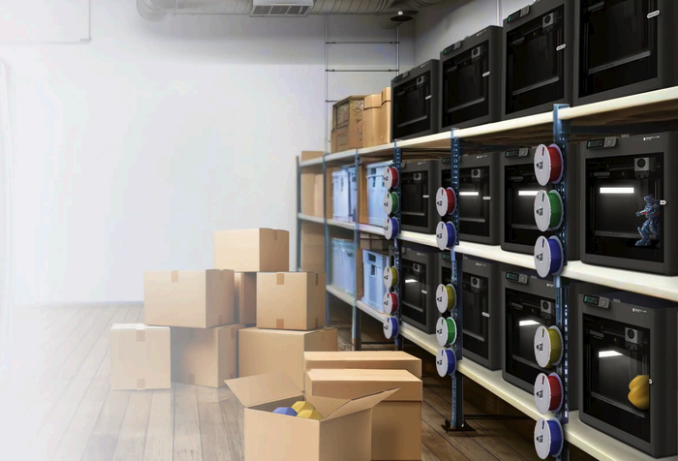
Canadian company 3DQue, which builds automation infrastructure for 3D printing, recently announced the launch of AutoFarm3D Lifetime, which offers 3D print farm operators subscription-free access for life to 3DQue’s automation platform for continuous 3D printing. Print farms have often used manual or fragmented processes, but as operations expand, this can create bottlenecks. In 2022, 3DQue launched AutoFarm3D, enabling a connected production system, unified operations, and automated job routing, monitoring, and tracking. The tool lets organizations maintain control of their infrastructure and data, while reducing downtime and increasing throughput. Now, with Lifetime licensing, print farm operators can support a wide range of operations. The Lite tier offers professional control and workflow efficiency, and the Pro tier enables autonomous production intelligence for larger, complex environments. AutoFarm3D Lifetime includes capabilities like smart job assignment, live monitoring and AI failure detection, secure remote access, centralized printer control, and more.
“Automation is becoming the backbone of successful 3D printing businesses. The next phase of additive manufacturing will be defined by reliability, consistency, and continuous production at scale,” said Steph Sharp, CEO of 3DQue.
Dentsply Sirona & Dreve Moving to Clinical Evaluation for Aligner Resin

German medical technology company Dreve, a leader in orthodontic materials and thermoforming technology, developed the Primeprint Direct Aligner resin specifically for dental manufacturing company Dentsply Sirona‘s Primeprint 3D printing system. Now, the two companies have announced that they are advancing to the clinical evaluation stage for the material, which has received FDA clearance but isn’t commercially available quite yet. The two collaborated with the University of Ulm for preclinical evaluations, which showed that the material has “excellent recovery characteristics,” according to Dr. Fayez Elkholy, senior physician who participated in the university study. With the initial findings in hand, Dentsply Sirona and Dreve are proceeding to the next step with a series of in vitro and in vivo studies. The two companies will gather clinical evidence for Primeprint Direct Aligner resin to further validate the early results, assess its fit within the SureSmile and Primeprint workflows, and inform continued development of the material.
“Direct-print aligners represent an exciting area of innovation in digital orthodontics. With FDA clearance in place for Primeprint Direct Aligner resin, our focus has shifted to collecting clinical data that will inform whether, how, and when this material could be integrated within the Primeprint and SureSmile ecosystems,” stated Mark Bezjak, Group Vice President Americas at Dentsply Sirona.
Croom Medical Breaks Ground on Expansion to Manufacturing Campus

Irish contract manufacturer Croom Medical recently broke ground on a major expansion at its Limerick manufacturing campus. Marking the largest single investment in the company’s history, Croom Medical is adding a purpose-built, solar-powered, 38,000 sq ft facility called ACOT, for Advanced Centre of Orthopaedic Technologies. ACOT will be an R&D and industrialization center of excellence to help bring orthopaedic implants all the way from early design and raw material to prototyping and finished medical device, enabling deeper integration across the product lifecycle for OEMs. The full spectrum of orthopaedic manufacturing will be integrated at ACOT, including precision CNC machining, lights-out machining and grinding, multimaterial AM, vacuum furnace heat treatment, digital inspection, and much more. The digitally connected facility, expected to be complete by the end of 2026, is being developed with the support of Enterprise Ireland, and will majorly grow the company’s capacity to meet demand from multinational customers for orthopaedic implants.
“ACOT is a strategic investment designed around where this industry is going next. For our OEM partners, it means deeper integration, advanced capability, and a facility built around their roadmaps. At the same time, it creates high-value roles and long-term career opportunities here in Croom, strengthening the local economy and the community that has supported us for over four decades,” said Patrick Byrnes, Croom Medical’s CEO. “This facility was built on the trust our partners place in our team, and we’re proud that our growth benefits both our global customers and the town of Croom.”
Proteus Space & NASA JPL Announce On-Orbit Payload Deployment with AM

The titanium deployment spring within the JPL Additive Compliant Canister (JACC), showcasing the embedded mechanism architecture enabled by additive manufacturing. (Courtesy Proteus Space)
Los Angeles-based aerospace company Proteus Space recently announced that it, in collaboration with NASA’s Jet Propulsion Laboratory (JPL), achieved a successful on-orbit payload deployment, and AM played a part. A deployable mechanism called the JPL Additive Compliant Canister (JACC), featuring a metal 3D printed spring, was used in the mission. Based on helical antenna systems, the JACC weighs less than 500 g and is only about the size of a small paperback book when it’s stowed. The aptly named jack-in-the-box style system was able to reduce its part count by a factor of three by integrating its canister, lid, torsion springs, hinges, and deployable compression spring into a largely monolithic titanium structure. The JACC is a great example of how AM can make simplify deployable structures and compliant mechanisms.
Douglas Hofmann, Senior Research Scientist and Principal at JPL, said that for some time now, the lab has been investigating the use of metal AM for the purposes of directly embedding springs, mechanisms, and flexures into structural hardware for the purposes of flexible thermal management, deployment, pointing, and manipulation or grasping applications. By partnering with Proteus Space on the JACC, NASA JPL “enabled rapid flight infusion of the additively manufactured spring.” The system, first sketched on a napkin, was developed and produced in-house at JPL in less than one year. It features a novel, embedded kinematic hinge architecture, and the coiled spring specifically used for on-orbit deployment by Proteus Space aboard its M1 ESPA-class satellite was printed out of Ti-6Al-4V on JPL’s EOS M290 system. You can see the JACC in action on the Proteus Space LinkedIn page here.
Washington State 3D Printing Ban Passes the House with Amendment

West Shore Royal Canadian Mounted Police (RCMP) in Canada seize 3D printed firearm. Image courtesy of (RCMP).
Last month, the House of Representatives in Washington State passed House Bill 2320, also known as the 3D printing ban. For anyone who is not a federally licensed firearms manufacturer, HB 2320 will prohibit the possession, sale, or distribution of “digital firearm manufacturing code,” as well as private use of milling machines and 3D printers to make firearms, and/or their related parts, that are already legally restricted or illegal. An amendment to HB 2320 was approved, and the 1st substitute bill will now be sent to the Senate for consideration for it officially becomes law. As the NRA-ILA said, if the bill passes, this could set “a dangerous precedent for enforcement and policing of the internet by state officials.”
The new section added to HB 2320 reads, “The legislature finds the production of undetectable and untraceable firearms and firearm components through three-dimensional printing and computer numerical control (CNC) milling presents a growing threat to public safety. The legislature further finds the production of firearms by unlicensed manufacturers allows prohibited individuals to evade background checks and obtain firearms they could not otherwise lawfully obtain. The legislature intends to address these problems by strengthening the state’s existing firearms laws.”
However, HB 2321, which would require any 3D printer or CNC machine sold or transferred to the state to have “blocking features” to prevent printing of firearm parts,” has run into a problem, as these machines are not smart enough to determine what exactly they are manufacturing. So this bill is still in committee.