
We’re kicking off today’s 3D Printing News Briefs with an America Makes Project Call, and then moving on to additive manufacturing in the UK. Then we’ve got some legal news regarding an IP case between Bambu Lab and Pop Mart. We’ll end with some interesting research involving asbestos and PLA.
Submission Deadline for AIM-4AM Project Call Extended

In January of this year, America Makes and the National Center for Defense Manufacturing and Machining (NCDMM) announced two Project Calls, worth a total of $8 million in funding. Within the last week, both have had their submission deadlines extended. The Powder Alloy Development for Additive Manufacturing (PADAM) 2.0 Project Call, funded by the Air Force Research Laboratory’s Material and Manufacturing Directorate (AFRL RXN), is meant to advance manufacturability, performance, readiness, and supply chain resilience of of high-temperature refractory alloys for AM applications that are relevant to the Department of War (DoW). The proposal submission deadline for PADAM 2.0 was recently extended to 5 pm ET, April 8th.
Additionally, the proposal submission deadline for the Artificial Intelligence for Material Allowables in Additive Manufacturing (AIM-4AM) Project Call has been pushed back to 5 pm ET, April 1st. This $2 million project is funded by the Office of the Under Secretary of Defense, Manufacturing Technology Office (OSD ManTech), with two phases and one anticipated award. The overarching goal is to develop an AI-driven framework, using machine learning to model process-structure-property relationships, that is capable of identifying and quantifying risk in the current material allowables approach for 17-4PH stainless steel produced with laser powder bed fusion (LPBF) technology.
AMUK Annual Action Plan Reveals Future AM Growth Plans
It would appear that the UK’s share of the global 3D printing market is shrinking, according to the recently published Annual Action Plan by Additive Manufacturing UK (AMUK). AMUK represents organizations working within the additive technology value chain, and is actively working to establish the UK as a world leader in the development, adoption, and use of AM. AMUK offers member services like sector promotion, academic engagement, strategic partnerships, and more. This is its third Annual Action Plan, offering an in-depth analysis of the UK’s AM sector and including key industry challenges and member-led initiatives; it also lays out a strategic plan for 2026. In 2024, AMUK says the global AM market grew to $21.9 billion, but the value of the UK’s AM market went the other way, and its global share fell by about 4%. AMUK members report hard trading conditions, so the 2025 figures are likely to be the same. But, with signs of recovery showing, AMUK wants to give its members the chance to achieve, according to a press release, “their portion of the UK’s potential of capturing a 7% market share.” Its Annual Action Plan offers a roadmap for developing and growing AM in the UK.
“Our plan highlights challenges that we must address in order to accelerate the adoption of additive manufacturing technologies,” explained Joshua Dugdale, the Head of AMUK. “Together with our members, we have identified supply chain, skills and standards as the top three challenges, which we will tackle during this year, as these are crucial areas impacting the AM industry.”
You can download the AMUK’s Annual Action Plan for 2026 here.
Bambu Lab Reaches Settlement with Pop Mart for 3D Printed Toy Models

P2S. Image courtesy of Bambu Lab.
Popular Chinese consumer-grade 3D printer manufacturer Bambu Lab recently reached a settlement with toy company Pop Mart International Group, which is the exclusive provider and distributor of the wildly (and weirdly) popular Labubu toys. The copyright case concerned an intellectual property (IP) dispute over unauthorized 3D printable models of Pop Mart characters, including Labubu and Twinkle Twinkle, hosted on Bambu Lab’s MakerWorld 3D model community. Bambu Lab did not create the models, but they essentially allowed them to go up on MakerWorld. Then, users could then download these files and print similar toy figurines on their printers, and even sell the knockoffs. Additionally, animation studio HMCH Anime also filed a lawsuit against Bambu Lab over alleged infringement regarding animated film The Legend of Hei. While there’s no word yet on the HMCH Anime suit, Bambu Lab, which said in January that its 2025 revenue exceeded CNY10 billion ($1.4 billion), posted a statement on its Weibo account that it had reached a settlement with Pop Mart, and pulled all related content from MakerWorld. In fact, the company accidentally delisted dozens of models that were unrelated to Pop Mart’s IP, which had a lot of people talking on Reddit.
“After looking into this with the relevant team, we’ve learned that some models were accidentally delisted due to an operational error on MakerWorld. We sincerely apologize for any inconvenience this has caused,” Bambu Lab responded on Reddit.
“We’d also like to let everyone know that most of the affected models have now been restored. If your model is still missing, please submit a support ticket so our team can help resolve it for you as quickly as possible.
“Please click here for the guide for creating a ticket on MakerWorld via the MakerWorld website and Bambu Handy.”
Upcycling Asbestos Cement into Safe Additive for PLA 3D Printing
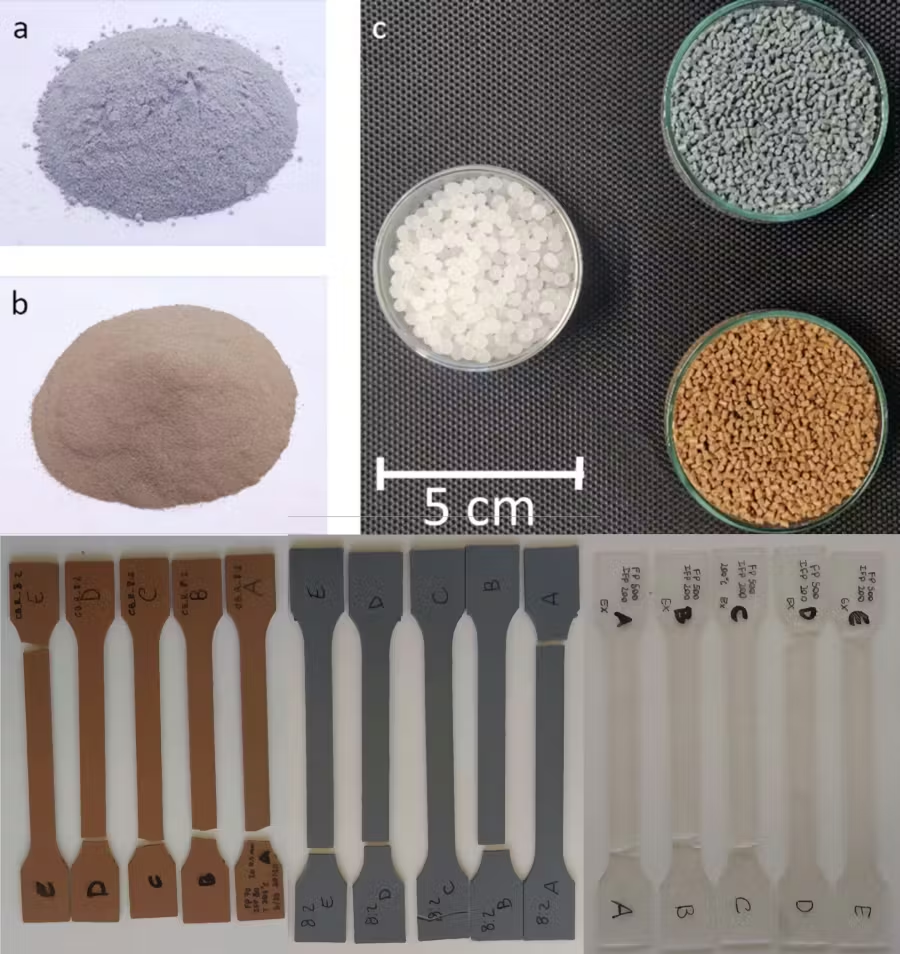
Detoxified asbestos cement (a, b) can be used as an additive for PLA pellets (c), delivering some interesting properties to 3D printed materials (bottom).
Once, we all thought asbestos was a miracle, but we’ve since discovered that the mineral sheds tiny fibers when it’s disturbed; these fibers can get into people’s lungs and cause serious long-term health issues. There’s still a lot of asbestos out in the world, which needs to be processed in a “detoxification” process in order to be rendered safe; unfortunately, this process leaves a lot of waste behind. Luckily, researchers from the Università di Milano Bicocca, Université de Lille, and Graftonica S.r.l. figured out a novel way to upcycle asbestos cement waste into a powder that’s used as a safe additive for 3D printing biodegradable PLA. As they explain in their published paper, they produced composite pellets with up to 50% “loading in PLA” using a standard twin screw extruder. While you won’t be able to use them on your typical desktop printer, these pellets are “sufficiently flowable and stable” for fused granular fabrication (FGF) 3D printing. The researchers also found that there’s potential for adding some interesting properties to composite material as well.
“Depending on the preparation method, the deactivated asbestos can be fully inert or endowed with catalytic properties. A variant produced in a reducing environment has a strongly hydroxylated surface that can induce PLA chain scission and reorganization from 200°C [392°F], significantly less than the 350°C [662°F] spontaneous degradation of the pristine polymer. This behavior facilitates post-consumer biodegradation while preserving material integrity under standard processing conditions,” the researchers wrote.