
We’ll kick off today’s 3D Printing News Briefs with some 3D scanning news from Artec 3D, and then move on to new America Makes Project Calls. Then, Raise3D and AMT are partnering for post-processing, and amsight launched a new website. Finally, we’ll end with a new tool that offers AI-generated optimization reports for FDM 3D printers.
Artec 3D Debuts SLAM-Powered LiDAR Scanner at Manufacturing World Nagoya
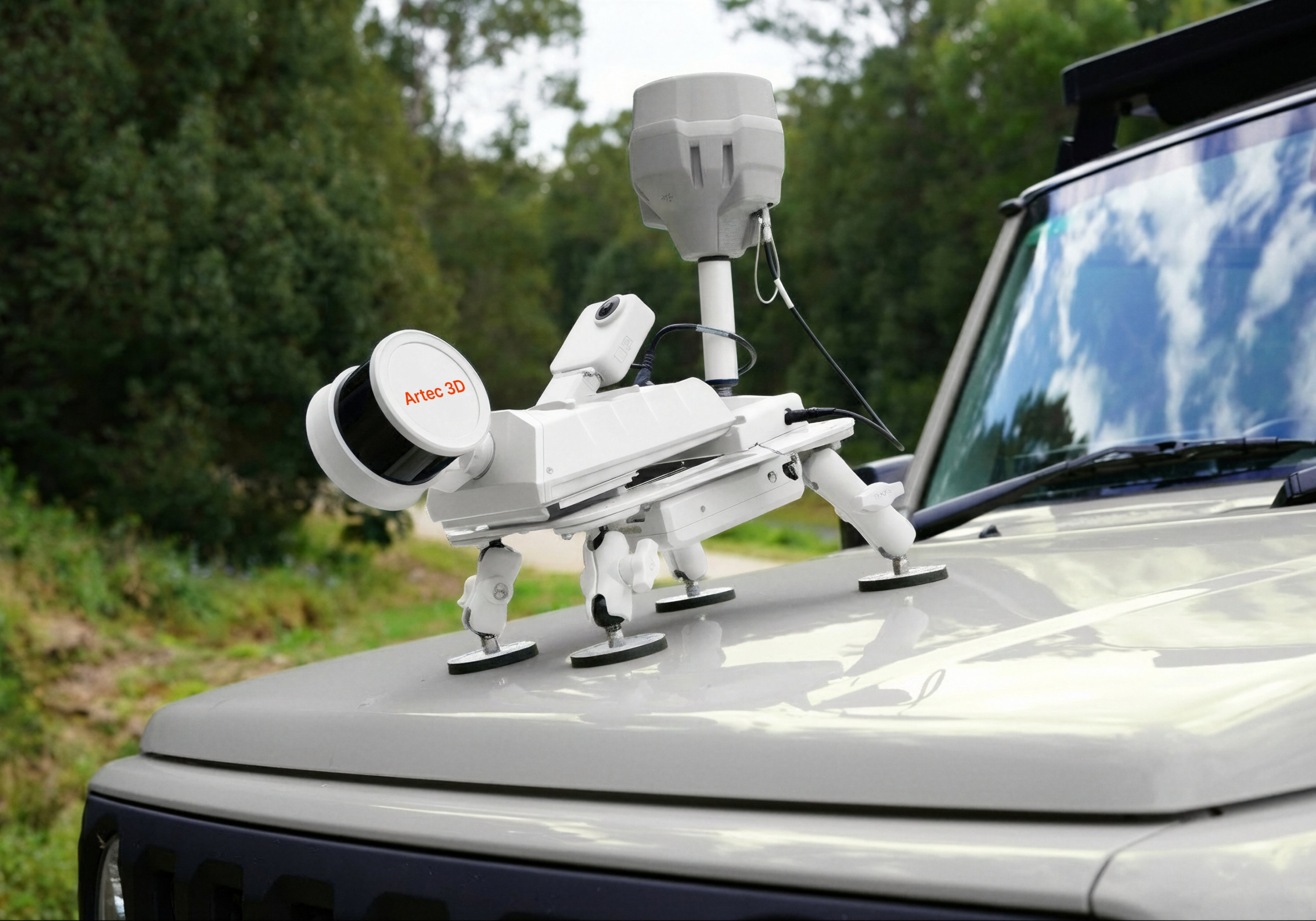
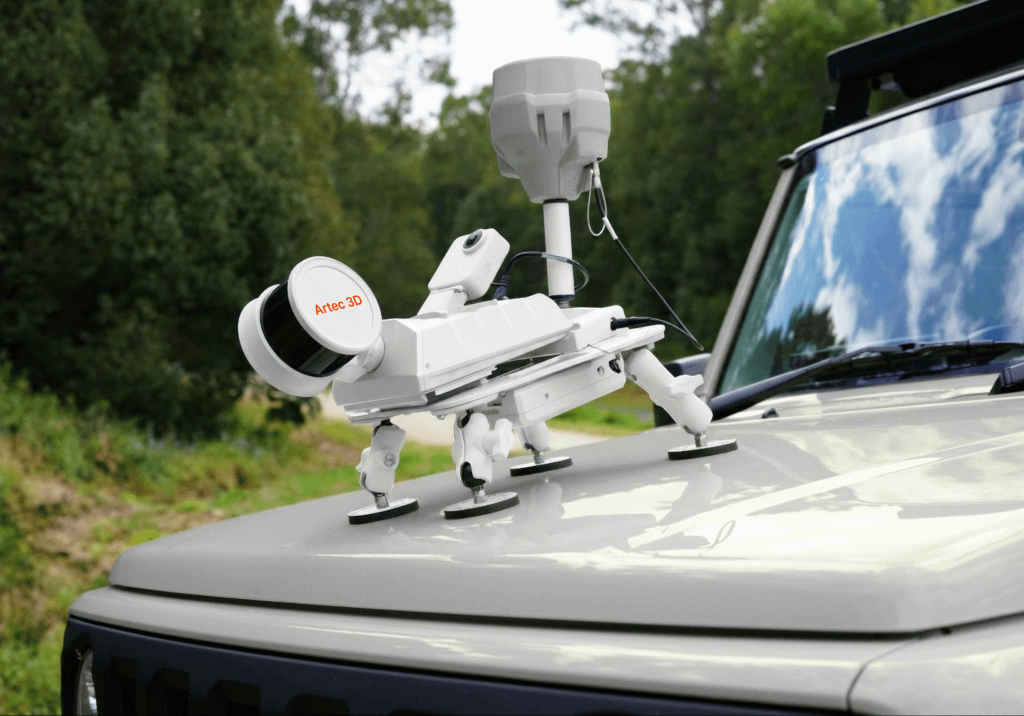
Artec Jet
At Manufacturing World Nagoya, which kicked off in Japan today, Artec 3D is launching its newest scanner, the Artec Jet: a powerful, survey-grade, SLAM-based LiDAR system for autonomous and precise 3D data capture at scale. The company says this fast, versatile scanner pairs high-density LiDAR sensors with SLAM positioning algorithms to capture large areas with an accuracy of ±10 mm indoors and underground, including in GPS-denied environments that traditional 3D mapping technologies can’t handle. Weighing in at just 1.57 kg, it’s said to offer a 360° x 290° field of view, a companion app for real-time feedback, IP65 dust and water protection, and autonomous flight control. In fact, one of the best-sounding features is the Artec Jet’s ability to scan fully autonomously, without human input, onboard a drone—independently mapping its own flight paths, maintaining stable positioning, and avoiding very small obstacles. The scanner is deployable by hand, vehicle, and drone, and used with Artec 3D’s new Artec Twins software, the company’s ecosystem can capture accurate digital twins on any scale.
“With Artec Jet, we’re entering an exciting new chapter. Our mission has always been to make 3D scanning as fast, accurate, and intuitive as possible. Artec Jet expands this approach into larger environments, empowering our customers to capture infrastructure with the same level of confidence and ease,” said Art Yukhin, President and CEO of Artec 3D. “This incredibly versatile device brings unprecedented speed, precision, and autonomy to reality capture at scale.”
Come hear more about the Artec Jet at the Data Design Booth 15-103, Hall 1. 3DPrint.com is a proud Media Partner of Manufacturing World Nagoya.
America Makes and NCDMM Announces Two Project Calls
Last week, America Makes and the National Center for Defense Manufacturing and Machining (NCDMM) launched their latest two Project Calls. Both are funded by the Office of the Under Secretary of Defense, Manufacturing Technology Office (OSD ManTech), and are worth a combined $14.5 million in funding. The first is the $9 million Delta Qual 2.0, which is focused on addressing key AM qualification challenges across the Defense Industrial Base to support Department of War (DoW) objectives for advanced manufacturing solutions. This will happen by streamlining the requirements for testing, increasing processing parameters flexibility, and making machine installation standards stronger. There will be three topic areas for Delta Qual 2.0, and participants are expected to deliver outcomes that can provide mutual value to the DoW and Organic Industrial Base (OIB), as well as “actionable insights” that can decrease both industrial and technical risk.
The second Project Call, worth $5.5 million in funding and consisting of two phases, is Generation Of Technical-data for High-strength Aluminum Alloy Material, or GOTHAAM. The focus is developing material allowables, over three classes of laser powder bed fusion (LPBF), for a high-strength 7075-T73-equivalent aluminum alloy. By coming up with an aerospace-grade, corrosion-resistant alloy with both commercial and defense applications, this will enable scalable production of all sizes of 3D printers, and could generate a strong ROI for OEMs and the OIB as the material transitions into qualified production. Main priorities include characterizing the alloy’s environmental durability, stress-corrosion cracking behavior, and fatigue-crack growth performance, to make sure the aluminum alloy is able to support high-strength, long-life structural applications. Proposals for both Delta Qual 2.0 and GOTHAAM are due by 5 pm ET on June 2, 2026.
Raise3D & AMT Bringing Post-Processing to RMS220 Customers in Europe
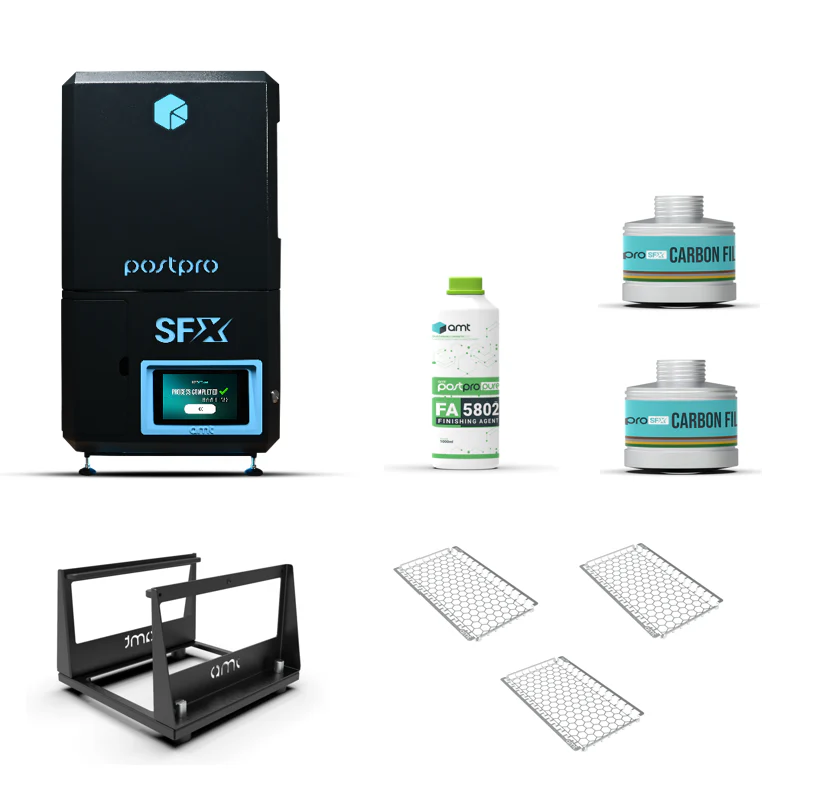
Raise3D AMT PostPro SFX Starter Bundle
3D printer manufacturer Raise3D announced that it’s partnering with Additive Manufacturing Technologies (AMT) to enable production-ready SLS workflows. As part of their agreement, Raise3D will offer AMT’s vapor smoothing solutions, including the current SFX and upcoming SF2X systems, to its clients in Europe. This will bring professional post-processing abilities to Raise3D’s RMS220 SLS 3D printer, and allow customers to efficiently print functional end-use parts with high-quality surface finishes. Raise3D’s AMT PostPro SFX Starter Bundle offers pre-configured AMT systems that are compatible with Raise3D powder materials. The €17,999.00 bundle includes a one-year warranty, one PostPro SFX—providing improved capacity for processing large builds—with PostPro Pure solvent cartridges, one storage stand, three processing racks, one cartridge of FA5802 finishing agent, and two air filters.
“Our partnership with Additive Manufacturing Technologies (AMT) completes our additive manufacturing workflow with advanced post-processing capabilities. AMT’s powerful yet user-friendly systems deliver industry-leading surface finishing and perfectly complement the large build volume of our RMS220,” said Fernando Hernandez, SLS Product Marketing Manager – Europe at Raise3D.
“This collaboration represents another step toward our goal of delivering a complete, end-to-end additive manufacturing solution.”
As Quality Management for AM Matures, amsight Launches New Website
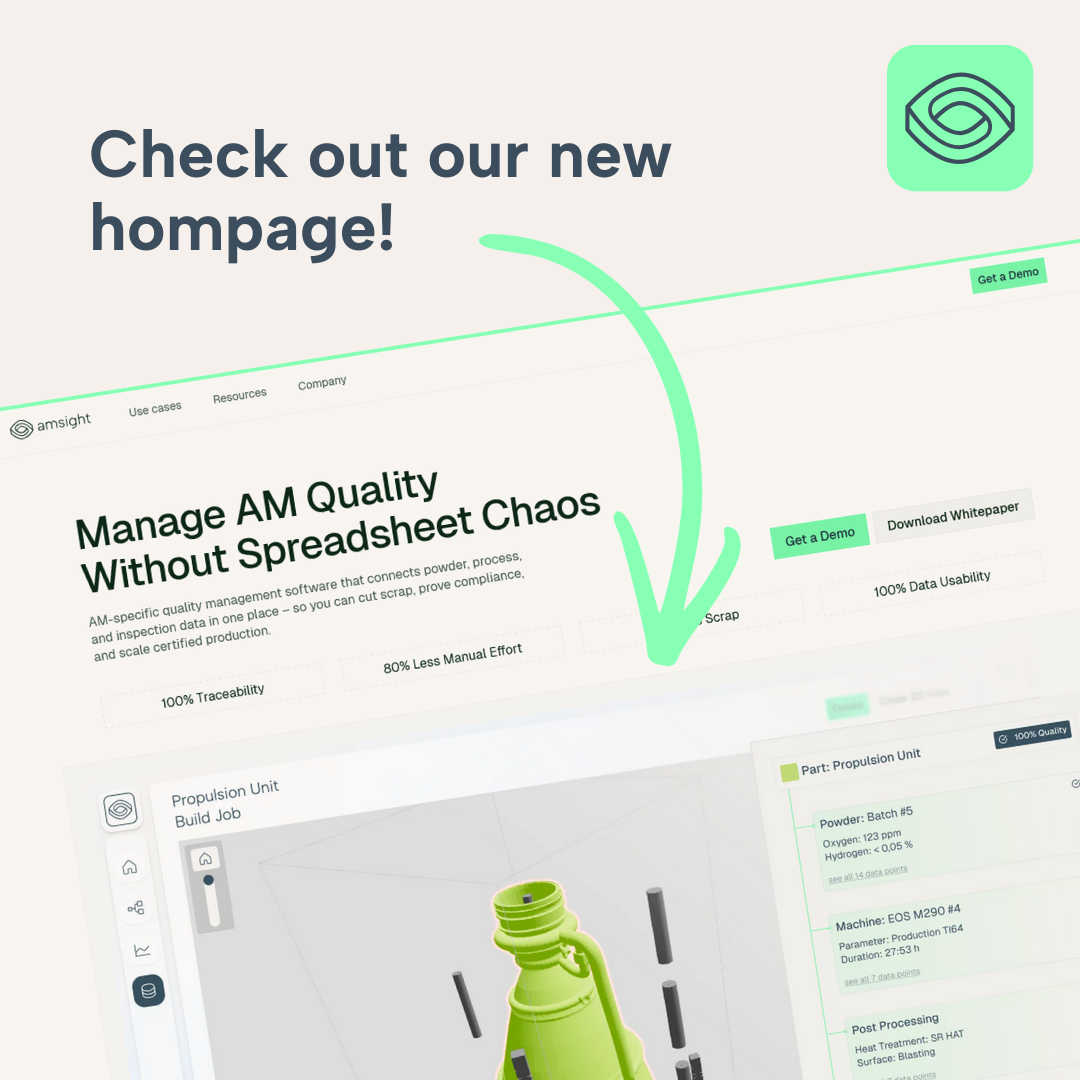
As its production-level quality management system (QMS) continues to mature, Fraunhofer spin-out amsight has launched a new website that reflects its evolution as a company. amsight is focused on data-driven quality management for additive, and developed production-level QM software for AM. Instead of presenting its offering as a generic platform, the new site structures content by use case, including traceable production data and automated documentation; proving part conformity with standardized, audit-ready reports; and process/machine qualification supported by SPC and IQ/OQ/PQ evidence. The homepage helps guide visitors to solutions, showcasing real-world use cases and quantified results, and an integrated ROI calculator helps them estimate the impact of switching to amsight’s QM software. The site’s Resources section was also revamped, and separates lengthy whitepapers and guides from shorter insights.
“Our customers aren’t looking for another dashboard. They need a reliable way to link powder, builds, post-processing, and inspection into one quality backbone that connects to their machines, MES, and ERP systems. The new website is our way of showing, in concrete terms, how amsight fills that gap,” explained amsight CEO and Co-Founder Tim Wischeropp.
“With this site, we wanted to make two things obvious. First, that amsight is an AM-specific quality management software, not a replacement for ERP or MES. Second, that data-driven quality isn’t a future vision, it’s already working today in space, aerospace, and semiconductor supply chains.”
BambuTune’s AI-Generated FDM Printer Optimization Reports
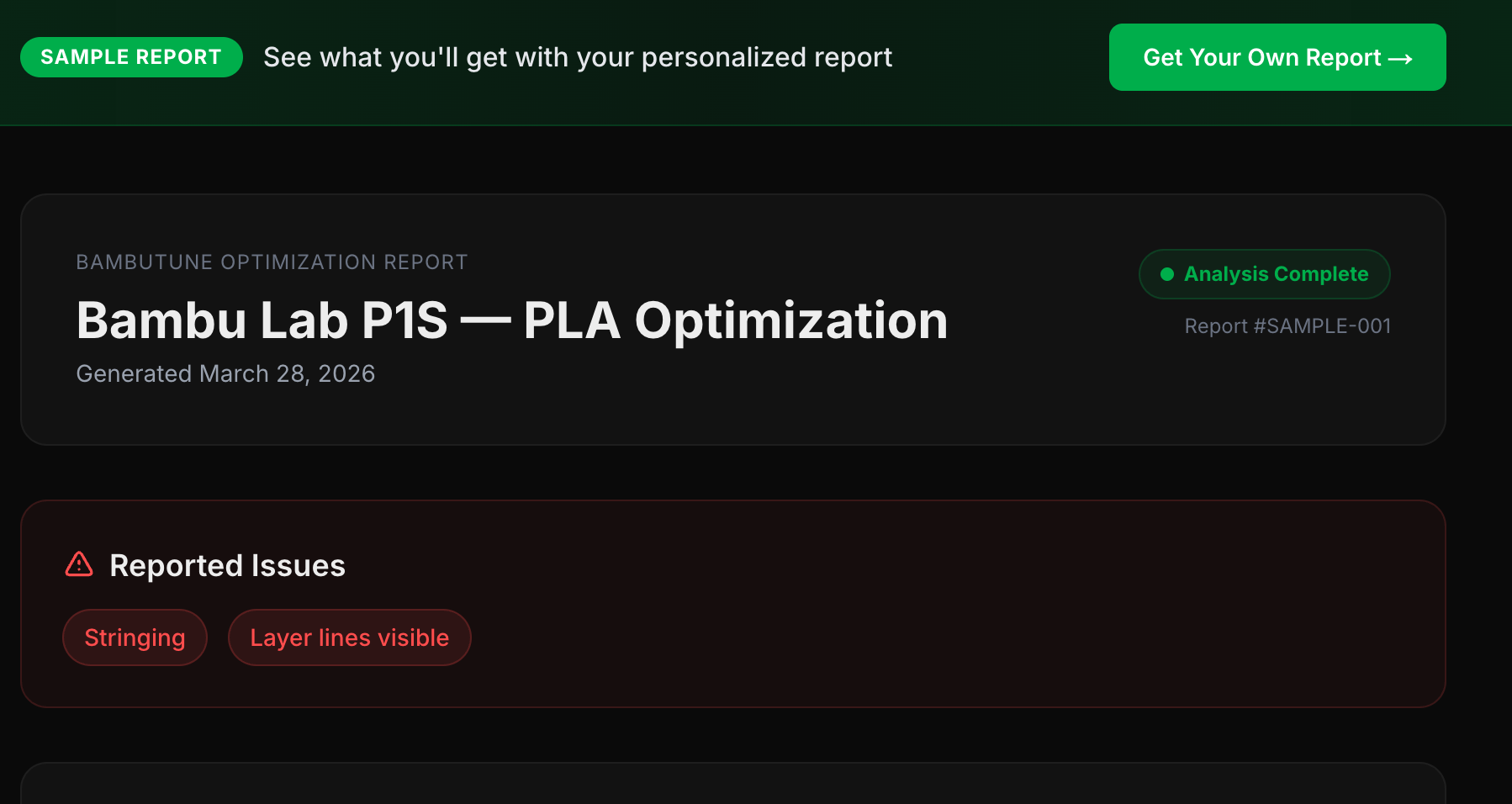
Screenshot of BambuTune sample report
On its website, BambuTune, an autonomous AI company powered by NanoCorp, claims to offer “AI-powered print optimization for every FDM 3D printer.” This tool generates personalized optimization reports for a variety of FDM printer brands, from consumer to professional. The website says BambuTune supports over 70 printers across more than 16 brands, including Elegoo, Creality, Bambu Lab, Snapmaker, Prusa, Flashforge, Qidi Tech, AnkerMake, Longer, and more. It sounds simple enough: users select their printer model, filament type, and settings, and describe the issue they’re having. Then, the AI-driven tool compares your settings to community-validated recommendations, and spits out a detailed report that includes specific recommendations, covering things like retraction tuning, temperature optimization, speed settings, flow rate precision, and more. You can see a sample report for a Bambu P1S here.
“Our AI optimization engine draws on community-validated settings and expert knowledge across the entire FDM ecosystem — from budget Ender-3s to premium Bambu Lab X1Cs. We know what works for every printer,” the website states.
It costs $4.99 for one report, or an Early Bird rate of $14.99 a month for unlimited reports. BambuTune also orders a “100% Money-Back Guarantee,” no questions asked, “if our tips don’t save you filament.”