

Align Technology (Nasdaq: ALGN), the company behind the popular Invisalign clear aligners, said 2025 wrapped up on a high note, with strong revenue and solid demand for products that depend heavily on 3D printing and digital manufacturing systems.
In the fourth quarter of 2025, Align reported total revenue of $1.05 billion, a record for the company and up more than 5% compared with the same period a year earlier. That growth came even though foreign exchange effects slightly affected the numbers, as some international sales translated into fewer U.S. dollars.
The clear aligner business was the standout in the quarter. Revenue in this segment, tied to Invisalign, reached about $838.1 million, up more than 5% year over year. Demand remained strong, with shipments hitting a record of about 677,000 cases, pointing to a continued global adoption of custom-printed clear aligners.
Invisalign aligners are made using digital scans and 3D printing techniques. Each patient’s aligner is custom-designed and printed based on their mouth’s 3D model. So when clear aligner revenue and shipment volumes rise, it also shows that the digital and 3D printing systems behind Invisalign are working well for dentists, labs, and patients.
During an earnings call with investors, Align executives also outlined further expansion of its 3D printing strategy. CEO Joe Hogan said it plans a limited market release of directly 3D printed retainers and attachments in 2026, with expectations that direct fabrication could begin contributing positively to margins starting in the second half of 2027.
Align also saw growth in its Imaging Systems and CAD/CAM Services, technologies that help dentists scan patients’ mouths, plan treatments digitally, and connect seamlessly to 3D printing networks. That segment of the business brought in more than $209 million in the quarter, up double digits sequentially and also higher year-over-year.
Hogan highlighted the company’s scale and manufacturing depth, describing Align as “the world’s most sophisticated treatment planning and 3D printing manufacturing operation.” He said the company’s ability to scale production and meet the speed and rigor required by rapidly growing dental service organizations (DSOs) is unmatched globally, adding that Align made strong progress with DSOs across all major regions over the past year.
Align also reported net profit of about $135.8 million for the quarter, along with adjusted earnings of $3.29 per share. Profit increased compared with the same quarter a year earlier, reflecting higher aligner volumes and continued demand for Invisalign.

Invisalign aligners. Image courtesy of Align Technology.
Looking at the full year 2025, the company crossed about $4 billion in total revenue, up slightly compared with 2024. For a consumer-focused medical device company, steady results matter. And we, the digital and 3D printing workflows behind Invisalign, helped support that performance.
At the same time, Align cautioned that its move toward direct fabrication will come with near-term tradeoffs. Hogan noted that direct 3D printing is expected to be margin dilutive during its early rollout in 2026, before efficiency gains and scale begin to improve profitability in later periods.
Align’s results show that digital orthodontics and 3D printing are key to its growing business. Patients continue to choose custom aligners, and dentists rely on digital scanning and 3D printing to deliver them. Moreover, that model, which is built around dentists rather than bypassing them, has proven to work better over time than other alternatives that tried to move treatment fully direct to consumers, like SmileDirect.
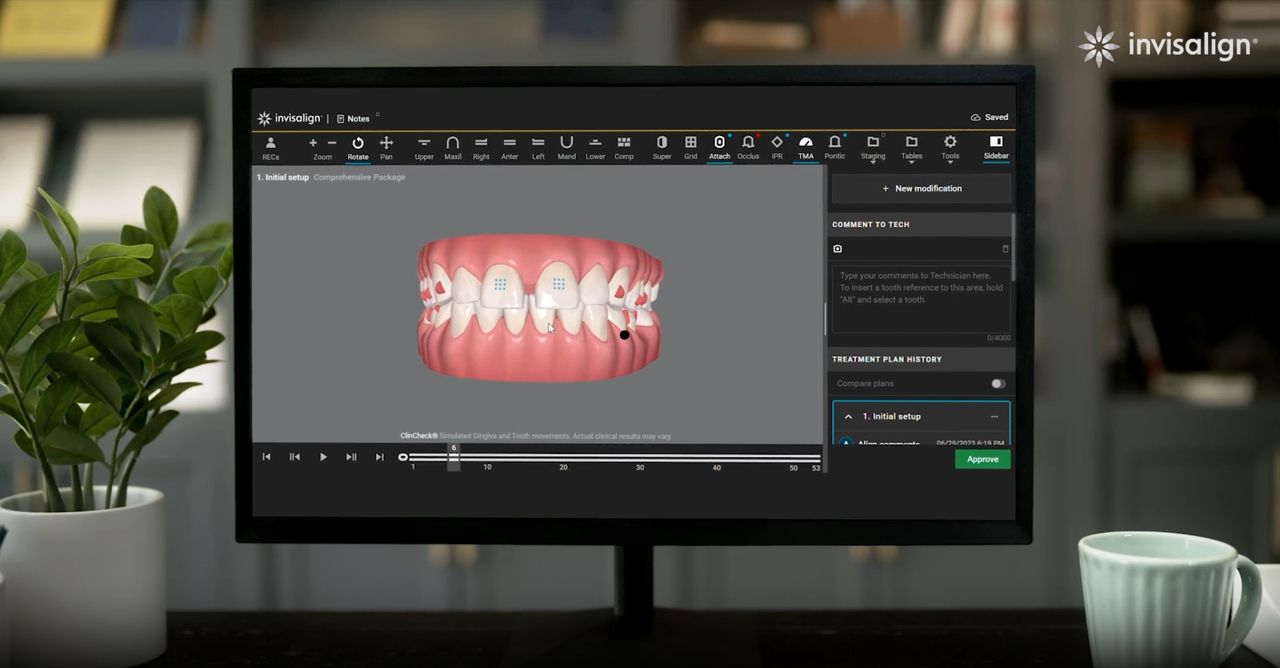
Invisalign’s platform helps with orthodontic treatment. Image courtesy of Align Technology.
Align’s results point to how digital orthodontics has matured into one of the most established real-world uses of 3D printing. Over time, Align has built a system that combines treatment planning, digital scanning, and large-scale additive manufacturing into a repeatable, global operation. Patients continue to choose custom aligners; dentists remain key to the process; and 3D printing enables personalization and scalability that make the model work. Years after Invisalign first launched, it remains one of the clearest examples of 3D printing succeeding within a complete digital workflow.